Art Nouveau vs Arts and Crafts Jewellery
Art Nouveau and Arts and Crafts jewellery share almost the same date range and both reacted against mainstream Victorian production, but one pursued artistic effect and the other craft ethics.
Art Nouveau and Arts and Crafts jewellery were made in the same few decades, on both sides of the Channel and beyond, by makers who were often reacting against the same thing - the heavier, more overtly valuable jewellery of mainstream late Victorian and Edwardian fashion. That shared target, and their near-identical date range, is exactly why the two are so often blurred together. Looked at closely, though, they pursued different goals: one an artistic and aesthetic movement, the other a movement about the ethics and visibility of craft.
Short Answer
Art Nouveau jewellery (roughly 1890-1910) prioritised flowing, organic “whiplash” line and dramatic artistic effect, achieved through virtuoso techniques like translucent plique-à-jour enamel and unconventional materials such as horn and glass, with insect and stylised female-figure motifs and René Lalique as its defining figure. Arts and Crafts jewellery (roughly 1880-1920) prioritised visible hand-craftsmanship and modest, “honest” materials - silver, low-carat gold, cabochon semi-precious stones - as a deliberate social and ethical statement about the value of skilled labour, exemplified by workshops like C. R. Ashbee’s Guild of Handicraft. Art Nouveau asked “how artistically striking can this be made to look?”; Arts and Crafts asked “how honestly can this be made to be made?”
What Defines Art Nouveau Jewellery?
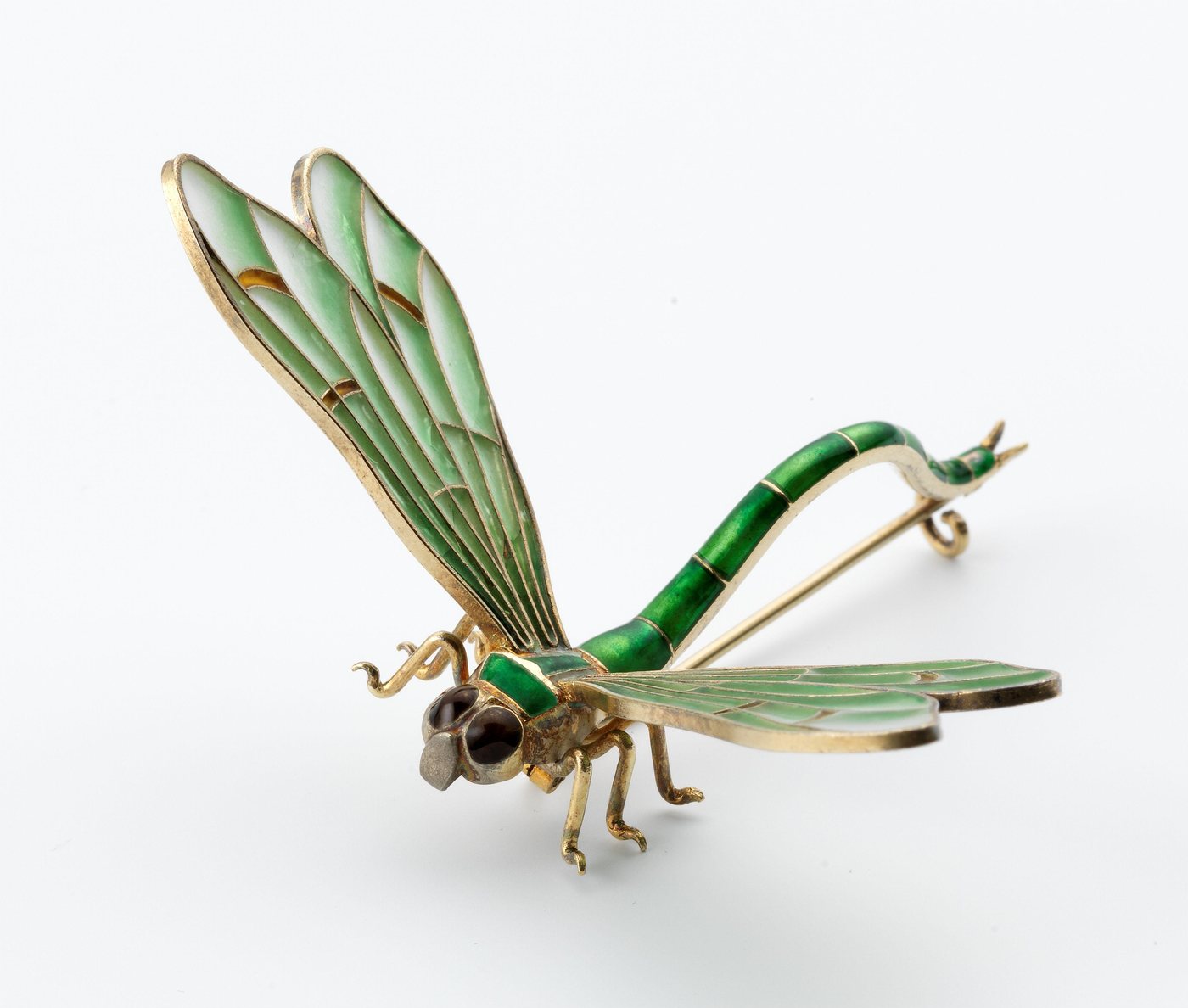
Art Nouveau jewellery treated the jeweller as an artist working in precious materials rather than a craftsman working within inherited convention. Its signature is sinuous, flowing line - the so-called “whiplash” curve - applied to naturalistic but highly stylised subjects: dragonflies, beetles and other insects, orchids and other exotic flowers, and languid female figures with flowing hair, often shown mid-transformation into plant or animal form. Technically, the movement is closely associated with plique-à-jour enamel, a technique producing panels of translucent colour unsupported by any metal backing, resembling stained glass in miniature, alongside a willingness to use materials valued for their artistic effect rather than their intrinsic cost - horn, glass, and semi-precious stones like moonstone - set alongside gold and gemstones rather than in place of them. René Lalique, working in Paris, is the movement’s defining figure, though it flourished across France, Belgium and, in different regional inflections, elsewhere in Europe and the United States.
What Defines Arts and Crafts Jewellery?
Arts and Crafts jewellery grew out of a broader design movement, led in Britain by figures such as William Morris and John Ruskin, that reacted against the perceived dehumanising effects of industrial mass production. Applied to jewellery from around the 1880s, this produced pieces that deliberately looked hand-made: hammer marks left visible, simple hand-wrought bezel or wire settings rather than polished machine precision, and a preference for silver and low-carat gold over the heavier fine gold of mainstream fashion. Cabochon-cut semi-precious stones - moonstone, opal, amethyst, turquoise, chrysoprase - were favoured over faceted precious gems, since their softer colour suited the movement’s aesthetic better than hard sparkle. This was, centrally, a statement about labour and value: C. R. Ashbee’s Guild of Handicraft, founded in London in 1888, trained craftsmen in hand techniques specifically to demonstrate that a piece’s worth lay in the skill and integrity of its making, not the market price of its materials.
Key Differences
| Property | Art Nouveau | Arts and Crafts |
|---|---|---|
| Guiding philosophy | Artistic and aesthetic - jewellery as fine art | Ethical and social - honest, visible hand-craftsmanship |
| Typical materials | Gold, enamel, horn, glass, semi-precious stones for artistic effect | Silver, low-carat gold, cabochon semi-precious stones |
| Signature technique | Plique-à-jour and other translucent enamelling | Hand-hammered surfaces, simple bezel or wire settings |
| Typical motifs | Insects, orchids, stylised female figures, flowing whiplash line | Restrained, often botanical but non-naturalistic forms |
| Key figures | René Lalique and Continental designer-jewellers | C. R. Ashbee and the Guild of Handicraft |
| Centre of activity | Strongest in France and Belgium | Strongest in Britain, with related US activity |
| Attitude to sparkle | Embraced dramatic, artistic visual effect | Generally avoided bright faceted sparkle deliberately |
Historical Context
Arts and Crafts jewellery emerged slightly earlier, from around 1880, as an extension of the wider Arts and Crafts movement in furniture, textiles and printing. Art Nouveau followed close behind from around 1890 and ran to roughly 1910, overlapping with Arts and Crafts almost completely for two full decades. Both movements developed in conscious opposition to the same backdrop - the mass-produced, diamond-and-heavy-gold jewellery of mainstream late Victorian and Edwardian taste - which is a large part of why they are so often discussed in the same breath, even though their responses to that backdrop differed sharply in aim.
Where the Terms Overlap
The overlap here is real and worth taking seriously rather than smoothing over. Many pieces from this window sit between the two categories: Arts and Crafts jewellers sometimes used flowing, Art-Nouveau-influenced line in their designs, and Art Nouveau jewellers occasionally worked with the modest materials and visible hand-finishing associated with Arts and Crafts. British Arts and Crafts jewellery in particular is sometimes described as a more restrained, morally inflected cousin of the freer Continental Art Nouveau style, and the two movements shared workshops, exhibitions and, at times, individual makers. Distinguishing them by philosophy - craft ethics versus artistic effect - is more reliable than trying to draw a hard stylistic line, since the visual results could and did shade into one another.
Related Reading
See the full entries on Art Nouveau Jewellery and Arts and Crafts Jewellery for more on each movement, and Moonstone in Art Nouveau Jewellery for a stone favoured, for different reasons, by both traditions.
Read next

Eras
Art Nouveau Jewellery
A guide to Art Nouveau jewellery (c.1890-1910): René Lalique and Gulbenkian, Fouquet and Mucha, Vever and Gaillard, plique-à-jour and horn, Jugendstil, Liberty's Cymric range, Tiffany, and the mass-produced silver that spread the style.

Eras
Arts and Crafts Jewellery
A guide to Arts and Crafts jewellery (c.1880-1920): Ashbee's Guild of Handicraft, Henry Wilson, the Gaskins and Birmingham's Vittoria Street School, Phoebe Traquair, the Glasgow Style, Liberty's Cymric range and American makers.

Eras
Edwardian Jewellery
A guide to Edwardian jewellery (1901-1915): platinum and the garland style, Queen Alexandra's dog collars, Cartier, Boucheron and Fabergé in London, the Cullinan diamond, lavaliers, milgrain settings and day jewellery.

Gemstones
Moonstone in Art Nouveau Jewellery
Why Ceylon moonstone's glowing sheen suited René Lalique, Arts and Crafts makers, Georg Jensen and Edwardian jewellers c.1890-1930, with its cabochon cutting, carved faces and settings.
Symbols
Insect Jewellery
Insect jewellery from the Napoleonic bee to Victorian diamond flies and Lalique's Dragonfly Woman: naturalistic and Art Nouveau traditions, scarabs and real beetle wings.

Techniques
What Is Filigree?
What filigree is, how the wire was drawn and soldered, cannetille c.1815-40, Genoese, Maltese and Portuguese filigree, Castellani revival work and die-struck 1920s 'filigree' rings.