Turquoise in Victorian Jewellery
Persian turquoise from Nishapur in Victorian jewellery: forget-me-not clusters, pavé snakes, Queen Victoria's bridesmaids' brooches, Arts and Crafts 'matrix', imitations and colour change.
Turquoise is an opaque gemstone ranging from sky blue to blue-green, prized since antiquity but especially associated with Victorian sentimental jewellery, where its colour was closely linked with the forget-me-not flower and the broader culture of coded, affectionate meaning that ran through so much 19th-century jewellery.

What Turquoise Is
Turquoise is a hydrated phosphate of copper and aluminium. Copper gives the blue; iron in the structure pushes the colour towards green. It forms in veins and nodules in dry regions where copper-bearing rocks have weathered, and is often laced with fragments of the host rock - the brown or black veining known as “matrix”. Its name comes from the French pierre turquoise, “Turkish stone”, because it reached Europe through the Ottoman trade routes.
Colour and the Forget-Me-Not Association
Turquoise’s pale, opaque blue lent itself naturally to imitating the forget-me-not flower, and Victorian jewellers frequently arranged small turquoise cabochons in five- or six-petalled clusters, often with a tiny pearl, rose-cut diamond or gold bead at the centre standing in for the flower’s yellow eye. This forget-me-not form appears across brooches, rings, bracelets and earrings throughout the Victorian period and drew directly on the flower’s own sentimental meaning - remembrance and lasting affection - within the wider Victorian language of flowers.
A Related but Distinct Tradition
Turquoise forget-me-not jewellery is often discussed alongside acrostic jewellery, and the two traditions share the same sentimental Victorian impulse to encode a message of affection or remembrance into a piece of jewellery - but they are not the same thing. Acrostic jewellery spells out a word, most famously “regard” or “dearest,” using the first letter of each gemstone’s name in sequence. Turquoise forget-me-not jewellery, by contrast, communicates its meaning through the flower shape itself and the flower’s established symbolic association, not through a letter code, and does not require a specific sequence of different gemstones to work. A turquoise forget-me-not brooch is a piece of sentimental jewellery in the same broad tradition as acrostic jewellery, but it should not be described as acrostic jewellery itself.
Royal Fashion: Queen Victoria’s Wedding
Turquoise was fashionable in the late Georgian years and reached its height between about 1830 and 1870. Queen Victoria gave it a prominent place at her wedding in February 1840: each of her twelve bridesmaids received a brooch in the form of an eagle, designed by Prince Albert, its body pavé-set with turquoises and set with pearls and other stones. Turquoise remained a standard choice for bridesmaids’ gifts and for jewellery given to young women through the following decades.
Pavé Turquoise and the Snake
In the 1840s and 1850s turquoise was often set in close pavé over the entire surface of a piece. The most characteristic example is the snake necklace or bracelet: a flexible body of linked gold sections covered in small turquoise cabochons, with a head set with garnet or ruby eyes and a diamond-set crown, sometimes with a heart-shaped locket hanging from the mouth. The snake, a symbol of eternity, was popular after Prince Albert gave Victoria a snake engagement ring in 1839. Turquoise was also combined with hair jewellery, as in the Stockholm bracelet of 1842 shown above, where a turquoise-set heart hangs from a snake of woven hair.
Typical Settings
Victorian turquoise jewellery is most often found as small cabochon-cut stones - domed and polished rather than faceted, since turquoise is opaque and does not take a faceted cut well - set closely together in clusters. Beyond the forget-me-not flower form, turquoise cabochons were also scattered more loosely in a “pavé” arrangement across the surface of a brooch, bangle or bracelet, sometimes alternating with small seed pearls or diamonds as accents. Mounts were typically gold, and settings ranged from simple closed collets to more elaborate pierced and engraved gold work, particularly in the naturalistic early-to-mid Victorian period. Each small stone was usually held in its own cup-shaped collet with the metal rubbed or pushed over its edge.
After 1880: Edwardian and Arts and Crafts Turquoise
Later in the century turquoise moved in two directions. In fine Edwardian jewellery a single oval cabochon of clear, even Persian blue was set with diamonds in platinum or gold, in bar brooches, rings and corsage ornaments. Arts and Crafts jewellers, by contrast, often preferred turquoise with its brown or black matrix showing, valuing the natural variation that earlier jewellers had avoided. The London firm Murrle, Bennett & Co. and Liberty & Co.'s “Cymric” range, launched in 1899, used turquoise matrix cabochons widely in silver and gold, often with blue-green enamel.
Historical Sourcing
Persia (modern Iran) was the most prized source of fine turquoise. The mines near Nishapur in the province of Khorasan in north-eastern Iran had been worked for many centuries and produced the even, sky-blue stones that set the standard for colour. Persian turquoise is frequently referenced in 19th-century jewellery and gemmological literature as the benchmark for colour and quality. Turquoise was also mined in the Sinai Peninsula, where the ancient Egyptians had worked it, and in the American Southwest - around Cerrillos in New Mexico, among other sites - first by Indigenous peoples and later by American companies, whose output reached the market in quantity from the later 19th century. It is Persian material that dominates in European jewellery.
Imitations
Because turquoise was in heavy demand and the best Persian stones were costly, imitations were common. Opaque blue glass and enamel were used throughout the period. “Odontolite” or “bone turquoise” was fossil bone or ivory, notably from deposits in southern France, coloured blue by iron phosphate - the colour developing when the material was heated - and was used as a turquoise substitute in the 18th and 19th centuries. In the 20th century, porous turquoise was often impregnated with wax, oil or plastic resin to stabilise and deepen its colour.
A Known Material Property: Colour Change
Turquoise is a porous mineral, and its colour can shift over time and with prolonged contact with skin oils, cosmetics, perfumes and other substances, typically toward a duller or greener tone. This is a known physical property of the material worth understanding when looking at older turquoise jewellery - it is not offered as a method for authenticating or dating an individual stone, since colour change can result from age, wear, prior treatment or simply the stone’s original mineral composition, and distinguishing between these causes reliably requires specialist examination.
Identifying Victorian Turquoise Jewellery
A cluster of small cabochon turquoise arranged as a flower, especially combined with a pearl or diamond centre and set in a naturalistic gold mount, is strongly consistent with Victorian sentimental jewellery, though similar forget-me-not motifs continued to be produced into the Edwardian period and beyond, so the motif alone does not pin down an exact date. Whether a given blue stone is turquoise, glass, odontolite or another material can only be settled by a gemmologist.
Read next

Eras
Georgian Jewellery
A guide to Georgian jewellery (1714-1837): Brazilian diamonds, closed-back foiled settings, rococo and Neoclassical styles, paste, cut steel and pinchbeck, sentimental miniatures, girandoles, rivières and Sévigné bows.

Eras
Victorian Jewellery
A guide to Victorian jewellery (1837-1901): the Romantic, Grand and Aesthetic periods, the Great Exhibition, gold rushes and 9ct gold, mourning and Whitby jet, archaeological revival, Scottish jewellery, and how to recognise each phase.
Gemstones
Garnets in Victorian Jewellery
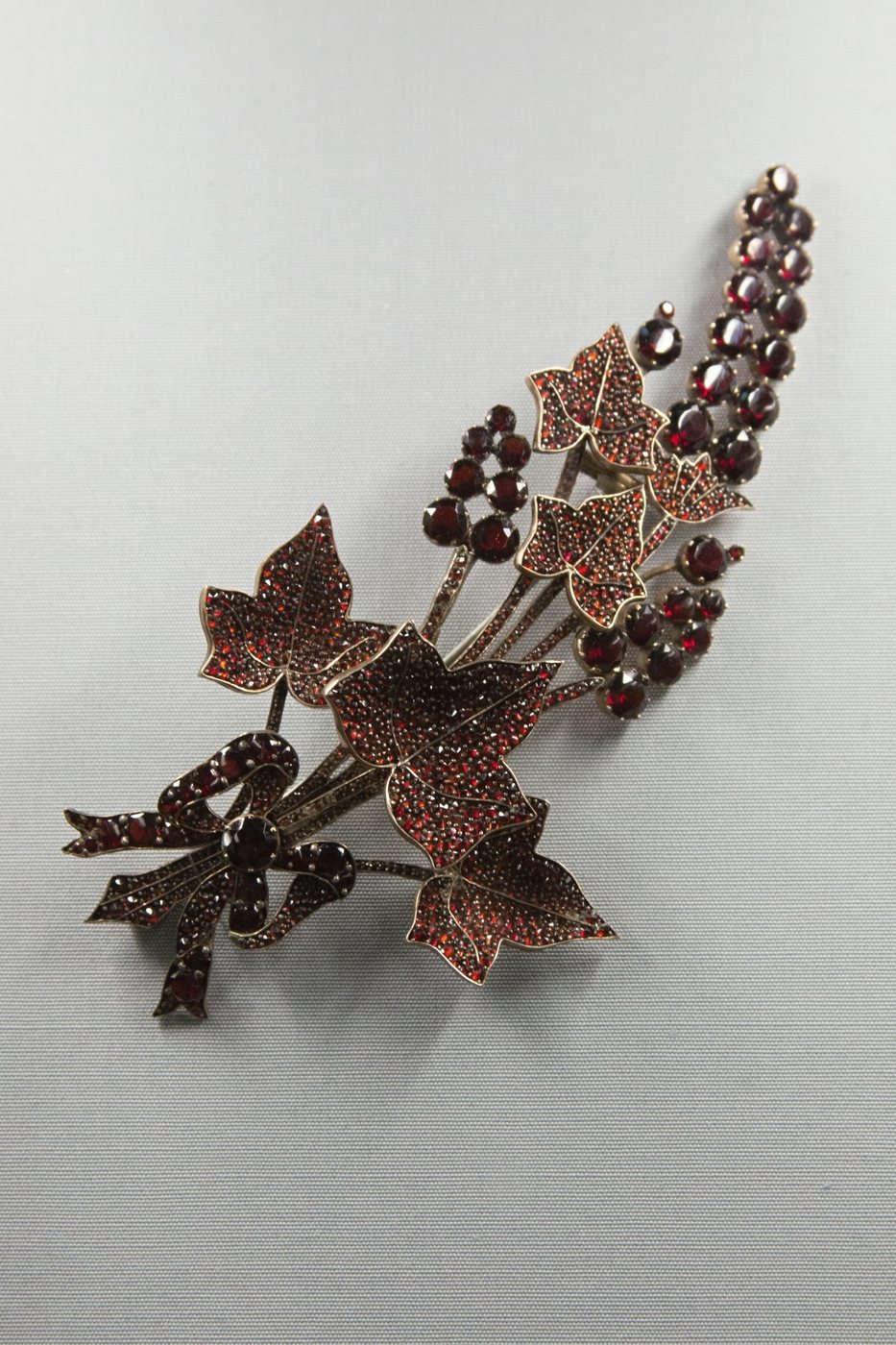
Why Bohemian pyrope garnets from Třebenice, cut and set in Turnov and Prague, became a hallmark of Victorian jewellery, with carbuncles, demantoids, cluster settings and their meanings.
Gemstones
Pearls in Jewellery History
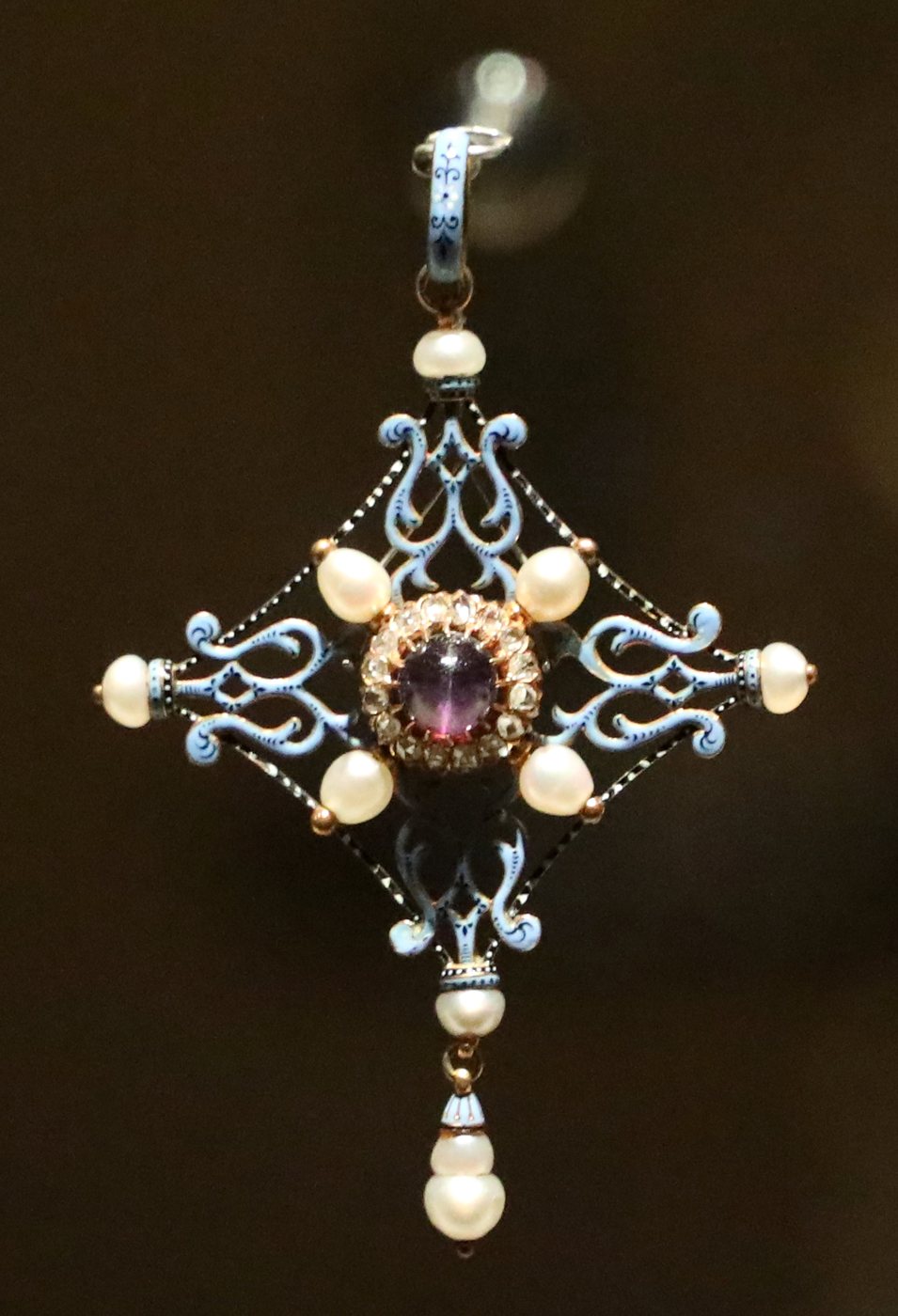
Natural pearls from the Gulf and Ceylon, seed-pearl work, Edwardian chokers and ropes, Mikimoto's cultured pearls of the 1910s-20s, imitation pearls, and pearls' bridal and mourning meanings.
Mourning & Sentimental
What Is Acrostic Jewellery?
What acrostic jewellery is, how REGARD and DEAREST rings spell words in gemstones, the Paris jewellers who popularised it, and why it is sentimental rather than mourning jewellery.

Mourning & Sentimental
What Is Mourning Jewellery?
What mourning jewellery is, how it developed from Stuart and Georgian memorial rings, why it peaked in Victorian Britain after Prince Albert's death in 1861, and the etiquette and materials behind it.