Flower Symbolism and the Language of Flowers
How the 19th-century 'language of flowers', from Charlotte de la Tour's 1819 dictionary to Kate Greenaway's of 1884, gave coded meanings to the flowers in sentimental jewellery.
Flowers are among the most common decorative and symbolic motifs in jewellery between 1700 and 1950, and much of their meaning in the 19th century draws on a specific cultural phenomenon known as the “language of flowers”, or floriography: a system in which particular flowers were assigned coded meanings, so that a chosen bloom, or a combination of blooms, could carry a message to anyone who knew the code.
Before the Dictionaries
The idea that flowers could carry a coded message reached Western Europe partly through travellers’ accounts of the Ottoman Empire. Lady Mary Wortley Montagu, writing from Constantinople in 1717-18, described a Turkish practice of sending messages through objects and flowers; her letters were published in 1763 and widely read. Eighteenth-century jewellery used flowers plentifully - the giardinetto (“little garden”) ring of the mid- and late 18th century, with a basket or vase of flowers picked out in coloured stones, is one example - but these were decorative rather than coded.
The Published Tradition
The language of flowers as it is generally understood today was created by a wave of flower-dictionary books published in the 19th century in France, Britain and the United States. The most influential was Le Langage des fleurs, published in Paris in 1819 under the name Charlotte de la Tour, a pseudonym usually identified with the writer Louise Cortambert. It paired flowers with sentiments and was translated, adapted and borrowed from for decades. In the United States, Sarah Josepha Hale’s Flora’s Interpreter appeared in 1832. In Britain, adaptations of the French book were followed by dozens of rival dictionaries, and the late-Victorian high point was Kate Greenaway’s illustrated Language of Flowers, published by George Routledge and Sons in 1884.
These books typically took the form of an alphabetical dictionary, pairing individual flowers, and sometimes specific colours of the same flower, with a short sentiment, alongside illustrations and verse. They were popular gift books and drawing-room reading. The existence and popularity of the books is not in doubt; the meaning attached to any one flower, however, often varied from one dictionary to another, and historians doubt that many readers used them as a working code.
From Page to Jewellery
The language of flowers fed directly into jewellery design. A flower in a brooch, ring, pendant or locket was not simply decorative - to a giver familiar with the code, a specific bloom, or a combination of several, could carry an intended message, much like the acrostic jewellery tradition that spelled out a word through a sequence of gemstones. Both reflect the Victorian taste for jewellery designed to be read as well as worn. A single flower carried a single message; a spray or wreath combining several could compose a longer sentiment, as a language-of-flowers bouquet did.
How Flower Jewellery Changed
Flower jewellery changed markedly between the 1820s and 1910s:
- 1820s-1840s: small gold brooches and rings with flowers in turquoise, seed pearls and coloured stones, including many forget-me-not clusters.
- 1840s-1860s: naturalistic diamond sprays of roses, lilies and wild flowers, often with some blooms mounted en tremblant - on fine coiled springs so they quivered as the wearer moved. Many sprays could be taken apart into smaller brooches and hair ornaments.
- 1860s-1880s: enamelled and carved flowers; mourning versions in jet and black enamel; flower heads painted on porcelain set into lockets.
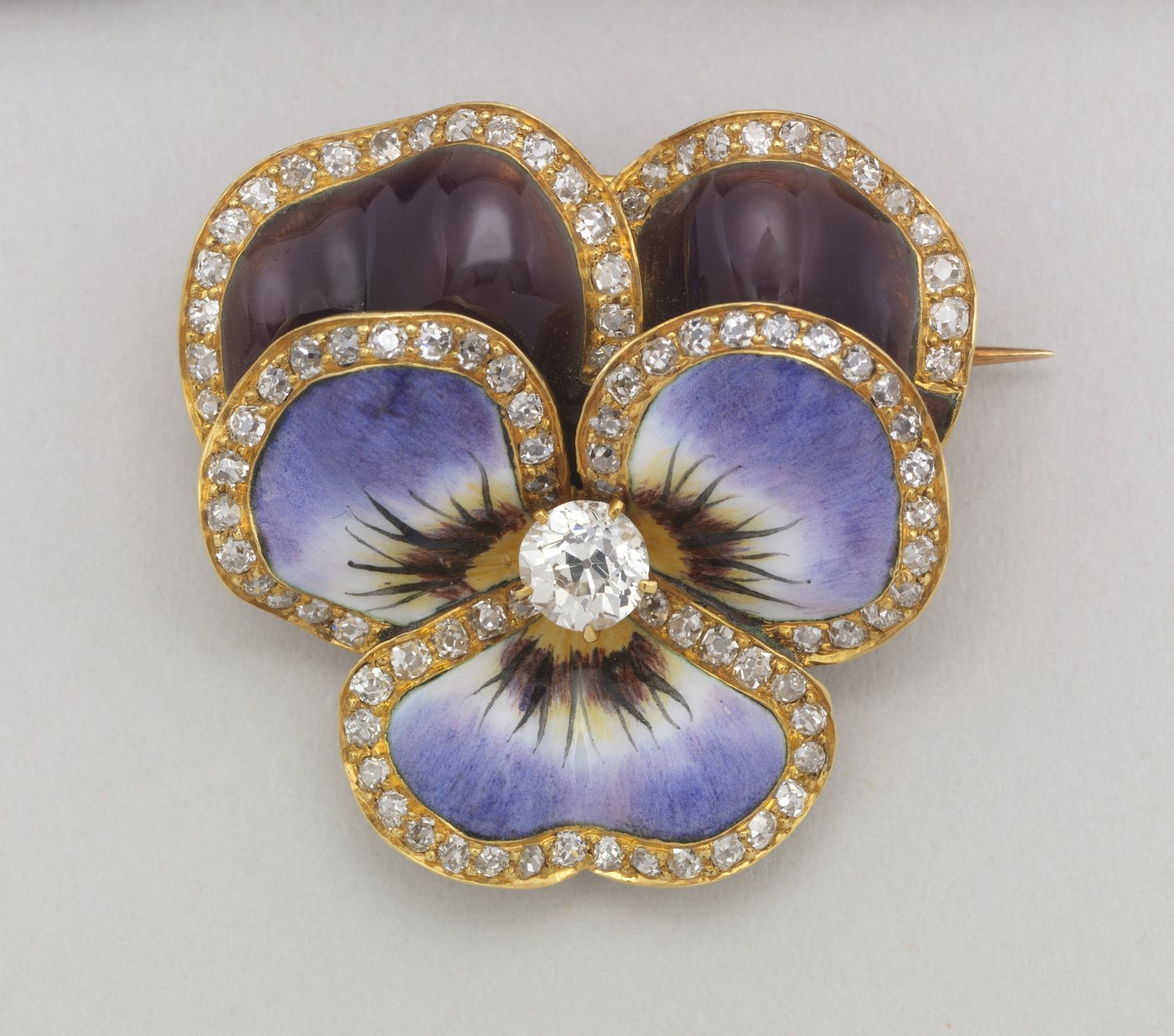
- 1890s-1900s: enamelled pansies, violets and daisies in gold, often with a diamond centre, as in the pansy brooch shown above; at the same time Art Nouveau designers such as René Lalique turned to orchids, poppies, thistles and wisteria for their form and colour rather than their dictionary meaning.
Flowers With Their Own Pages
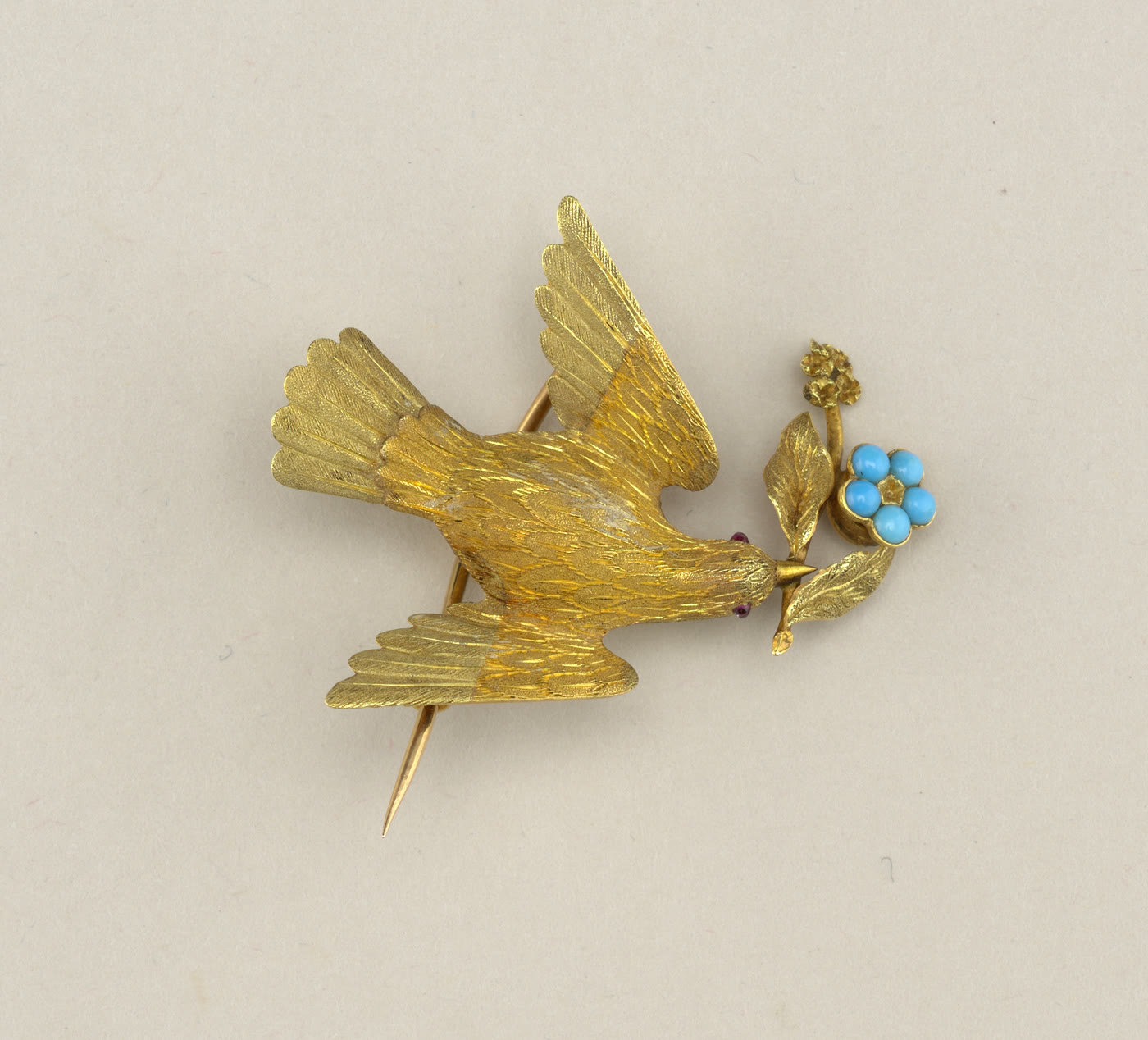
The forget-me-not is one of the most consistently interpreted flowers in the language-of-flowers literature, carrying a meaning of remembrance and lasting affection that varied little between sources - a large part of why the motif appears so often in Victorian sentimental and mourning jewellery, often as a small cluster of turquoise cabochons.
Ivy, a climbing plant rather than a flower, belongs to the same symbolic vocabulary and is covered at ivy jewellery, where its evergreen, clinging habit gave it a meaning of fidelity and enduring attachment.
The oak tree and its acorn carry their own meaning of strength, endurance and growth from small beginnings, discussed at oak and acorn jewellery.
Other Flowers Commonly Cited
The pansy was widely associated with thoughts and remembrance - an association carried in its English name, derived from the French pensée, “thought”. The rose, in its many varieties and colours, was the most familiar emblem of love, with different colours assigned more specific shades of meaning in different dictionaries. Lily-of-the-valley was commonly given the meaning “return of happiness”, suiting jewellery that marked a recovery or reunion. The violet stood for modesty or faithfulness, the daisy for innocence, and the white lily for purity. The weeping willow, though a tree, was the standard mourning image of late Georgian memorial jewellery, painted on ivory beside an urn or tomb. As with all such meanings, the precise wording varied between sources.
Materials and Typical Forms
Flower motifs appear across the full range of jewellery types and materials - engraved or enamelled on gold and silver brooches and rings, picked out in coloured gemstones chosen to evoke a particular bloom (as with the forget-me-not’s turquoise), painted on porcelain or enamel plaques set into lockets and pendants, carved in coral, ivory or jet, and worked as sprays, wreaths or single blossoms.
Reading Floral Motifs Today
The language of flowers is most strongly associated with the Victorian period, though flower symbolism in jewellery has roots in the Georgian era and earlier, and continued after Victoria’s reign. When identifying a floral motif, distinguish flowers with a consistent symbolic reading - such as the forget-me-not, pansy, ivy or oak and acorn - from decorative floral ornament that may not have been intended to carry any coded message at all. Many pieces used flowers because they were fashionable and attractive, and not every rose in Victorian jewellery was meant to be “read”. An inscription, a paired motif or a documented history are the most reliable indicators of deliberate symbolic intent.
Read next

Eras
Georgian Jewellery
A guide to Georgian jewellery (1714-1837): Brazilian diamonds, closed-back foiled settings, rococo and Neoclassical styles, paste, cut steel and pinchbeck, sentimental miniatures, girandoles, rivières and Sévigné bows.

Eras
Victorian Jewellery
A guide to Victorian jewellery (1837-1901): the Romantic, Grand and Aesthetic periods, the Great Exhibition, gold rushes and 9ct gold, mourning and Whitby jet, archaeological revival, Scottish jewellery, and how to recognise each phase.
Symbols
Forget-Me-Not Jewellery
The small blue forget-me-not as a 19th-century symbol of remembrance and lasting affection, the legends behind its name, and its common form as clustered turquoise cabochons.

Symbols
Heart Jewellery Through History
The heart in jewellery from 1700 to 1950: crowned hearts, Scottish luckenbooth brooches, Sacred Heart pendants, padlock-and-key pendants, Claddagh rings and wartime sweetheart brooches.

Symbols
Ivy Jewellery
Ivy as a jewellery motif for fidelity and lasting attachment, from Bacchic wreaths and archaeological revival gold to Victorian vine borders, jet leaves and mourning brooches.
Symbols
Oak and Acorn Jewellery
The oak and acorn as jewellery motifs for strength, endurance and growth, from Charles II's Royal Oak and Heart of Oak to Victorian acorn drops and finials.