Identify
Earring Fittings Through History
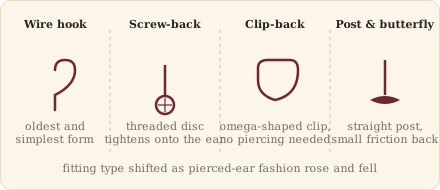
How pierced wire hooks, screw-backs and clip-backs rose and fell in prominence, and why fitting type is a useful but replaceable clue to an earring's age.
Section
18 articles
Identify
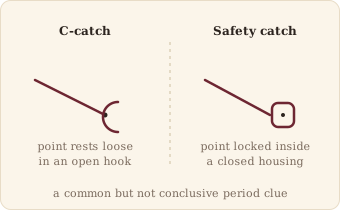
What clasp and catch styles can suggest about a brooch's likely period, and why the catch alone can never confirm a date.

Identify
How clasp mechanisms on necklaces and bracelets changed over time, and why a clasp is one of the least reliable dating clues on a piece that saw regular wear.

Identify
How pin-and-hinge mechanisms work across brooches, hatpins and stickpins, and why the presence or absence of a catch is a useful structural distinction.
Identify
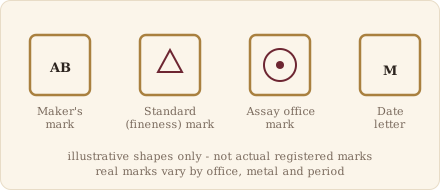
What a British hallmark is, the four marks that make up a traditional set, how the system developed from 1300 to the 1973 Hallmarking Act, and why so much antique jewellery is unmarked.
Identify
Every British gold standard from 22ct to 9ct, when each was legal, how each was marked before and after 1975, and how to read a gold standard mark as a dating clue.
Identify
The sterling and Britannia standards, the lion passant, lion's head erased, Scottish thistle and lion rampant, Irish harp, the 925 mark, and why so much antique silver jewellery carries no hallmark.
Identify
How British hallmark date letters work: cycles, typefaces and shield shapes, why London letters span two calendar years, the 1975 uniform cycle, and how to avoid the common misreadings.
Identify
How jewellery was marked in France, the United States, Germany and Russia: the eagle's head and Minerva, karat stamps and the 1906 Stamping Act, the crescent and crown, zolotniks and the kokoshnik.
Identify
General signs that a piece of jewellery has been repaired, altered or reworked over its lifetime, and why this is normal jewellery history rather than deception.
Identify
How to spot a resized ring shank, why resizing is normal rather than a warning sign, and how it can complicate reading a ring's hallmark.
Identify
A practical starting process for researching an inherited piece of jewellery, from family history and construction clues to when to consult a specialist.
Identify
A step-by-step method for reading a British hallmark on jewellery, a quick-reference list of marks that fix a date range, and worked examples showing how to combine marks with style and construction.
Identify
What an 18ct or 750 gold mark means, when the British 18 carat standard was introduced in 1798, how it was marked before and after 1975, and why 18ct dominated fine jewellery.
Identify
What a 9ct or 375 gold mark means, why the 1854 introduction of 9 carat gold transformed British jewellery, how 9ct marks changed over time, and what 9ct looks and feels like.
Identify
What a maker's or sponsor's mark identifies, how British makers' marks changed from 1363 to the present, why the mark often names a retailer rather than a craftsman, and how to research one.
Identify
What the assay office mark shows, the marks of London, Birmingham, Sheffield, Edinburgh, Chester, Glasgow, Dublin and the closed offices, and how the office mark helps date jewellery.
Identify
How diamond cutting changed from the rose cut and old mine cut to the old European and modern brilliant, the step cuts of Art Deco, and how to read a stone's outline, table, culet and facets as dating evidence.