What Is an Assay Office Mark?
What the assay office mark shows, the marks of London, Birmingham, Sheffield, Edinburgh, Chester, Glasgow, Dublin and the closed offices, and how the office mark helps date jewellery.
The assay office mark, sometimes called the town mark, shows where a piece was tested and hallmarked. Each British office has its own symbol, usually taken from its city’s arms. Identifying it is the essential first step in reading a hallmark, because date letters are only meaningful against the right office’s tables. For the other marks in a set, see What Is a Hallmark?.
What “Assay” Means
To assay metal is to test its composition. Traditionally a small scraping was taken from the piece and tested by cupellation - heating with lead in a porous dish until the base metals were absorbed, leaving the precious metal to be weighed. Pieces that passed were struck with the office’s mark; pieces that failed could be broken. Modern offices use X-ray fluorescence and other instrumental methods, but the principle of independent testing is the same.
The British Assay Offices and Their Marks
| Office | Mark | Operating |
|---|---|---|
| London (Goldsmiths’ Hall) | Leopard’s head - crowned until about 1821, uncrowned since | Since 1300; still operating |
| Birmingham | An anchor | Since 1773; still operating |
| Sheffield | A crown on silver until 1974; a Yorkshire rose since 1975 | Since 1773; still operating |
| Edinburgh | A castle with three towers | Medieval origins; still operating |
| Chester | Three wheatsheaves and an upright sword | Closed 1962 |
| Glasgow | A tree, bird, bell and fish | Closed 1964 |
| Exeter | A castle with three towers | Closed 1883 |
| Newcastle | Three separate castles | Closed 1884 |
| York | Various city marks | Closed in the 1850s |
| Dublin | A seated figure of Hibernia, alongside the crowned harp | Still operating (Ireland) |
Four offices operate in the UK today: London, Birmingham, Sheffield and Edinburgh. Dublin continues as the Republic of Ireland’s assay office.
Which Marks You’re Most Likely to See on Jewellery
- Birmingham’s anchor is by far the most common office mark on British gold and silver jewellery after about 1850. Birmingham’s Jewellery Quarter was the centre of the British jewellery trade, and its manufacturers sent their work to the local office.
- Chester marks are common on jewellery and watch cases from the late 19th and early 20th centuries, including many imported pieces.
- London’s leopard’s head is more typical of fine retail jewellery and of silverware.
- Sheffield is more strongly associated with cutlery and plate than jewellery.
Office Marks as Dating Evidence
Because offices opened and closed at known dates, the office mark alone can narrow a date:
- A Chester mark means the piece was marked before 1962; a Glasgow mark, before 1964.
- An Exeter or Newcastle mark points to before the mid-1880s.
- A crowned leopard’s head belongs to London before about 1821.
- A Sheffield rose means 1975 or later.
One complication: until the 19th century some provincial offices also struck a leopard’s head alongside their own town mark, so a leopard’s head doesn’t automatically mean London. Look for a second town mark beside it.
Imported Pieces
From 1904, foreign gold and silver assayed in Britain received separate import marks, with a different symbol for each office and the standard shown as a decimal (“.375”, “.925” and so on). An import mark means the piece was made abroad and assayed in Britain - a useful distinction on continental jewellery sold by British retailers.
Reading It Alongside the Rest of the Hallmark
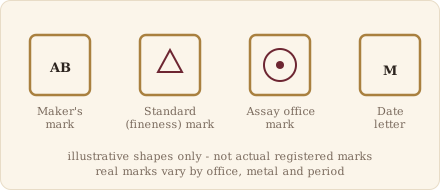
The office mark tells you where, not who or when. Combine it with the maker’s mark, the standard mark (gold or silver) and the date letter. For the marks used in other countries, see Hallmarks Outside Britain.
Read next
Identify
British Gold Hallmarks Explained
Every British gold standard from 22ct to 9ct, when each was legal, how each was marked before and after 1975, and how to read a gold standard mark as a dating clue.
Identify
British Silver Hallmarks Explained
The sterling and Britannia standards, the lion passant, lion's head erased, Scottish thistle and lion rampant, Irish harp, the 925 mark, and why so much antique silver jewellery carries no hallmark.
Identify
Understanding Hallmark Date Letters
How British hallmark date letters work: cycles, typefaces and shield shapes, why London letters span two calendar years, the 1975 uniform cycle, and how to avoid the common misreadings.
Identify
Hallmarks Outside Britain
How jewellery was marked in France, the United States, Germany and Russia: the eagle's head and Minerva, karat stamps and the 1906 Stamping Act, the crescent and crown, zolotniks and the kokoshnik.
Identify
What Is a Hallmark?
What a British hallmark is, the four marks that make up a traditional set, how the system developed from 1300 to the 1973 Hallmarking Act, and why so much antique jewellery is unmarked.
Identify
What Is a Maker's Mark?
What a maker's or sponsor's mark identifies, how British makers' marks changed from 1363 to the present, why the mark often names a retailer rather than a craftsman, and how to research one.