What Is a Hallmark?
What a British hallmark is, the four marks that make up a traditional set, how the system developed from 1300 to the 1973 Hallmarking Act, and why so much antique jewellery is unmarked.
A hallmark is an official mark struck onto a gold, silver or (since 1975) platinum item by an independent assay office, after the metal has been tested and found to meet a legal standard of fineness. Britain’s system is one of the oldest forms of consumer protection in the world: the word itself comes from Goldsmiths’ Hall in London, where items were brought to be tested and marked.
The Basic Idea
Gold and silver used in jewellery are almost never pure. They are alloyed with copper, silver, zinc and other metals for strength and colour, which makes it impossible to judge precious-metal content by eye. Hallmarking puts an independent body between maker and buyer: a sample is scraped from the piece and assayed, and only if it meets the declared standard is the mark struck. Anything below standard was traditionally broken up and returned.
The Four Traditional Marks
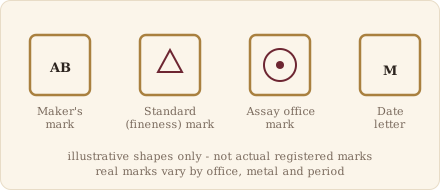
A full traditional British hallmark is a row of separate punches, each answering a different question:
| Mark | What it tells you | Typical examples |
|---|---|---|
| Sponsor’s (maker’s) mark | Who submitted the piece | Initials in a shaped shield, e.g. “WE” |
| Standard mark | The metal and its fineness | Lion passant for English sterling; crown and “18” for 18ct gold; “9 .375” for 9ct |
| Assay office mark | Where it was tested | Leopard’s head (London), anchor (Birmingham), crown or rose (Sheffield), castle (Edinburgh) |
| Date letter | The year of marking | A letter in a particular typeface and shield, changed annually |
Each has its own page: What Is a Maker’s Mark?, British Gold Hallmarks Explained, British Silver Hallmarks Explained, What Is an Assay Office Mark? and Understanding Hallmark Date Letters.
Two other marks turn up on older pieces. Between 1784 and 1890 a duty mark - the sovereign’s head in profile - showed that tax on the item had been paid, so its presence alone places a piece within that window. And in certain years, optional commemorative marks were added, such as the paired heads of George V and Queen Mary for the 1935 Silver Jubilee and the Queen’s head for the 1953 Coronation.
A Short History of British Hallmarking
- 1300 - A statute of Edward I requires silver to be of the sterling standard (92.5% pure) and gold of the “touch of Paris”, and to be tested and struck with a leopard’s head by the wardens of the goldsmiths’ guild.
- 1363 - Makers are required to strike their own mark as well.
- 1478 - The London office introduces an annual date letter.
- 1544 - The lion passant appears as the sterling mark.
- 1697-1720 - The higher Britannia silver standard (95.8%) is compulsory, marked with a figure of Britannia and a lion’s head erased.
- 1773 - New assay offices open in Birmingham and Sheffield.
- 1784-1890 - The sovereign’s-head duty mark is struck.
- 1798 - An 18 carat gold standard is introduced, marked with a crown and “18”.
- 1854 - Lower gold standards of 15, 12 and 9 carats become legal.
- 1932 - 15ct and 12ct are replaced by 14ct.
- 1973 - The Hallmarking Act (in force from 1 January 1975) modernises the system: gold fineness is shown in parts per thousand (silver followed in 1999), platinum is hallmarked for the first time, and all offices share one date-letter cycle.
- 1999 - The compulsory marks are reduced to sponsor’s mark, millesimal fineness mark and assay office mark; the date letter and traditional symbols such as the lion passant become optional.
Why So Much Antique Jewellery Is Unmarked
Readers are often surprised to find an apparently gold Georgian or Victorian brooch with no hallmark at all. That is normal. The Plate Offences Act of 1738 exempted many small items and “jewellers’ works” - pieces set with stones - from compulsory marking, with mourning rings a notable exception. A great deal of jewellery made before the 20th century was therefore never sent for assay; when it carries any mark, it is often only a standard mark such as “15” or “9”, struck by the maker.
Wedding rings, by contrast, are frequently fully hallmarked, which is one reason they are among the most precisely datable pieces of antique jewellery.
Under current rules, items below a set weight are still exempt: 1 gram for gold, 7.78 grams for silver and 0.5 grams for platinum. A light silver brooch can therefore be modern and still be legitimately unmarked.
What a Hallmark Can and Can’t Tell You
A hallmark is strong evidence about the part it is struck on, at the time it was tested. It cannot vouch for parts added later: a hallmarked ring shank may carry a replacement head, and a marked clasp may have been moved from another necklace. Marks can also be worn, partly removed by resizing, or - rarely - transposed or forged. Read the hallmark together with the style and construction of the whole piece; How to Use Hallmarks to Date Jewellery walks through that process.
Hallmarking Varies by Country
The system described here is British. France, the United States, Germany, Russia and others developed different systems, some with no independent testing at all. See Hallmarks Outside Britain for the main alternatives.
Read next
Identify
British Gold Hallmarks Explained
Every British gold standard from 22ct to 9ct, when each was legal, how each was marked before and after 1975, and how to read a gold standard mark as a dating clue.
Identify
British Silver Hallmarks Explained
The sterling and Britannia standards, the lion passant, lion's head erased, Scottish thistle and lion rampant, Irish harp, the 925 mark, and why so much antique silver jewellery carries no hallmark.
Identify
Understanding Hallmark Date Letters
How British hallmark date letters work: cycles, typefaces and shield shapes, why London letters span two calendar years, the 1975 uniform cycle, and how to avoid the common misreadings.
Identify
Hallmarks Outside Britain
How jewellery was marked in France, the United States, Germany and Russia: the eagle's head and Minerva, karat stamps and the 1906 Stamping Act, the crescent and crown, zolotniks and the kokoshnik.
Identify
What Is a Maker's Mark?
What a maker's or sponsor's mark identifies, how British makers' marks changed from 1363 to the present, why the mark often names a retailer rather than a craftsman, and how to research one.
Identify
What Is an Assay Office Mark?
What the assay office mark shows, the marks of London, Birmingham, Sheffield, Edinburgh, Chester, Glasgow, Dublin and the closed offices, and how the office mark helps date jewellery.