How to Research an Inherited Piece of Jewellery
A practical starting process for researching an inherited piece of jewellery, from family history and construction clues to when to consult a specialist.
Inheriting a piece of jewellery often means inheriting a mystery along with it - who wore it, when it was made, and what, if anything, it might be worth. Some of that can be narrowed down through careful observation and comparison; the rest requires a specialist. This guide sets out a sensible order for doing your own research before deciding what to do next.
What to Look At
Before turning to outside resources, gather what you can from the object and its context: overall style and motifs, materials, construction details such as clasp or hinge type, wear patterns, visible repairs, any marks or hallmarks, and - just as importantly - whatever family history or provenance survives alongside the piece. No single one of these will confirm a date or origin on its own, but together they can meaningfully narrow the range of likely possibilities.
Start With What the Family Already Knows
Family memory and paperwork are often the single most valuable, and most overlooked, source of evidence for an inherited piece. Ask relatives who might remember: who originally wore the piece, roughly when, and on what occasions. Look through old letters, diaries, wills and photographs - a photograph or portrait clearly showing a relative wearing the piece can anchor it to a specific decade far more reliably than style alone ever could, and an inscription, mourning date, or mention in a letter or will can sometimes date a piece precisely. This kind of documentary provenance, where it survives, is worth more than any amount of stylistic guesswork, so it is worth exhausting this avenue thoroughly before moving on to physical examination.
Examine Construction and Style
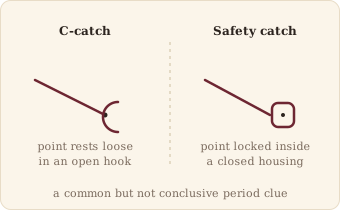
Once you’ve gathered what family evidence exists, look closely at the piece itself. Note the metal (or apparent metal), the type of stones or materials used, the setting style, and - for a brooch specifically - the clasp and hinge construction, which changed fairly consistently over time; see How to Date an Antique Brooch by Its Clasp for more detail on reading that particular feature. Wear patterns and any visible repairs, such as mismatched solder or a replaced pin, are also worth recording, since they can indicate both age and a history of use or alteration.
Compare Against Reference Material
With those observations in hand, this site’s jewellery-type and era guides are a good starting point for comparison - a piece’s overall motifs, materials and construction can often be compared against the characteristic features described for periods such as Victorian jewellery to suggest a plausible range. Museum collection databases, many of which are searchable online and include dated, provenanced examples, are a further step up in reliability, since they let you compare your piece against objects whose date and origin are already established by expert examination. Treat any similarity you find as suggestive rather than conclusive - style was often imitated, revived or simply continued in production well beyond its original period of fashion.
Hallmarks, Where Present
If the piece carries a hallmark or maker’s mark, it can be a useful clue toward narrowing origin and, in jurisdictions with date-letter hallmarking systems, sometimes a specific year or narrow range of years. Reading a hallmark accurately, however, takes reference to the correct assay office records or current official guidance for the country and period in question, and a mark alone does not confirm that every component of the piece - as opposed to just the marked part - dates to the same time, since settings, pins and other elements can be replaced. Treat a hallmark as one strong piece of evidence to be verified properly, not as a complete answer by itself.
When to Consult a Specialist
Once you’ve done what research you reasonably can, consult a qualified antique jewellery dealer, an independent appraiser, or an auction house specialist - particularly before making any decision that depends on the piece’s date, authenticity or value, including sale, insurance, significant restoration, or dividing an inheritance between family members. A specialist can examine construction, metal content, stones and marks directly, in ways that photographs and written descriptions cannot fully substitute for, and can give you a considered opinion appropriate to what you actually intend to do with the piece.
Where to Go From Here
Keep a written record of everything you gather - family recollections, photographs, your own observations of construction and marks, and any comparisons you’ve made against reference material - since this record will be useful both for your own understanding and for any specialist you eventually consult. From there, browsing this site’s jewellery-type, era and mourning sections is a reasonable way to build a general sense of what you’re looking at before seeking a professional opinion.
Read next
Compare
Georgian vs Victorian Jewellery
How Georgian and Victorian jewellery differ in settings, techniques and motifs, and why Victorian jewellery itself spans several distinct phases.

Eras
Victorian Jewellery
A guide to Victorian jewellery (1837-1901): the Romantic, Grand and Aesthetic periods, the Great Exhibition, gold rushes and 9ct gold, mourning and Whitby jet, archaeological revival, Scottish jewellery, and how to recognise each phase.
Identify
How to Date an Antique Brooch by Its Clasp
What clasp and catch styles can suggest about a brooch's likely period, and why the catch alone can never confirm a date.
Identify
How to Recognise Repaired or Altered Jewellery
General signs that a piece of jewellery has been repaired, altered or reworked over its lifetime, and why this is normal jewellery history rather than deception.
Jewellery
What Is a Brooch?
What a brooch is, how its pin-and-catch fastening works, and how brooch styles moved from naturalistic Victorian sprays through mourning brooches to Art Deco geometry.

Mourning & Sentimental
What Is Mourning Jewellery?
What mourning jewellery is, how it developed from Stuart and Georgian memorial rings, why it peaked in Victorian Britain after Prince Albert's death in 1861, and the etiquette and materials behind it.