Pearls in Jewellery History
Natural pearls from the Gulf and Ceylon, seed-pearl work, Edwardian chokers and ropes, Mikimoto's cultured pearls of the 1910s-20s, imitation pearls, and pearls' bridal and mourning meanings.
Pearls occupy a distinctive place in jewellery history because, unlike a cut gemstone, they require no cutting or faceting to be worn as found - and because the pearl market itself changed fundamentally in the early 20th century with the commercial arrival of cultured pearls.
Natural Pearls Before the 20th Century
Until the early 1900s, all pearls used in jewellery were natural pearls - formed without human intervention inside a mollusc, and harvested by divers from wild oyster and mussel beds. Because natural pearls of good size, shape and lustre are rare, fine matched pearls were highly prized and expensive throughout the Georgian, Regency and Victorian periods, while smaller, irregular or lower-quality natural pearls, including tiny seed pearls, were far more widely affordable.
Where Natural Pearls Came From
The most important source was the Persian Gulf, where pearl oysters were fished each summer from boats working the banks off Bahrain, Qatar and the Trucial coast; Bahrain was the chief market, and many of the finest stones passed through Bombay to the Paris and London trade. The Gulf of Mannar, between Ceylon and southern India, was the second great source. The Red Sea also produced pearls, and in the 16th century Spanish colonists had exploited pearl beds off Venezuela and Panama.
Freshwater mussels gave a separate supply. Scottish rivers such as the Tay yielded pearls throughout the period, and in North America a large pearl found at Notch Brook in New Jersey in 1857 set off a pearl-hunting rush; it is said to have been bought by Tiffany & Co. and sold on to the Empress Eugénie. Further rushes along the rivers of the Mississippi basin followed in the 1890s.
Seed Pearl Jewellery
Seed pearls - very small natural pearls, often just a millimetre or two across, imported mainly from India and China - were worked in large numbers into late Georgian and early Victorian jewellery, roughly 1790 to 1850. Each pearl was drilled and threaded with silk or fine white horsehair onto a pierced frame of mother-of-pearl, building up delicate lace-like motifs such as bows, flowers, wreaths or initials. Complete seed pearl parures, with necklace, earrings, brooch and bracelets, were a favourite wedding present in the 1830s and 1840s and were often kept in their fitted cases. This work is fragile - the threads and backing deteriorate over time - and surviving pieces in good condition are correspondingly valued by collectors. Seed pearl jewellery was also used for mourning and memorial pieces, sometimes combined with hair-work or engraved initials of the person commemorated.
Edwardian Pearls
Pearls reached their greatest prestige between about 1890 and 1914. Queen Alexandra, as Princess of Wales and then queen, made the multi-row pearl choker or “dog collar” fashionable, and long ropes of pearls, worn to the waist or knotted as a sautoir, were the mark of a fashionable evening toilette in the 1900s and again in the 1920s. Fine natural pearl necklaces could cost more than any other jewel. The best-known illustration is Cartier’s acquisition in 1917 of the mansion at 653 Fifth Avenue in New York, which became its American headquarters, in exchange for a double strand of natural pearls for Maisie Plant, the wife of the house’s owner, who had admired the necklace in Cartier’s shop.
Two pearl jewels in public and royal collections show the range of grand pearl work. The pearl and diamond tiara made by Gabriel Lemonnier for the Empress Eugénie’s marriage to Napoleon III in 1853 was in the Louvre until it was stolen in the robbery of October 2025. The Lover’s Knot tiara, made by Garrard for Queen Mary in 1913-14 with drop pearls hanging from diamond bows, is still worn by the British royal family.
The Shift to Cultured Pearls
Cultured pearls are grown by deliberately inserting a bead or piece of tissue into a mollusc to stimulate nacre formation under controlled conditions. Kokichi Mikimoto produced his first half-round “blister” cultured pearls in Japan in 1893 and patented the method in 1896. The technique for fully round cultured pearls was developed in Japan in the first decade of the 20th century, by Tokichi Nishikawa and Tatsuhei Mise among others, and Mikimoto obtained his own patent for round pearls in 1916. His pearls reached the London and Paris markets in the early 1920s, causing alarm in the natural pearl trade.
The arrival of cultured pearls in quantity, followed by the Depression after 1929 and the decline of Gulf pearling in the 1930s, brought the price of natural pearls down sharply. It also led to new testing methods: the London Chamber of Commerce set up a laboratory in 1925 largely to distinguish natural from cultured pearls, using X-rays and instruments that looked into the drill hole.
This is a significant dividing line for dating pearl jewellery: pearl jewellery made before the 1920s is very unlikely to contain cultured pearls unless they were added later, while pearl jewellery from the 1920s onward may use either, and the two became increasingly difficult to distinguish without specialist testing as culturing techniques matured. No attempt is made here to determine, from a description or photograph, whether a specific pearl is natural or cultured; that determination requires laboratory examination.
Imitation Pearls
Imitation pearls have a long history of their own. In the late 17th century a Paris maker named Jacquin is credited with developing essence d’orient, a lustrous coating made from fish scales, applied to the inside of thin hollow glass beads which were then filled with wax. Coated glass beads of this kind were made in France and later in Italy and Spain into the 20th century, and were the basis of much costume jewellery of the 1920s and 1930s.
Symbolism
Pearls carried several overlapping symbolic associations between 1700 and 1950. Their whiteness and simplicity gave them a long-standing association with purity and innocence, making them a favoured choice for bridal and young women’s jewellery. Pearls were also linked poetically with tears - a symbolism cited in period literature and verse - which, combined with their pale, restrained colour, made them an acceptable material for half mourning, the later, less severe stage of Victorian mourning dress that permitted materials beyond the stark black of full mourning.
Typical Uses
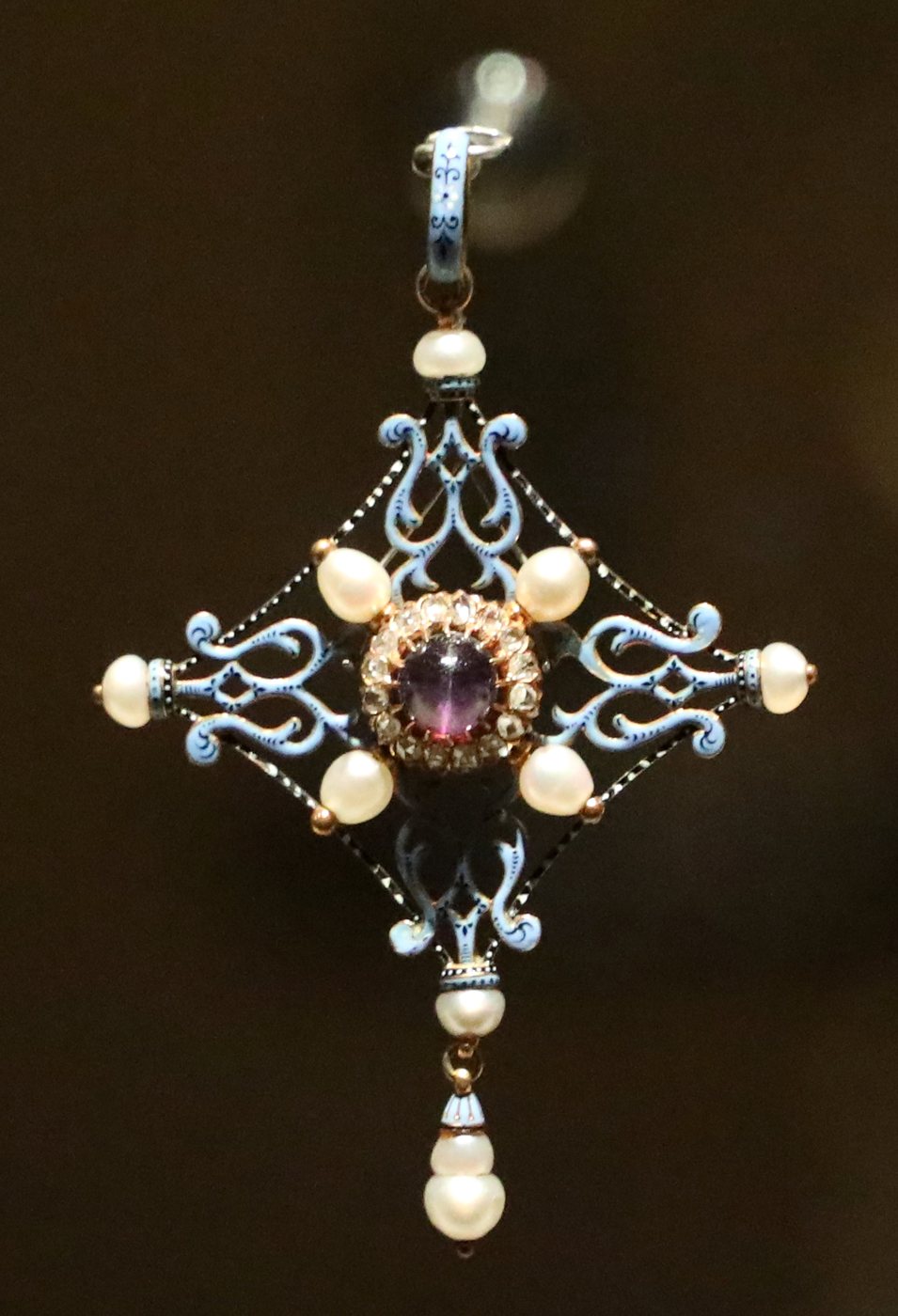
Pearls appear in almost every form of jewellery, but several uses recur often enough to name. The negligee necklace, fashionable in the late Victorian and Edwardian periods, suspended two drops of unequal length from a fine chain, frequently finished in pearls. Pearl drop earrings, whether a single pearl or a pearl beneath a smaller stone, were a lasting staple from the 18th century onward. Pearls were also very commonly used as accent stones - small pearls surrounding a central coloured gemstone or diamond in a cluster setting, or forming a border around a locket, brooch or miniature - a role in which their neutral colour and soft lustre complemented rather than competed with a piece’s centrepiece. Irregular “baroque” pearls were used for the bodies of figures and animals in Renaissance revival pendants of the 19th century.
Identifying Period Pearl Jewellery
Setting style, mount metal and the surrounding design are generally more reliable dating clues than the pearls themselves, since a natural pearl gives no visual indication of its date of harvest. Fine seed pearl work with threaded mother-of-pearl backing is a strong indicator of Georgian or early Victorian manufacture, while a strand of closely graduated, highly uniform round pearls is more consistent with 20th-century cultured pearl production, though this remains a general association rather than a firm test. Pearl necklaces are restrung regularly, so the strand, clasp and pearls may all be of different dates.
Read next

Eras
Edwardian Jewellery
A guide to Edwardian jewellery (1901-1915): platinum and the garland style, Queen Alexandra's dog collars, Cartier, Boucheron and Fabergé in London, the Cullinan diamond, lavaliers, milgrain settings and day jewellery.

Eras
Victorian Jewellery
A guide to Victorian jewellery (1837-1901): the Romantic, Grand and Aesthetic periods, the Great Exhibition, gold rushes and 9ct gold, mourning and Whitby jet, archaeological revival, Scottish jewellery, and how to recognise each phase.
Gemstones
Garnets in Victorian Jewellery
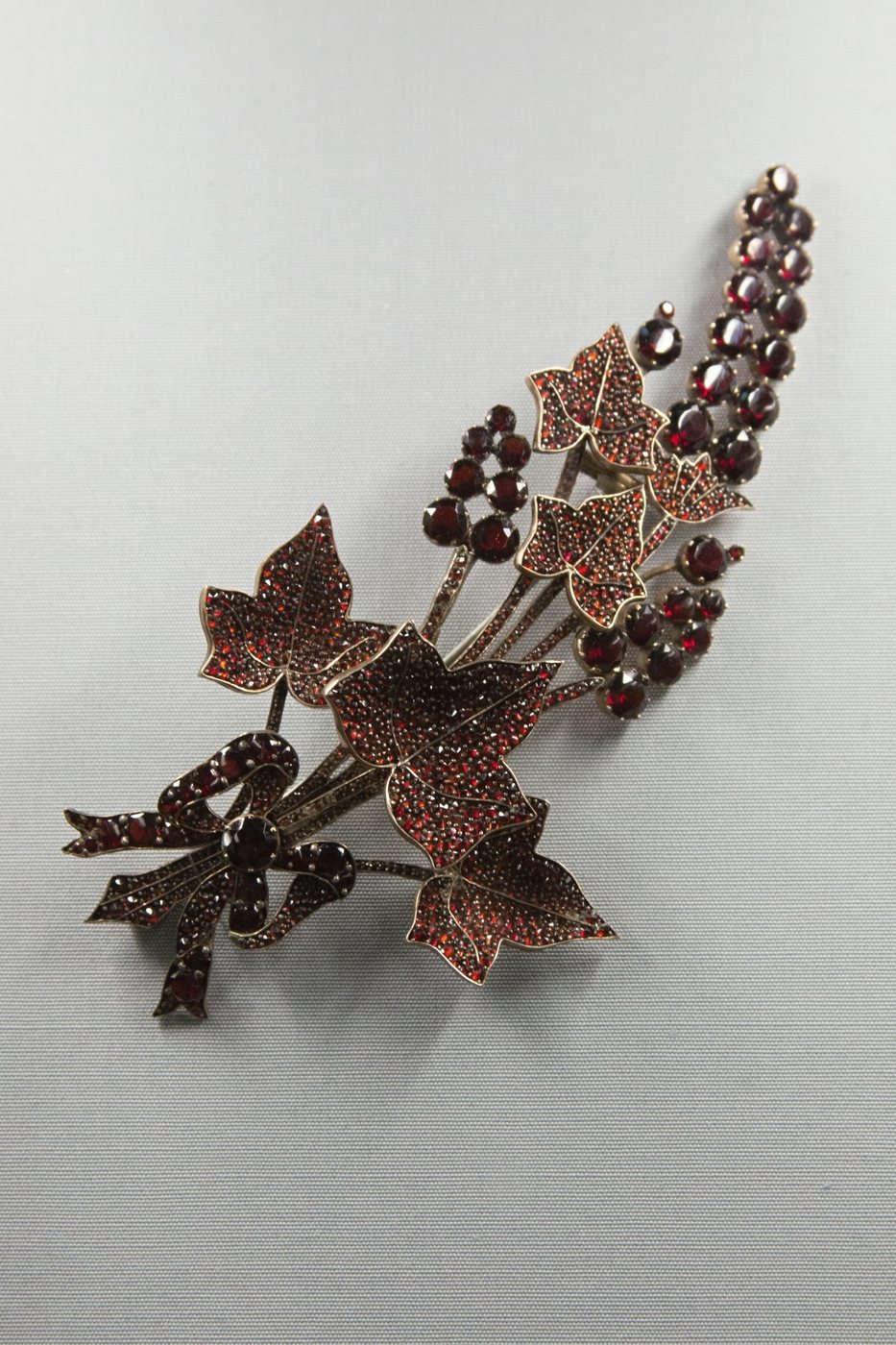
Why Bohemian pyrope garnets from Třebenice, cut and set in Turnov and Prague, became a hallmark of Victorian jewellery, with carbuncles, demantoids, cluster settings and their meanings.
Jewellery
What Is a Lavalier Necklace?
What a lavalier necklace is, how its single fine-chain drop defined Edwardian and Belle Epoque style, and how it differs from a plain pendant, negligee necklace or sautoir.
Jewellery
What Is a Rivière Necklace?
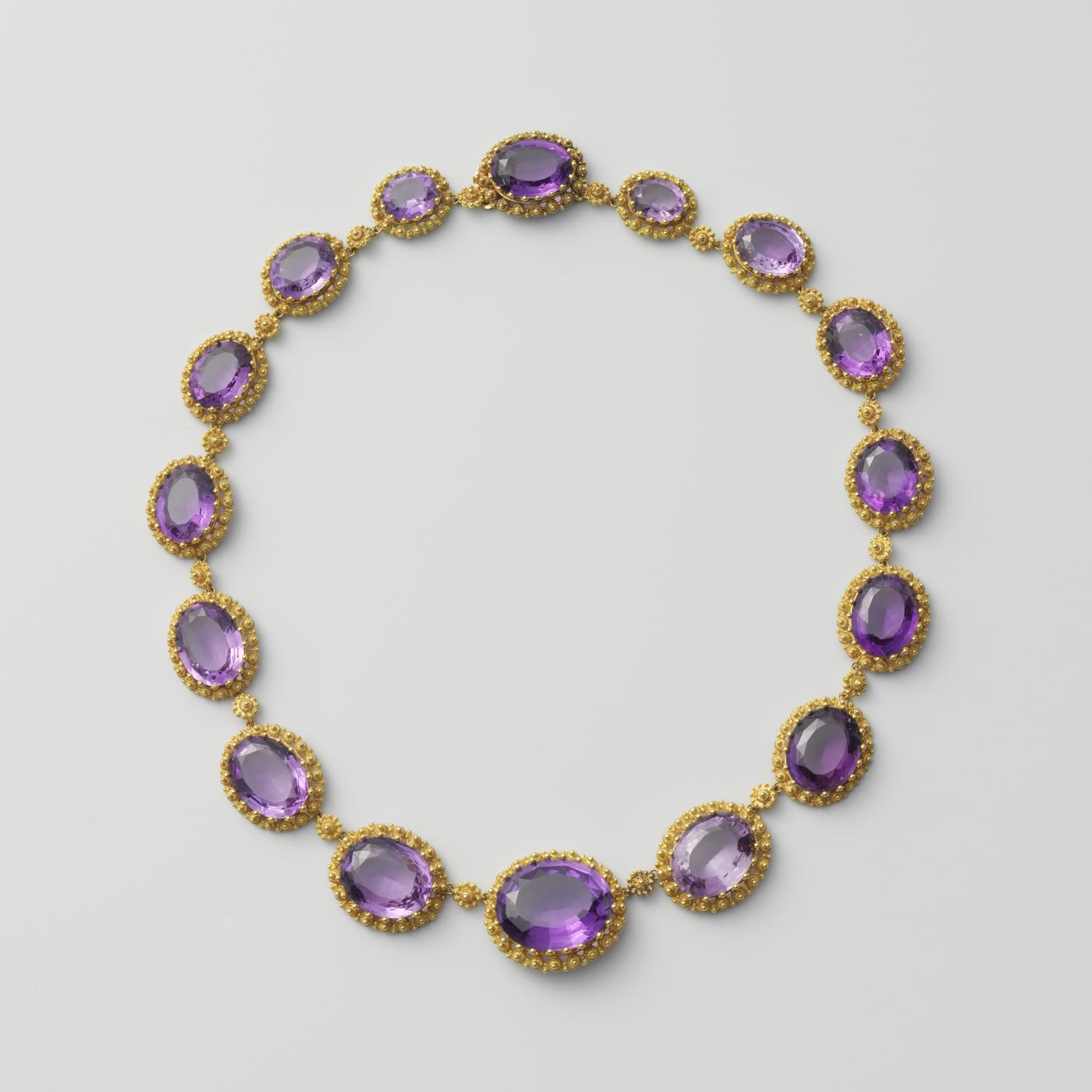
What a riviere necklace is, why its unbroken line of individually set stones made it one of the most enduring necklace forms, and how it differs from a festoon or fringe necklace.

Mourning & Sentimental
What Is Mourning Jewellery?
What mourning jewellery is, how it developed from Stuart and Georgian memorial rings, why it peaked in Victorian Britain after Prince Albert's death in 1861, and the etiquette and materials behind it.