What Is a Choker?
What a choker necklace is, how the late-Victorian and Edwardian dog-collar form developed, and its documented association with Alexandra, Princess of Wales.
A choker is a necklace worn snugly at the throat rather than hanging below it, a form especially associated with the wide, multi-strand “dog collar” style fashionable in the late Victorian and Edwardian periods.
What Is a Choker?
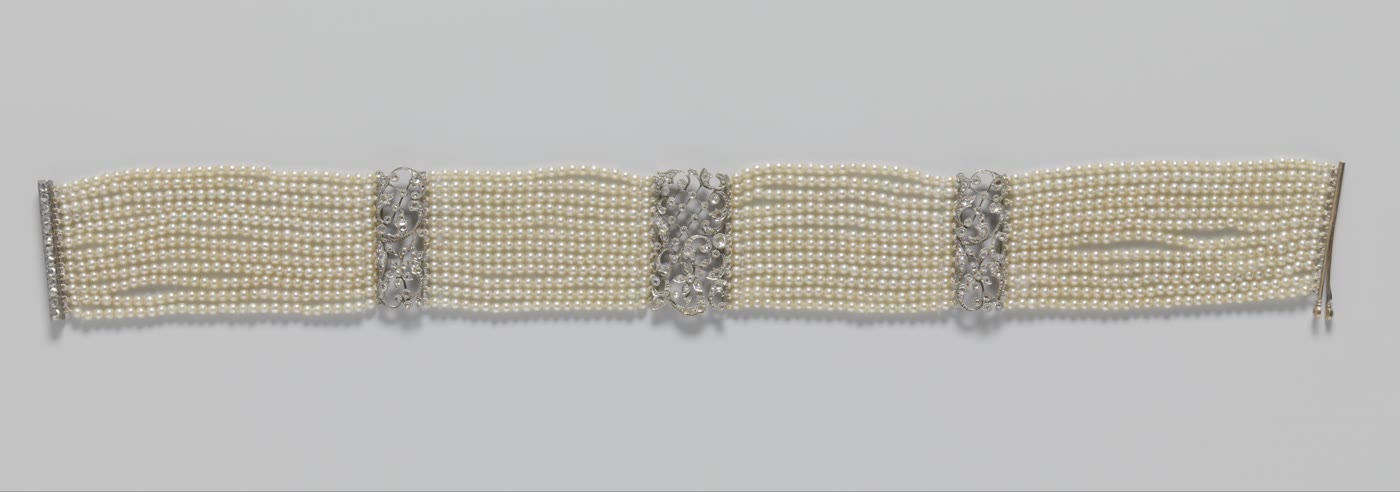
The defining feature of a choker is simply its fit: unlike a rivière, sautoir or other necklace designed to hang loosely, a choker sits close against the throat, with little or no drape. Within that basic definition, choker styles range from a single narrow band to the far more elaborate “dog collar,” a wide band made of multiple strands of pearls or gemstones, or a wide jewelled panel, worn tight to the neck and especially fashionable from the 1880s through the Edwardian period.
How to Recognise It
Look at the fit and length: a choker sits directly against the throat with essentially no hanging drop, in clear contrast to a rivière or sautoir, which hang at or below the throat with visible slack. The dog-collar variant is further distinguished by its width and construction, typically several rows of pearls or beads held in place by vertical bars or spacers, or a continuous wide band of set gemstones, sometimes mounted on a fabric or velvet backing rather than metal alone.
When Was It Worn?
Chokers were worn for both formal evening and fashionable daytime occasions, with the wide dog-collar form in particular strongly associated with formal Edwardian dress, worn with the high necklines fashionable at the time.
Origins
Close-fitting neck ornaments have appeared across many periods and cultures, but the specific “dog collar” choker fashion is a product of the late 19th century, gaining particular prominence in Britain and France from the 1880s onward.
How It Changed Over Time
The dog-collar choker rose to particular prominence in the 1880s and 1890s and remained fashionable through the Edwardian period, worn wide and high against the throat in keeping with the era’s high-necked fashionable dress. Alexandra, Princess of Wales, was a documented and influential wearer of the style during this period, and the association between her and the wide jewelled dog collar is well attested in period sources, though the style was worn broadly across fashionable society rather than by her alone. As necklines dropped and silhouettes lengthened through the 1910s and into the 1920s, the tightly fitted choker gave way in fashionable prominence to the much longer sautoir, though narrower choker forms persisted in more casual wear, often in ribbon, velvet or simple beaded versions rather than fine jewelled ones.
Materials
The finest dog-collar chokers used multiple strands of natural pearls, held in position by gold or diamond-set bar spacers, or a continuous wide band of diamonds and other gemstones. Velvet ribbon set with a jewelled clasp or a scattering of small stones offered a lighter, less costly alternative, while simple metal or beaded bands served as an everyday version of the same close-fitting silhouette.
Construction
A multi-strand pearl dog collar is built from several parallel strands of pearls, kept evenly spaced and rigid enough to sit upright against the throat by vertical metal spacer bars set at intervals along its width, finished with a secure clasp at the back of the neck. A wide gem-set band choker, by contrast, is built more like a rigid or semi-rigid panel, sometimes hinged in sections to follow the curve of the neck.
How It Was Worn
Worn snugly against the throat with no hanging drop, often filling the space at a high neckline, in clear contrast to necklaces designed to hang below the throat such as the rivière or sautoir.
Who Wore It?
The choker, and particularly the dog-collar form, was women’s fashionable jewellery, worn across society from the most elaborate pearl-and-diamond versions favoured by royalty and the wealthy to simpler velvet-and-clasp versions worn more broadly.
Notable Variations
- Dog-collar choker - the wide, multi-strand or panel-form choker especially associated with the late Victorian and Edwardian periods.
- Velvet-and-clasp choker - a narrow band of velvet ribbon fastened with a jewelled clasp, a lighter and more affordable variant.
- Bead choker - a simple single or multi-strand beaded band, worn across a broad social range.
Similar Jewellery
A choker is most often confused, in loose modern usage, with any short necklace, but its defining feature is fit rather than length alone - it sits snugly against the throat with essentially no drape. It contrasts most clearly with the longer rivière necklace, which hangs with some slack at or below the throat, and with the far longer sautoir, which hangs well below it.
Examples in Museum Collections
- Collier de chien, possibly French, c.1900-20. Rijksmuseum, Amsterdam, BK-16581. Twelve strands of pearls held by three diamond-set spacer bars - the classic multi-strand dog collar.
- Plaque from a dog-collar necklace, c.1900. Victoria and Albert Museum, London, M.27-1962. Enamelled gold and diamonds set in silver, with wisteria and foliage: the decorative panel that sat at the front of the throat.
- Choker, Madeleine Marguerite Perrier for Madame Stéphane, c.1910-20. Victoria and Albert Museum, London, T.167O-1987. A woven silk ribbon set with a large clear glass “diamond” and yellow glass beads - the lighter fabric version that carried the fashion beyond fine jewellery.
Read next
Compare
Victorian vs Edwardian Jewellery
How Victorian jewellery's heavier gold work and mourning materials gave way to the light, platinum-set, diamond-and-pearl style of the Edwardian era.

Eras
Edwardian Jewellery
A guide to Edwardian jewellery (1901-1915): platinum and the garland style, Queen Alexandra's dog collars, Cartier, Boucheron and Fabergé in London, the Cullinan diamond, lavaliers, milgrain settings and day jewellery.
Gemstones
Pearls in Jewellery History
Natural pearls from the Gulf and Ceylon, seed-pearl work, Edwardian chokers and ropes, Mikimoto's cultured pearls of the 1910s-20s, imitation pearls, and pearls' bridal and mourning meanings.
Jewellery
What Is a Rivière Necklace?
What a riviere necklace is, why its unbroken line of individually set stones made it one of the most enduring necklace forms, and how it differs from a festoon or fringe necklace.

Jewellery
What Is a Sautoir?
What a sautoir is, why its very long chain suited the flat-fronted, dropped-waist silhouette of the 1920s, and how it differs from a negligee necklace or riviere.
Jewellery
What Is a Torque Necklace?
What a torque necklace is, its ancient rigid open-ended form, and why Art Deco jewellers revived it as a sculptural, architectural necklace and bracelet style.