What Is a Bangle?
What a bangle is, how its rigid, typically clasp-free form differs from a flexible chain bracelet, and why it was often worn stacked in multiples.
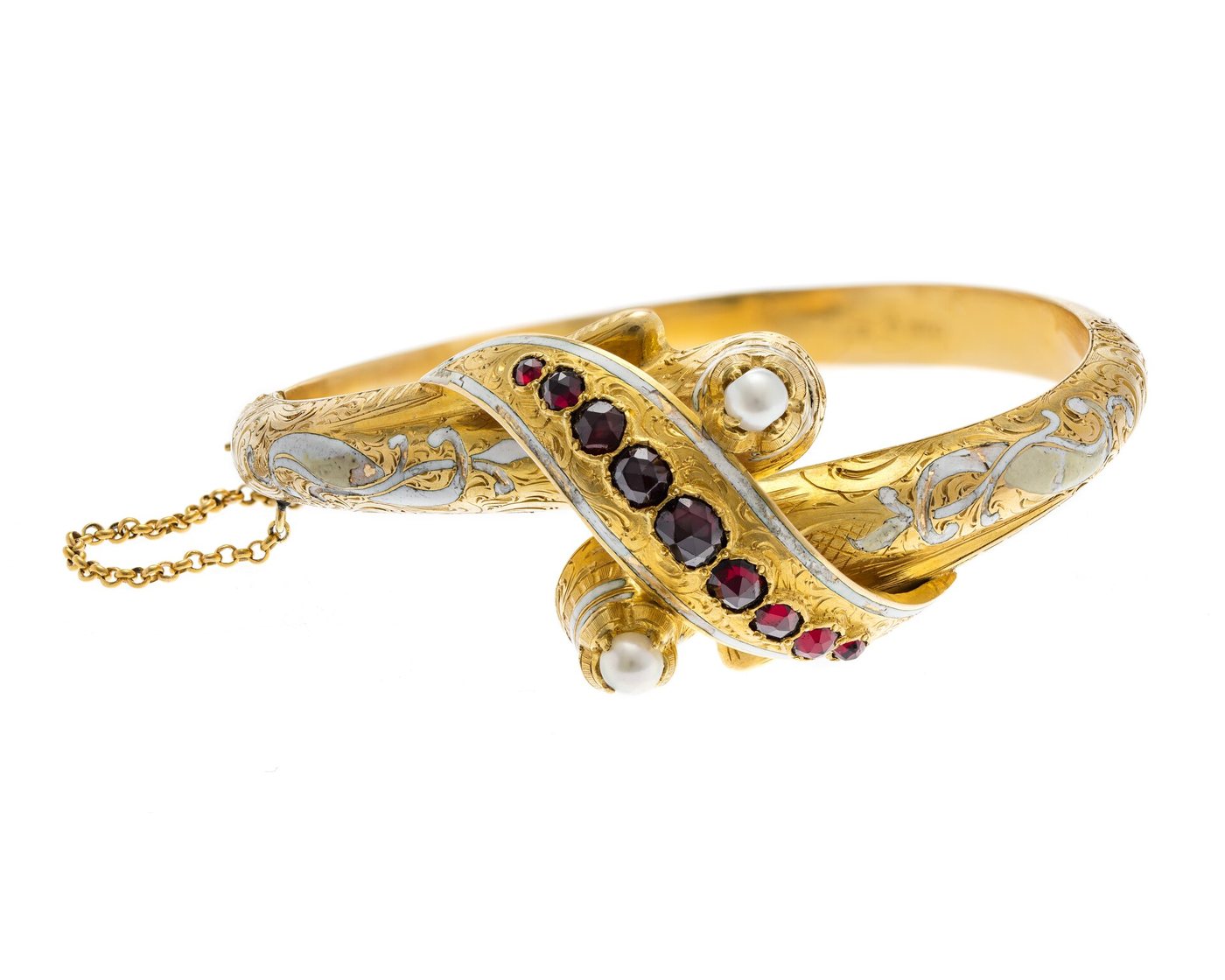
A bangle is a rigid, typically circular bracelet, usually worn either by slipping it directly over the hand with no clasp at all, or opened by a simple hinge secured with a safety chain, distinguishing it from a flexible, linked or chained bracelet.
What Is a Bangle?
As a sub-type of the broader bracelet category, a bangle is defined by its rigidity: rather than a series of linked or articulated sections that flex with the wrist, a bangle is a single solid or near-solid band, closed into a fixed circular or oval shape. Some bangles are entirely unbroken and must be slid over the hand; others are hinged at one point, opening just enough to fit over the wrist and closing with a simple catch, often paired with a safety chain in case the catch failed.
How to Recognise It
Look for a solid, rigid band with no flexible linking sections; if the piece opens at all, it will do so at a single hinge point rather than flexing along its length. A safety chain, a short secondary chain connecting the two sides of a hinged bangle, is a useful and period-appropriate feature to look for on Victorian examples in particular, guarding against loss if the main catch worked loose. See Bangle vs Bracelet for a direct, side-by-side comparison with the more general bracelet category.
When Was It Worn?
Bangles were worn as everyday and dress jewellery throughout the Victorian period and remained fashionable into the Art Deco era, when they were frequently worn stacked, several at once, on a bare forearm as part of 1920s and 1930s eveningwear.
Origins
Rigid wrist ornaments are ancient and appear across many cultures well before the Victorian period, but the bangle as a mainstream, fashionable form of Western jewellery grew prominent through the 19th century, alongside a broader Victorian taste for substantial, sculptural gold jewellery.
How It Changed Over Time
Victorian bangles were often solid gold bands, sometimes wide and richly engraved, chased or set with a small number of stones, and frequently hinged with a safety chain as a practical safeguard. Later Victorian and Edwardian bangles grew somewhat lighter and more delicate in keeping with contemporary taste. The Art Deco period saw bangles embraced anew, often in a bolder, more geometric style, and - distinctively for that era - worn in multiples, stacked together on the forearm as a fashion statement in its own right rather than worn singly.
Materials
Gold was the standard material for Victorian bangles, ranging from plain polished bands to heavily decorated examples, with silver used for less expensive pieces. Platinum and, less often, other metals appear in some Edwardian and Art Deco bangles, particularly where diamonds or fine gem-setting were involved.
Construction
A closed bangle is cast or formed as a single unbroken circular or oval band, sized to pass over the hand; a hinged bangle is built in two sections joined by a hinge on one side and a catch, often paired with a safety chain, on the other. Decoration - engraving, chasing, applied motifs or set stones - is worked directly onto the solid band.
How It Was Worn
Slipped over the hand and worn around the wrist, either alone or, especially in the Art Deco period, stacked with several other bangles on the same arm, a look made possible by the bare-armed fashions of the 1920s and 1930s.
Who Wore It?
Bangles were worn predominantly by women across this period, from a single substantial gold bangle as an everyday Victorian accessory to multiple stacked bangles as a fashionable Art Deco statement.
Notable Variations
- Hinged bangle - opens at a single hinge point and closes with a catch, often with a safety chain.
- Solid slip-on bangle - a fully closed band with no opening, worn by passing it over the hand.
- Gem-set bangle - a bangle set with a small number of stones, sometimes centred on a single feature stone.
Terminology
“Bangle” and “bracelet” are sometimes used interchangeably in casual and retail usage, though jewellery historians and collectors generally reserve “bangle” specifically for the rigid, typically clasp-free or simply hinged form; see Bangle vs Bracelet for the fuller distinction.
Similar Jewellery
A bangle is most often confused with a rigid cuff bracelet or with a hinged bracelet that has multiple articulated sections rather than a single solid band; checking whether the piece flexes along its length, rather than only at a hinge, is the clearest way to tell them apart.
Examples in Museum Collections
- Kate Terry’s bracelet, c.1867. Victoria and Albert Museum, London, S.55-2003. A gold bangle with an enamelled, diamond-set laurel wreath around a locket compartment, given to the actress Kate Terry in 1867. Its catalogue title is a reminder that “bracelet” and “bangle” were used interchangeably; see Bangle vs Bracelet.
- Bangle, firm of John Brogden, London, c.1880. Victoria and Albert Museum, London, M.105:1-2007. A hollow gold bangle in archaeological-revival style, with a central relief plaque of putti.
- Bangle, made by Verger Frères for Chaumet, Paris, 1935-45. Victoria and Albert Museum, London, M.122-2007. Gold and platinum, designed to look as though it has been sliced open to reveal a core of rubies within a field of pavé diamonds.
Read next
Compare
Bangle vs Bracelet: What's the Difference?
Why every bangle is a bracelet, but not every bracelet is a bangle - the rigid, clasp-free construction that sets bangles apart.

Eras
Art Deco Jewellery
A guide to Art Deco jewellery (c.1915-1935): geometric symmetry, the 1925 Paris Exposition, Cartier's Tutti Frutti and Van Cleef & Arpels' Mystery Set, the modernist jewellers, new stone cuts, Egyptian and Indian influences, and costume jewellery.

Eras
Victorian Jewellery
A guide to Victorian jewellery (1837-1901): the Romantic, Grand and Aesthetic periods, the Great Exhibition, gold rushes and 9ct gold, mourning and Whitby jet, archaeological revival, Scottish jewellery, and how to recognise each phase.
Jewellery
What Is a Bracelet?
An overview of bracelets as a broad jewellery category, how wrist fashion shifted with sleeve length across the period, and how a bracelet differs from a bangle.
Materials
Gold in Historical Jewellery
How gold standards, supply, colour and working methods changed from Georgian to 1940s jewellery - the 1854 standards, the gold rushes, bloomed and coloured gold, rolled gold - and gold's imitations.