Art Deco Jewellery
A guide to Art Deco jewellery (c.1915-1935): geometric symmetry, the 1925 Paris Exposition, Cartier's Tutti Frutti and Van Cleef & Arpels' Mystery Set, the modernist jewellers, new stone cuts, Egyptian and Indian influences, and costume jewellery.
Art Deco jewellery replaced the Edwardian garland’s soft curves with hard-edged geometry, bold colour contrast and a confident, machine-age sensibility that still defines popular ideas of 1920s glamour today.

Overview
Art Deco emerged during and immediately after the First World War and took its name, retrospectively, from the 1925 Exposition Internationale des Arts Décoratifs et Industriels Modernes in Paris, which showcased the style across furniture, architecture and decorative arts as well as jewellery. In jewellery, it continued the Edwardian period’s preference for platinum settings but turned decisively away from naturalistic and floral ornament toward symmetrical, geometric pattern.
Geometric Symmetry and Bold Contrast
Art Deco design favoured clean geometric forms - straight lines, chevrons, sunbursts, stepped and fan shapes - arranged with strict bilateral symmetry, a marked departure from both the flowing asymmetry of Art Nouveau and the softer curves of the Edwardian garland style. Colour contrast was equally central: black onyx or black enamel set boldly against white diamonds and platinum became one of the style’s signature combinations, alongside strong colour pairings such as emerald and sapphire against diamond, chosen for graphic impact as much as for traditional gemstone harmony.
Egyptian Revival Influence
The 1922 discovery of Tutankhamun’s largely intact tomb by Howard Carter generated enormous public fascination with ancient Egypt, and jewellers responded with a wave of Egyptian Revival motifs - scarabs, lotus flowers, pharaonic figures, hieroglyph-like ornament and stepped pylon shapes - integrated into otherwise contemporary Art Deco settings. This was not the era’s only historical influence, but it is among the most immediately recognisable, and it illustrates the period’s wider taste for bold, exoticised ornament drawn from sources outside the European jewellery tradition.
Cubism and Machine-Age Aesthetics
Art Deco’s geometric vocabulary also drew on contemporary fine-art movements, particularly Cubism’s fractured, geometric treatment of form, and on a broader cultural enthusiasm for machinery, speed and industrial precision in the years after the war. This is visible in the crisp, almost engineered look of much Art Deco jewellery, and in techniques like calibré-cutting - shaping small coloured gemstones, such as sapphires, rubies or emeralds, to fit precisely into a continuous geometric line of channel-set stones, producing an unbroken band of colour with no visible metal between stones.
Common Jewellery Types
The double-clip brooch, which could be worn as a single piece or separated into two matching dress clips fastened at each side of a neckline, is one of the period’s most distinctive forms. Cocktail rings, featuring a large central stone in a bold geometric mount, brooches and pendants in strongly architectural outlines, long sautoir necklaces, and wide, flexible bracelets designed to be worn over bare forearms were all characteristic.
Fashion Context: The Jazz Age
Art Deco jewellery developed alongside major changes in women’s fashion - shorter hemlines, bare arms and a more streamlined silhouette - which favoured long necklaces, multiple bracelets worn stacked on a bare arm, and jewellery designed to move with an increasingly active, socially visible lifestyle. The style is closely associated with the “Jazz Age” culture of the 1920s in Britain, France and the United States, though its geometric idiom continued in more subdued form somewhat later, into the early 1930s.
Materials and Gemstones
Platinum remained the preferred setting metal for fine work, continuing the Edwardian shift away from gold, though white gold became a more common and less expensive alternative as the period went on. Diamonds remained central, joined by onyx, black enamel, coral, jade, and calibré-cut coloured gemstones used for graphic contrast rather than sheer size.
The Great Paris Houses
The 1925 Exposition was dominated by the established Paris jewellers - Cartier, Boucheron, Chaumet, Mauboussin, Lacloche, Mellerio and Van Cleef & Arpels - who adapted geometric design to costly materials.
- Cartier developed the colourful “Tutti Frutti” style of carved rubies, emeralds and sapphires in the Indian manner, set with diamonds in platinum, and was a leader in Egyptian-revival and Chinese-inspired pieces.
- Van Cleef & Arpels filed a patent for its “Mystery Set” technique in 1933, in which calibré rubies or sapphires slide onto fine rails so that no metal is visible from the front.
- Boucheron, Chaumet and Mauboussin produced large geometric brooches and bracelets in diamonds with onyx, coral, jade and lapis lazuli.
The Modernist Jewellers
Alongside the great houses, a smaller group of designers - Raymond Templier, Jean Fouquet (son of the Art Nouveau jeweller Georges Fouquet), Jean Després and Gérard Sandoz - made jewellery inspired by machinery, Cubist painting and aviation: plain planes of polished metal, lacquer and enamel, used with few or no precious stones. Several were members of the Union des Artistes Modernes, founded in 1929. Their work was made in small numbers and is now among the most collected of the period.
Indian, Chinese and Persian Influences
Besides Egypt, Art Deco jewellers drew on Indian carved gems and jewelled turbans, Chinese jade, lacquer and pagoda forms, and Persian and Islamic ornament. Carved emerald and ruby leaves, jade plaques and coral beads were set into otherwise geometric platinum mounts - a mixture that typifies the 1920s.
New Stone Cuts
Art Deco design depended on stones cut to geometric shapes: baguettes, emerald cuts (step cuts with cut corners), trapezes, half-moons and calibré stones made to measure for a particular setting. Combined with brilliant-cut diamonds, these let designers build lines, blocks and stepped outlines entirely of stones. A brooch with many tiny baguettes and calibré stones fitted edge to edge is one of the clearest signs of the period.
Costume Jewellery and Plastics
Coco Chanel made openly fake jewellery fashionable in the 1920s, wearing ropes of imitation pearls and glass “gems” with day clothes. Costume jewellery in paste, glass, chrome and early plastics - celluloid, Galalith and later Bakelite - brought the geometric style to a mass market. Chanel nonetheless showed a collection of real diamond jewellery in 1932. See Paste vs Rhinestone.
How to Recognise Art Deco Jewellery
Strict geometric symmetry, black-and-white or other bold colour contrast, calibré-cut coloured stones set in unbroken lines, Egyptian Revival motifs, and the double-clip brooch form are all strong indicators, particularly in combination with platinum or white-gold settings.
Transition Out of the Style
By the mid-1930s, economic pressure following the 1929 financial crash and a shifting design taste led jewellery toward softer, more sculptural and less strictly geometric forms - a transition that moved the mainstream style away from pure Art Deco and toward the bolder Retro style of jewellery in the 1930s.
Read next
Compare
Cameo vs Intaglio: What's the Difference?
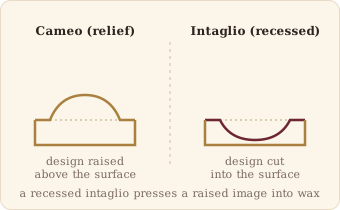
The structural difference between a cameo, carved in relief, and an intaglio, carved into the surface - and why that difference mattered for seals.
Compare
Edwardian vs Art Deco Jewellery
Edwardian and Art Deco jewellery both favoured platinum, but one is soft and curved and the other hard-edged and geometric - here's how to tell the garland style from Deco.

Eras
A Guide to Jewellery Through History
A chronological guide to jewellery history from the Georgian era to the 1940s - how style, materials and meaning changed decade by decade across Britain, France and the United States.

Eras
Art Nouveau Jewellery
A guide to Art Nouveau jewellery (c.1890-1910): René Lalique and Gulbenkian, Fouquet and Mucha, Vever and Gaillard, plique-à-jour and horn, Jugendstil, Liberty's Cymric range, Tiffany, and the mass-produced silver that spread the style.

Eras
Edwardian Jewellery
A guide to Edwardian jewellery (1901-1915): platinum and the garland style, Queen Alexandra's dog collars, Cartier, Boucheron and Fabergé in London, the Cullinan diamond, lavaliers, milgrain settings and day jewellery.
Jewellery
What Is a Brooch?
What a brooch is, how its pin-and-catch fastening works, and how brooch styles moved from naturalistic Victorian sprays through mourning brooches to Art Deco geometry.