What Is a Pendant?
What a pendant is, how it differs from an integrated necklace centrepiece, and how forms like the locket, lavalier and negligee pendant developed within the broader category.
A pendant is an ornament suspended from a chain, cord or necklace so that it hangs freely, distinct from the necklace itself, which provides the suspension rather than being the ornament.
What Is a Pendant?
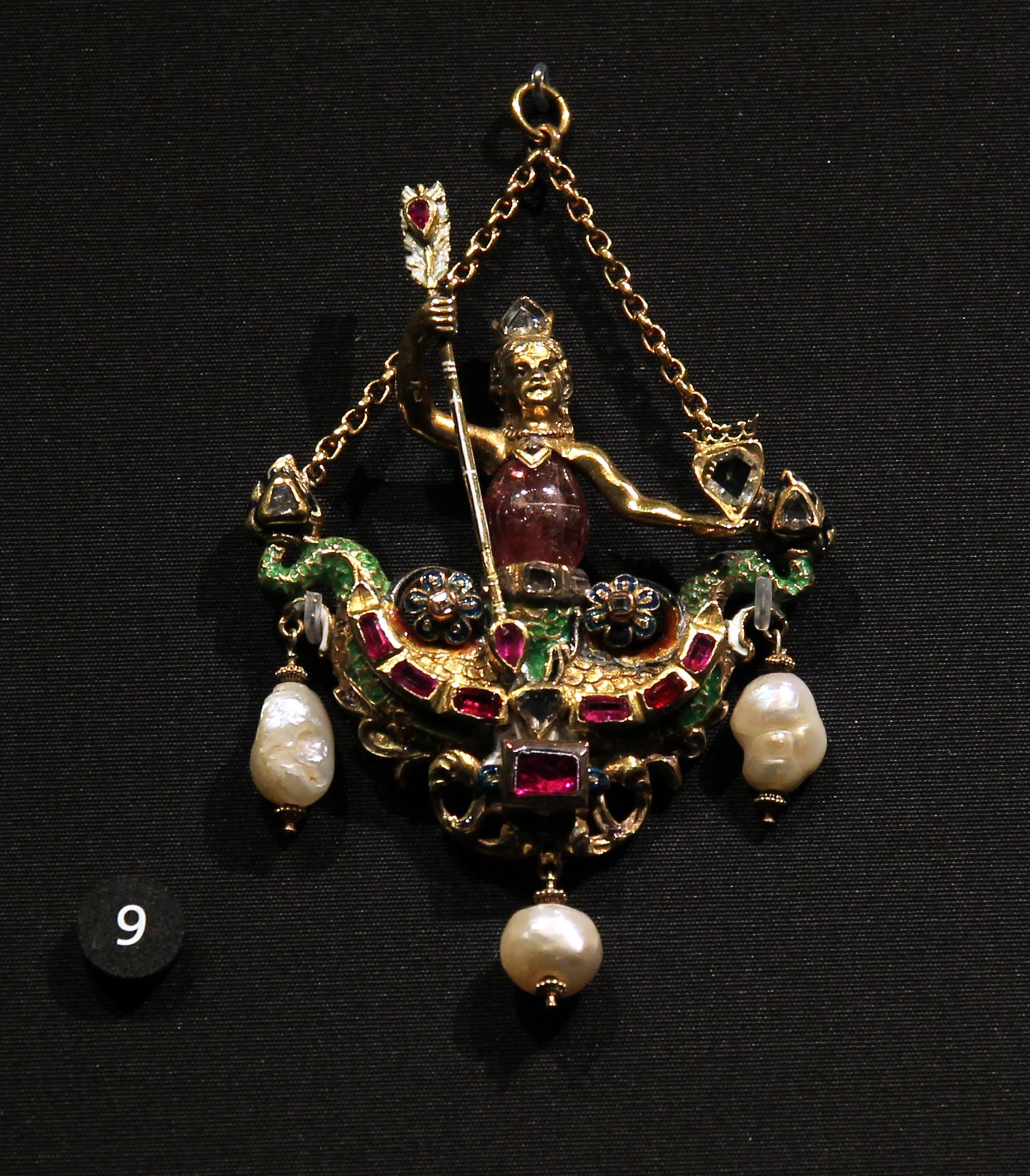
The defining feature of a pendant is that it hangs from a loop or bail attached to a separate chain, ribbon or cord, rather than being fixed to clothing or built directly into a necklace’s structure. This makes the category broad by design: a pendant can be a simple drop, a locket, a cross, a cameo, a miniature portrait, or an elaborate jewelled centrepiece, and the same chain can often be worn with different pendants interchanged.
How to Recognise It
Look for a bail, loop or jump ring at the top of the piece through which a separate chain passes - if that fitting is absent and the ornament is instead soldered directly into a necklace’s own links or fixed to a fabric collar, it is better described as a necklace centrepiece rather than a true pendant. Many pendants also carry a small ring or catch allowing them to be removed and re-hung, or even converted from a former brooch by adding a bail, which collectors should watch for as a sign of later alteration.
When Was It Worn?
Pendants were worn at the neckline from 1700 to 1950, with their scale and placement shifting alongside necklines and fashionable silhouettes - substantial pendants suited the open necklines and fuller dress of the mid-Victorian period, while the lighter, lace-like lavalier and negligee forms suited the narrower Edwardian silhouette.
Origins
Suspending an ornament from a cord around the neck is one of the oldest and most widespread forms of adornment, attested in various forms across ancient civilisations long before the specific styles covered here. Within the 1700-1950 period, the pendant as a distinct fashion category grew alongside the broader vogue for necklaces and chains, particularly from the Georgian period onward.
How It Changed Over Time
Georgian pendants often took the form of foiled gemstone drops or memorial pieces, sometimes doubling as posy-like sentimental tokens. Victorian pendants ranged from large naturalistic gold drops in the early period to mourning pendants incorporating hair or jet, and increasingly to pendant-lockets holding a photograph. The Edwardian period favoured the delicate lavalier necklace, a single fine chain ending in a small diamond or pearl drop, alongside the “negligee” pendant, whose two drops of deliberately unequal length hung asymmetrically from a short chain or ribbon. Art Deco pendants embraced geometric outlines and coloured stone combinations, often on longer sautoir-style chains.
Materials
Gold and silver were the standard settings, with pinchbeck and other gilt base metals used for less expensive pieces. Set stones ranged from diamonds, pearls and coloured gemstones to paste imitations, and mourning pendants frequently used jet, enamel or a woven-hair compartment in place of gemstones.
Construction
A pendant is typically built around a mount or frame holding its stones, enamel or compartment, with a bail or loop soldered or hinged at the top to take the suspension chain. Some pendants incorporate a hinged compartment, effectively making them lockets, while others are solid throughout.
How It Was Worn
Suspended at the neckline from a chain sized to the piece and the fashion of the day - shorter for a pendant meant to sit close to the throat, considerably longer for a sautoir-style chain carrying a pendant to waist level, a look especially fashionable in the 1920s.
Who Wore It?
Pendants were worn predominantly by women across the period, though men occasionally wore smaller pendant forms, such as a watch fob or a religious medal, on a separate chain.
Notable Variations
- Locket - a pendant that opens to reveal a compartment, typically for a photograph, portrait or hair.
- Lavalier necklace - a delicate Edwardian single-drop pendant on a fine chain.
- Negligee pendant - an asymmetric double-drop form with two pendants of different lengths hanging from a short chain or bar.
- Cameo pendant - a carved relief portrait or scene set as a hanging ornament.
Terminology
“Pendant” is sometimes used loosely to describe any ornament hanging at the neckline, including pieces more precisely called lockets or lavaliers; where a piece opens or holds a specific sentimental content, the more specific term is usually more accurate and more useful for research.
Similar Jewellery
Pendants are easily confused with necklace centrepieces that are permanently fixed within the necklace’s own structure - the presence of a separate, removable bail and chain is the most reliable distinguishing feature. They are also sometimes confused with lockets, which is really a pendant sub-type defined by its opening compartment.
Examples in Museum Collections
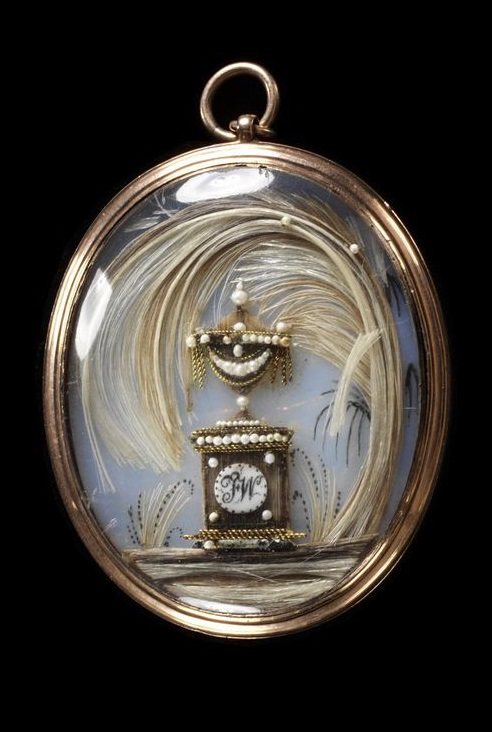
- Memorial pendant for Princess Charlotte, 1817, perhaps painted by Charlotte Jones. Victoria and Albert Museum, London, M.82-1969. Gold, enamel, rock crystal and diamonds, with a miniature of the princess and a small hanging vase holding three curls of her hair, made in the year of her death.
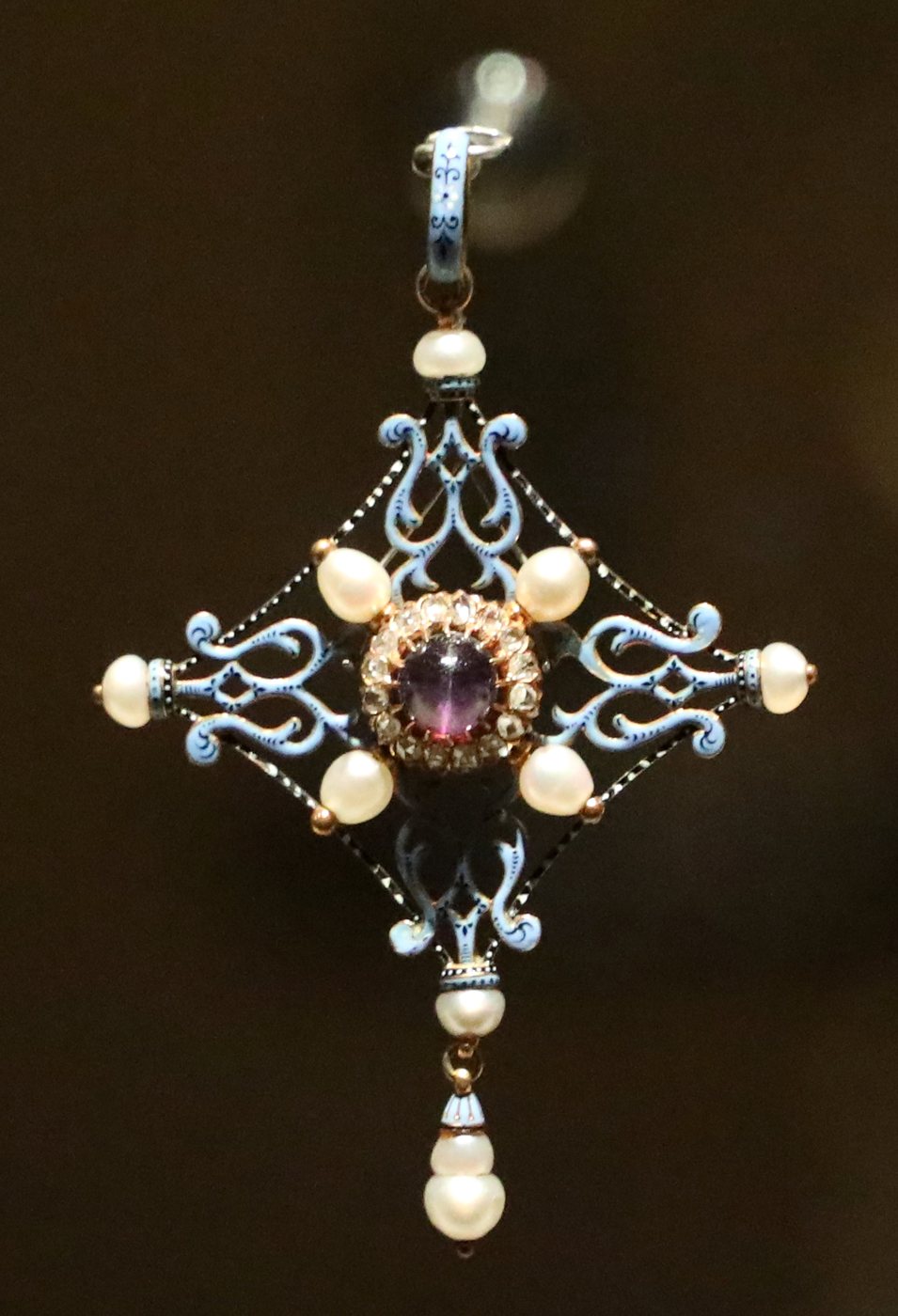
- Vase-shaped pendant, Carlo Giuliano, London, c.1867. Victoria and Albert Museum, London, 164-1900. Enamelled gold set with rubies, diamonds and river pearls, with three pearl drops and a locket compartment at the back - showing how pendant and locket overlap.
- Pendant, Janesich, Paris, c.1925. Victoria and Albert Museum, London, M.74A-1979. Platinum and enamelled gold set with diamonds, carved sapphires, stained chalcedony and jadeite, hung from a ribbon - the Art Deco taste for mixed coloured stones.
Read next
Compare
Pendant vs Necklace: What's the Difference?
Why a pendant and a necklace describe different parts of the same worn ornament, and where the two terms blur together.
Gemstones
Pearls in Jewellery History
Natural pearls from the Gulf and Ceylon, seed-pearl work, Edwardian chokers and ropes, Mikimoto's cultured pearls of the 1910s-20s, imitation pearls, and pearls' bridal and mourning meanings.

Jewellery
What Is a Cameo?
What a cameo is, how it differs from an intaglio, and how carved shell and hardstone cameos moved from Grand Tour souvenirs to mass-produced Victorian jewellery.
Jewellery
What Is a Lavalier Necklace?
What a lavalier necklace is, how its single fine-chain drop defined Edwardian and Belle Epoque style, and how it differs from a plain pendant, negligee necklace or sautoir.
Jewellery
What Is a Locket?
What a locket is, how its hinged compartment was used to hold a photograph, portrait or hair, and how the form evolved from plain Georgian cases to elaborate Victorian mourning lockets.
Jewellery
What Is a Rivière Necklace?
What a riviere necklace is, why its unbroken line of individually set stones made it one of the most enduring necklace forms, and how it differs from a festoon or fringe necklace.