What Is a Posy Ring?
What a posy ring is, why its short engraved verse was often hidden on the inside of the band, and how the form declined from a common love token to a rarer survival by the Victorian era.
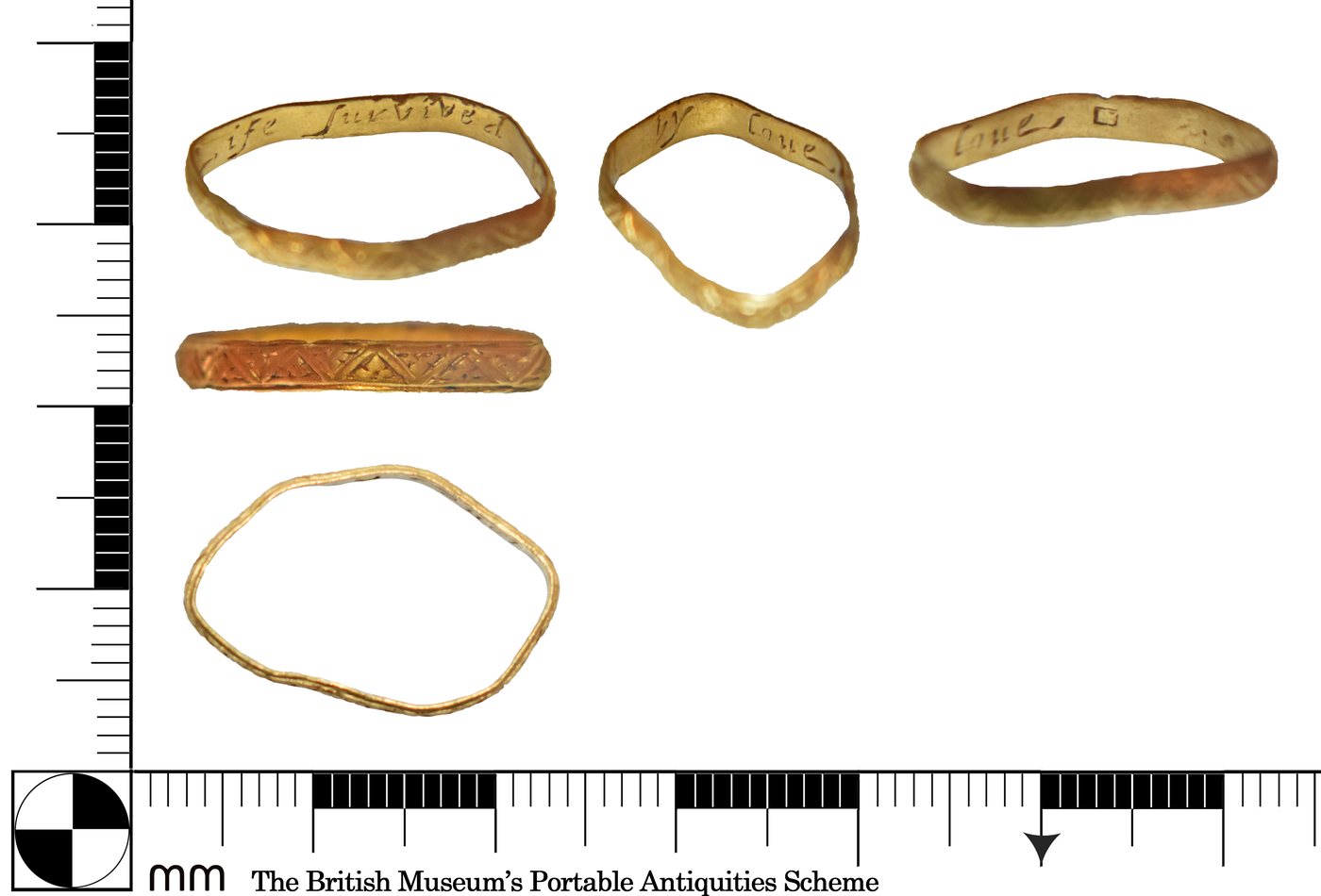
A posy ring is a plain band, usually gold, engraved with a short romantic or sentimental verse - the word “posy” coming from “poesy,” meaning a short poem - most often given as a love token or worn as a betrothal or wedding ring.
What Is a Posy Ring?
A posy ring’s defining feature is its inscription: a brief phrase, motto or rhyming verse, engraved either on the ring’s outer surface or, very often, on the inside of the band, where it would be hidden against the wearer’s finger and known only to the wearer and giver. That inward-facing inscription is one of the form’s most distinctive traits, turning an outwardly plain ring into a private, personal message.
How to Recognise It
Look for a relatively plain, unadorned band, usually in gold, with an engraved inscription running around the inside or outside surface; the lettering is typically in a period-appropriate script, and the verse itself is usually short enough to fit the band’s limited circumference - a line or two rather than an extended text. The ring’s simplicity is itself a clue, since posy rings generally relied on their inscription rather than gemstones or elaborate goldwork for their meaning.
When Was It Worn?
Posy rings were worn as everyday jewellery once given, most commonly as a betrothal or wedding ring, or simply as a token of affection between friends or family, with their popularity strongest from the medieval and Renaissance periods through the 18th century.
Origins
The posy ring has much older roots than most jewellery covered in depth here - engraved verse rings are documented from the medieval period, and the custom was already well established by the Renaissance, when giving a ring engraved with a motto was a recognised way to seal a betrothal or express affection. By the period this site focuses on, the posy ring was a long-established, rather than a new, tradition.
How It Changed Over Time
Posy rings remained a common form of betrothal and love-token ring well into the 18th century, continuing a tradition already centuries old. Through the Georgian period, the custom gradually gave ground to jewellery that expressed sentiment through gemstones instead of text - acrostic rings, in which the first letters of a sequence of stones spelled a word such as “regard” or “dearest,” and mourning rings inscribed with a name and date rather than a verse. By the Victorian period, the plain engraved posy ring was considerably less common than it had been, though the underlying custom of engraving a personal inscription inside a ring band never entirely disappeared and can still be found on rings from throughout the 19th century.
Materials
Gold was the standard material for posy rings, reflecting their role as a meaningful personal gift rather than an everyday accessory; silver examples exist but are less typical of the form at its most fashionable.
Construction
A posy ring is typically a simple band, sometimes flattened slightly on the inside to provide a smoother surface for engraving, with the verse cut by hand using a graver. Because the inscription was often meant to be private, the engraving is frequently found on the inner surface of the band rather than the outer face.
How It Was Worn
Worn on the finger as an ordinary ring, with its sentimental meaning conveyed privately through the hidden inscription rather than through outward display, in contrast to more visibly symbolic Georgian and Victorian sentimental jewellery.
Who Wore It?
Posy rings were exchanged between couples and given as tokens of affection more broadly, worn by both men and women depending on the specific relationship and occasion marked by the gift.
Notable Variations
- Betrothal posy ring - given specifically to mark an engagement or promise of marriage.
- Friendship posy ring - inscribed with a verse of affection or loyalty rather than romantic love specifically.
- Mourning posy-style ring - a later, related form using a short inscribed name or verse for memorial rather than romantic purposes; see Mourning Rings.
Terminology
“Posy” and the older spelling “poesy” both refer to the short verse itself rather than to the ring’s shape or material, and the term is sometimes written “posey” in period and antiquarian sources.
Similar Jewellery
Posy rings are sometimes confused with plain wedding bands that carry no inscription at all, or with later mourning and acrostic rings that use text or stones for a different sentimental purpose; checking for an engraved verse, and reading it where legible, is the clearest way to identify a true posy ring.
Examples in Museum Collections
- Gold ring inscribed “No joy in life to a uerteous wife”, English, early 18th century. Victoria and Albert Museum, London, M.94-1960. A plain band whose only decoration is its marriage motto.
- Gold ring inscribed “MB / remember, the (heart) that.is.in.payne.”, English, 17th century. Victoria and Albert Museum, London, 910-1871. The verse and initials are on the inside of the hoop, where only the wearer would see them.
- Gold ring inscribed “TIME. DEVM. ME. AMA. QD.”, 17th century. Victoria and Albert Museum, London, 904-1871. Chased and inscribed inside with a Latin motto meaning “Fear God, love me” and the couple’s initials. The museum identifies it as both a posy ring and a wedding ring, and explains how posies were often chosen from published collections of verses.
Read next
Compare
Georgian vs Victorian Jewellery
How Georgian and Victorian jewellery differ in settings, techniques and motifs, and why Victorian jewellery itself spans several distinct phases.
Compare
Posy Ring vs Regard Ring: What's the Difference?
How the Georgian posy ring's engraved verse differs from the regard ring's acrostic sequence of gemstones, and why both count as hidden-message jewellery.

Eras
Georgian Jewellery
A guide to Georgian jewellery (1714-1837): Brazilian diamonds, closed-back foiled settings, rococo and Neoclassical styles, paste, cut steel and pinchbeck, sentimental miniatures, girandoles, rivières and Sévigné bows.
Materials
Gold in Historical Jewellery
How gold standards, supply, colour and working methods changed from Georgian to 1940s jewellery - the 1854 standards, the gold rushes, bloomed and coloured gold, rolled gold - and gold's imitations.
Mourning & Sentimental
What Is a Mourning Ring?
What a mourning ring is, the custom of bequeathing them in wills from Shakespeare to Pepys, enamelled name-and-date inscriptions, and how their design changed from 1650 to the Victorian period.

Symbols
Heart Jewellery Through History
The heart in jewellery from 1700 to 1950: crowned hearts, Scottish luckenbooth brooches, Sacred Heart pendants, padlock-and-key pendants, Claddagh rings and wartime sweetheart brooches.