Jewellery in the 1930s
A guide to 1930s jewellery: all-white diamond and platinum, dress clips and double clips, Van Cleef & Arpels' Mystery Set, Belperron and Boivin, Chanel and Schiaparelli, Hollywood, Bakelite and marcasite, and the move towards Retro.
Jewellery in the 1930s softened Art Deco’s strict geometry into bolder, more sculptural forms, while the Depression-era economy pushed a new kind of jewellery - openly artificial costume jewellery, worn without embarrassment - into the mainstream for the first time.
Overview
The Art Deco style did not end abruptly; rather, its sharp geometric lines gradually relaxed through the early 1930s into rounder, more three-dimensional and sculptural forms, a transitional style often called Retro or Retro Modern that would fully mature in the following decade. At the same time, the 1929 financial crash and the Depression that followed reshaped who bought jewellery and what they bought, accelerating the growth of costume jewellery as a legitimate, fashionable category rather than a poor imitation of fine jewellery.
From Art Deco to Retro
Compared with the strict bilateral symmetry of the 1920s, 1930s jewellery increasingly favoured curved, scrolled and ribbon-like forms with a more solid, three-dimensional presence - sometimes described as a “Machine Age” sculptural quality, echoing contemporary industrial design and automotive styling rather than Art Deco’s flatter, more graphic patterning.
White Jewellery and the Clip
In the early 1930s, fine jewellery was dominated by an all-white look: diamonds set in platinum, often with rock crystal or frosted crystal, in bold geometric or scrolled shapes. Long sautoirs gave way to shorter necklaces and to the clip, a brooch held by a hinged, sprung back that gripped the edge of a neckline, lapel, belt or hat. Pairs of clips designed to fit together as a single brooch - the double clip - were made by almost every major house; Coro’s patented “Duette” brought the same idea to costume jewellery. Bracelets were wide and flexible, and the cocktail ring, with a large central stone, became a fixture of evening dress.
The Great Designers
- Van Cleef & Arpels filed a patent for its “Mystery Set” technique in 1933, setting rubies and sapphires on hidden rails so that no metal shows between the stones.
- Suzanne Belperron, who joined the Paris firm of Bernard Herz in 1932, designed bold, sculptural jewels in gold, chalcedony and rock crystal that anticipated the Retro style.
- René Boivin, run after its founder’s death by his widow Jeanne Boivin, made sculptural gold jewellery with animals, shells and flowers.
- Coco Chanel, best known for costume jewellery, presented a collection of real diamond jewellery, Bijoux de Diamants, in 1932.
- In the United States, Paul Flato and others made witty, colourful jewellery for a fashionable New York and Hollywood clientele.
Hollywood and Surrealism
Films spread jewellery fashions to a mass audience. Studios needed jewellery that photographed well, and Joseff of Hollywood supplied costume pieces to the major studios from the 1930s, later selling versions to the public. In Paris, the couturier Elsa Schiaparelli commissioned surreal, playful costume jewellery - insects, buttons in odd shapes, transparent plastic necklaces - from designers including Jean Schlumberger and Jean Clément, showing that costume jewellery could be wittier than fine jewellery.
The Rise of Costume Jewellery
Reduced spending power made fine jewellery a harder purchase for many households, and manufacturers responded with well-designed, openly non-precious jewellery marketed on style rather than intrinsic material value. American firms such as Trifari and Coro, among others, built substantial businesses on this basis through the decade, and prominent designers including Coco Chanel had already begun encouraging fashionable women to wear costume jewellery openly earlier in the century, removing much of the stigma that had previously attached to visibly artificial materials.
Bakelite and Other Plastics
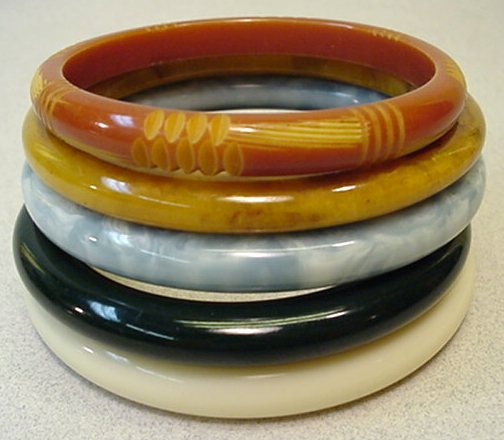
Bakelite and related early plastics, mouldable into bold colours and forms, became a popular jewellery material in this decade - bangles, clip brooches and novelty pieces in butterscotch, cherry-red and other saturated colours are among the most recognisable costume jewellery of the period, and remain widely collected today independent of their originally low cost.
Marcasite and Chrome
Silver set with marcasite - small faceted pieces of pyrite - was one of the most popular inexpensive jewellery types of the decade, especially in Britain, France and Germany, in brooches, clips and watch bracelets with Art Deco and Retro outlines. Chrome-plated metal, enamel and plastics gave other costume jewellery a streamlined, machine-made look.
Gemstones and Synthetic Stones
Large, boldly coloured stones - citrine, aquamarine, amethyst and topaz - set in generous, sculptural mounts were fashionable in both fine and costume jewellery, often in what would later be called “cocktail ring” styles. Synthetic corundum (created ruby and sapphire, produced commercially by the Verneuil flame-fusion process, developed around the turn of the century and well established by the 1930s) was also increasingly used, in fine jewellery as well as costume pieces, offering the visual effect of a fine coloured gemstone at a fraction of the cost.
Materials
Yellow and rose gold remained standard for fine jewellery, while platinum continued in use for the most formal pieces, though its dominance would be interrupted in the following decade by wartime metal restrictions. Costume jewellery of the period used gilt base metal, rhodium-plated white metal, glass paste stones and Bakelite alongside genuine, if inexpensive, semi-precious stones.
How to Recognise 1930s Jewellery
Sculptural, rounded, three-dimensional forms rather than flat Art Deco geometry; large single coloured stones or synthetic gems in bold mounts; and confidently non-precious costume pieces in Bakelite or base metal, sold and worn as fashion rather than as an imitation of fine jewellery, are all characteristic of the decade.
Transition to the 1940s
The sculptural, curved direction jewellery had taken by the late 1930s intensified through the 1940s, when wartime conditions would further reshape which materials were available and how jewellery was worn.
Read next

Eras
Jewellery in the 1940s
A guide to 1940s jewellery: wartime platinum bans and the rose-gold Retro style, Cartier's caged bird, Van Cleef & Arpels and Verdura in New York, American costume jewellery in sterling and Lucite, British Utility rings, sweetheart badges and the New Look.

Eras
A Guide to Jewellery Through History
A chronological guide to jewellery history from the Georgian era to the 1940s - how style, materials and meaning changed decade by decade across Britain, France and the United States.

Eras
Art Deco Jewellery
A guide to Art Deco jewellery (c.1915-1935): geometric symmetry, the 1925 Paris Exposition, Cartier's Tutti Frutti and Van Cleef & Arpels' Mystery Set, the modernist jewellers, new stone cuts, Egyptian and Indian influences, and costume jewellery.

Jewellery
What Is a Tiara?
What a tiara is, how it differs from a full diadem, and how bandeau and convertible tiara styles developed alongside aristocratic and fashionable wear.
Materials
Gold in Historical Jewellery
How gold standards, supply, colour and working methods changed from Georgian to 1940s jewellery - the 1854 standards, the gold rushes, bloomed and coloured gold, rolled gold - and gold's imitations.

Materials
What Is Paste Jewellery?
What paste jewellery is, from English lead glass and Georges Frédéric Strass in Paris to foiled closed settings, black-dot culets and later Bohemian stones, and why fine paste is collected today.