Jewellery in the 1940s
A guide to 1940s jewellery: wartime platinum bans and the rose-gold Retro style, Cartier's caged bird, Van Cleef & Arpels and Verdura in New York, American costume jewellery in sterling and Lucite, British Utility rings, sweetheart badges and the New Look.
Jewellery in the 1940s was shaped above all by the Second World War. Platinum was requisitioned for the war effort, base metals were restricted, and many European workshops closed or relocated. Out of these shortages came the bold, sculptural gold jewellery now called the Retro style, a boom in American costume jewellery, and a distinctive body of wartime sentimental jewellery.

Overview
The sculptural direction jewellery had taken in the later 1930s intensified into large, three-dimensional pieces in yellow and rose gold - scrolls, ribbons, bows, fans and flowers - often set with big coloured stones rather than diamonds. The centre of the luxury trade shifted partly from Paris to New York, where several French houses and émigré designers spent the war. After 1945, materials returned slowly, and by the end of the decade Christian Dior’s New Look of 1947 was steering fashion back towards femininity, parures and glitter.
Wartime Restrictions on Metals
Platinum was classified as a strategic metal in the United States, Britain and elsewhere and was effectively unavailable for civilian jewellery for most of the war. Jewellers turned to gold, and the alloys they chose gave the period its look: rose gold, rich in copper, and two- or three-colour combinations of rose, yellow and green gold.
In the United States, the War Production Board restricted the use of base metals such as brass and nickel from 1942. Costume jewellery makers switched to sterling silver, frequently gold-plated (vermeil), which is why so much American costume jewellery of 1942-45 is marked “Sterling”.
In Britain, the manufacture of jewellery for the home market was severely restricted, and new jewellery was scarce and heavily taxed. Wedding rings were made under the government’s Utility scheme as plain 9 carat gold bands of regulated weight. A great deal of 1940s British jewellery was therefore remade from older pieces or bought second-hand.
The Retro Style
Retro jewellery favoured scale and volume: wide scrolled and ribbon brooches, “tank-track” and gas-pipe (tubular link) bracelets, chunky bombé rings, and large clips worn on lapels and hats. Settings were frequently stepped or curved, with small calibré stones or tiny rubies used as accents. The main stones were large and relatively inexpensive - citrine, aquamarine, amethyst and topaz - together with synthetic rubies and sapphires, which by this date were cheap and widely accepted. See Natural vs Synthetic Gemstones.
The Great Houses in Wartime
- Cartier. In Paris, Cartier, under its creative director Jeanne Toussaint, showed a brooch of a bird in a cage in 1942, read as a comment on the occupation of France, followed after the Liberation by a bird singing in an open cage.
- Van Cleef & Arpels. The firm established itself in New York from 1939, opening a permanent Fifth Avenue shop in the early 1940s. Its brooches of ballerinas and fairies, set with rubies, emeralds and diamonds, became one of the signature designs of the decade.
- Verdura. Fulco di Verdura, who had designed jewellery for Chanel in Paris, opened his own New York salon in 1939, known for bold gold pieces set with coloured stones and shells.
- Suzanne Belperron and René Boivin in Paris worked in sculptural gold and carved hardstone, anticipating and influencing the Retro taste.
American Costume Jewellery
The 1940s were a golden age for American costume jewellery, designed for a mass market and promoted through films and magazines.
- Trifari produced the “jelly belly” brooches designed by Alfred Philippe - animals and insects with clear Lucite bodies - alongside sterling vermeil patriotic pieces.
- Coro was one of the largest producers, known for its “Duette” clip-brooches, which separated into two clips like the double-clip brooches of fine jewellery.
- Miriam Haskell made hand-wired pieces of glass beads and imitation seed pearls.
- Joseff of Hollywood supplied jewellery to the film studios and sold versions to the public.
For the materials, see Paste vs Rhinestone and Glass in Historical Jewellery.
Sweetheart Jewellery
The war produced a large body of sentimental jewellery known as sweetheart jewellery: brooches, pins, lockets and bracelets showing regimental or service badges, wings, ships, flags, eagles and V-for-victory symbols. They were given by servicemen to wives, girlfriends and mothers, or bought by women at home as a visible sign of support. In Britain, small silver and enamel versions of RAF wings and regimental badges are common; in America, sterling and enamel flags and eagles. These pieces can usually be dated closely by the units, ships or events they commemorate. They sit in a long tradition of sentimental jewellery, worn openly rather than in mourning.
After the War
Platinum returned to civilian use in the later 1940s, and diamonds came back into fashion. Dior’s New Look, launched in February 1947, with its full skirts and tiny waists, favoured jewellery that was lighter and more decorative than the Retro style: clusters, sprays, earrings worn close to the face, and costume parures of rhinestones and imitation pearls. By 1950 Retro had given way to the more delicate mid-century style.
How to Recognise 1940s Jewellery
- Large, sculptural brooches and clips in rose or yellow gold, often with two or three gold colours.
- Big citrines, aquamarines, amethysts or synthetic rubies and sapphires, with diamonds used sparingly or in small accents.
- Tubular, tank-track or heavy curb bracelets.
- American costume jewellery stamped “Sterling”, often gold-plated.
- Patriotic and service motifs, datable by their insignia.
Read next
Eras
Jewellery in the 1930s
A guide to 1930s jewellery: all-white diamond and platinum, dress clips and double clips, Van Cleef & Arpels' Mystery Set, Belperron and Boivin, Chanel and Schiaparelli, Hollywood, Bakelite and marcasite, and the move towards Retro.

Eras
A Guide to Jewellery Through History
A chronological guide to jewellery history from the Georgian era to the 1940s - how style, materials and meaning changed decade by decade across Britain, France and the United States.

Eras
Art Deco Jewellery
A guide to Art Deco jewellery (c.1915-1935): geometric symmetry, the 1925 Paris Exposition, Cartier's Tutti Frutti and Van Cleef & Arpels' Mystery Set, the modernist jewellers, new stone cuts, Egyptian and Indian influences, and costume jewellery.
Jewellery
What Is a Rivière Necklace?
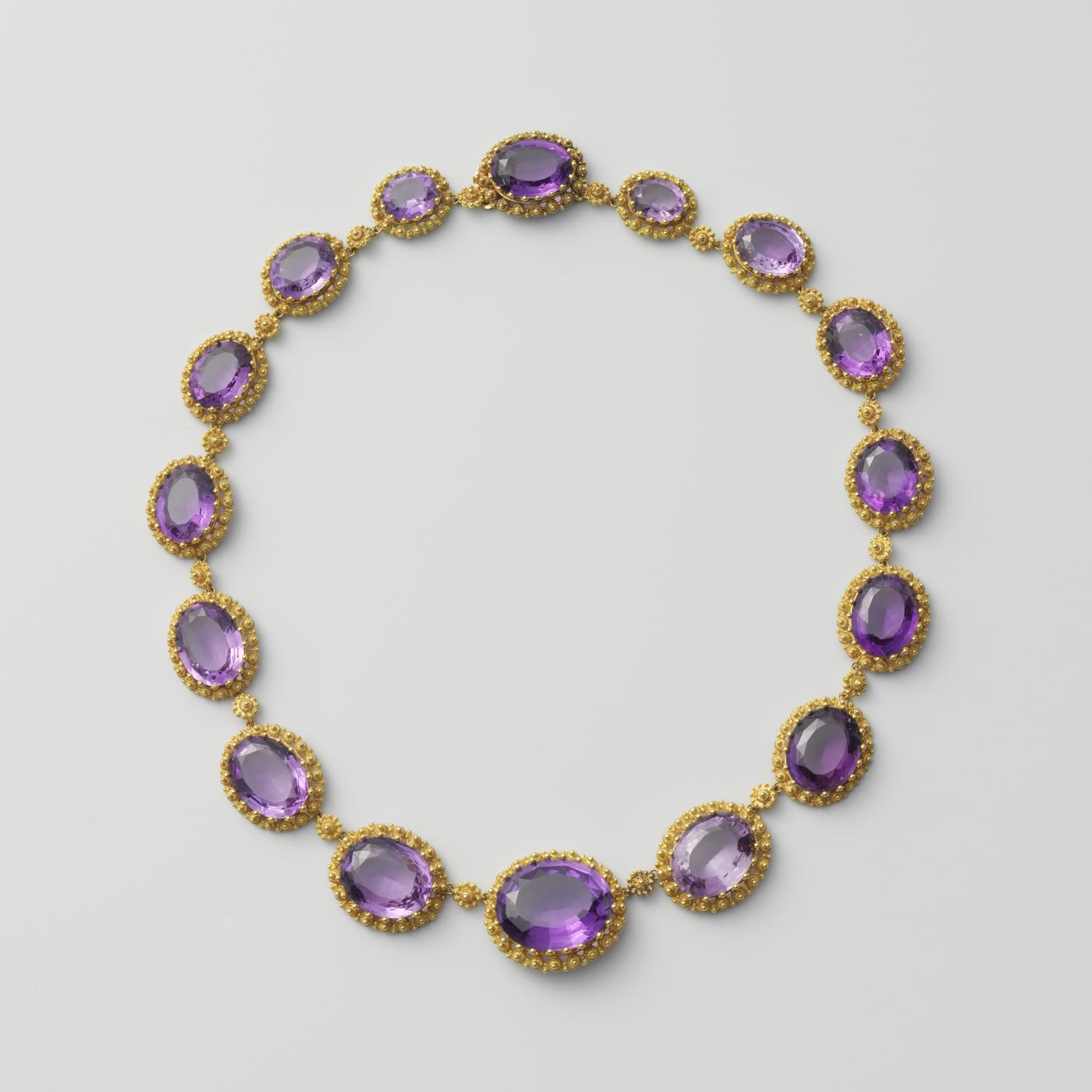
What a riviere necklace is, why its unbroken line of individually set stones made it one of the most enduring necklace forms, and how it differs from a festoon or fringe necklace.
Materials
Gold in Historical Jewellery
How gold standards, supply, colour and working methods changed from Georgian to 1940s jewellery - the 1854 standards, the gold rushes, bloomed and coloured gold, rolled gold - and gold's imitations.

Materials
A History of Costume Jewellery
How costume jewellery grew from Georgian paste and pinchbeck into a fashion industry: Chanel and Schiaparelli, Trifari, Coro, Miriam Haskell and Eisenberg, Swarovski crystal, wartime sterling, and how to recognise and date costume pieces.