Glass in Historical Jewellery
The roles of glass in jewellery 1700-1950: paste, Tassie's glass gems, French jet, Venetian and Bohemian beads, micromosaic, Lalique and pâte de verre - and why glass is not simply a synonym for fake.
Glass has played several distinct roles in historical jewellery, from a deliberate, skilfully worked imitation of gemstones and organic materials to a respected decorative material in its own right.
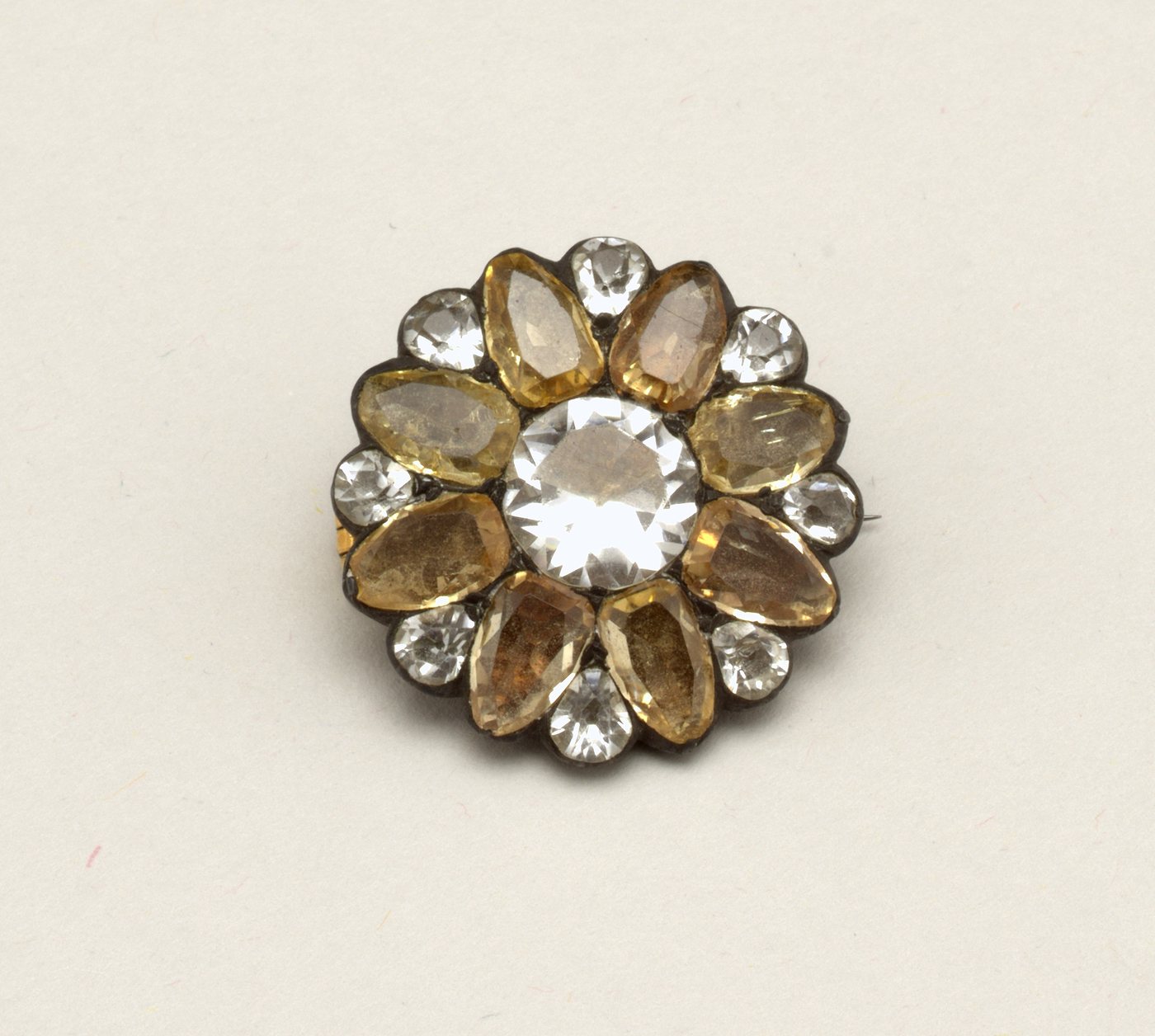
Glass as Imitation: Paste
The best-known jewellery use of glass is as paste, a specially formulated, dense lead glass cut and often foil-backed to imitate the brilliance and colour of diamonds and coloured gemstones. Fine 18th and 19th-century paste was cut and set with real skill, sometimes by jewellers working across both genuine gemstones and paste, and good period paste is collected and valued in its own right today rather than dismissed purely as a cheap substitute. See Paste for more on how paste jewellery was made and how it compares to genuine gemstones.
Glass Gems: Tassie and the Cast Intaglio
A different kind of imitation copied engraved gems rather than faceted stones. James Tassie (1735-1799), a Glasgow-born modeller who settled in London in 1766, perfected a hard white glass paste, developed with the Dublin physician Henry Quin, from which he cast copies of ancient and modern cameos and intaglios. Tassie’s casts were set in rings and fob seals and sold to collectors as study sets; in 1791 the scholar Rudolf Erich Raspe published a catalogue of his collection running to many thousands of casts. Coloured glass intaglios imitating carnelian, amethyst and sardonyx were also widely used in 18th and early 19th-century seals and rings.
Glass as Imitation: Black Glass and “French Jet”
Glass also served as a close imitation of jet, the dense black organic gemstone material fashionable in mourning jewellery. Black glass, widely if confusingly known as “French jet” despite containing no jet at all, was cut and polished to a glassy brilliance distinct from carved jet’s softer, more resinous sheen, and it was produced in enormous quantities to meet demand that genuine jet’s limited natural supply could not satisfy on its own. Much of it was made in France and Bohemia, and it was cut in facets, moulded into beads and buttons, or sewn onto dresses and bonnets as trimming. See Jet for more on how black glass and other jet imitations compare to genuine jet.
Glass as Decorative Material: Beads and Art Glass
Beyond imitation, glass was also moulded, pressed and worked into beads, cabochons and decorative elements valued for glass’s own qualities - its colour, translucency and the range of effects achievable through moulding and pressing.
- Venice. The glassworks of Murano and Venice made beads for centuries: drawn seed beads, lampwork beads wound on a wire over a flame, and millefiori beads made from slices of patterned glass cane. Venice was also the source of aventurine glass or “goldstone”, a brown glass glittering with copper crystals, used in Victorian brooches and beads.
- Rome. The micromosaic workshops of Rome built pictures from tiny pieces of opaque glass cut from drawn rods; see What Is Micromosaic?.
- Bohemia. In the 19th century the area around Gablonz (Jablonec nad Nisou) became the world centre for pressed glass beads, buttons and imitation stones, made in hand-operated moulds and exported across Europe and America. Bohemian glass dominated costume jewellery into the 1930s.
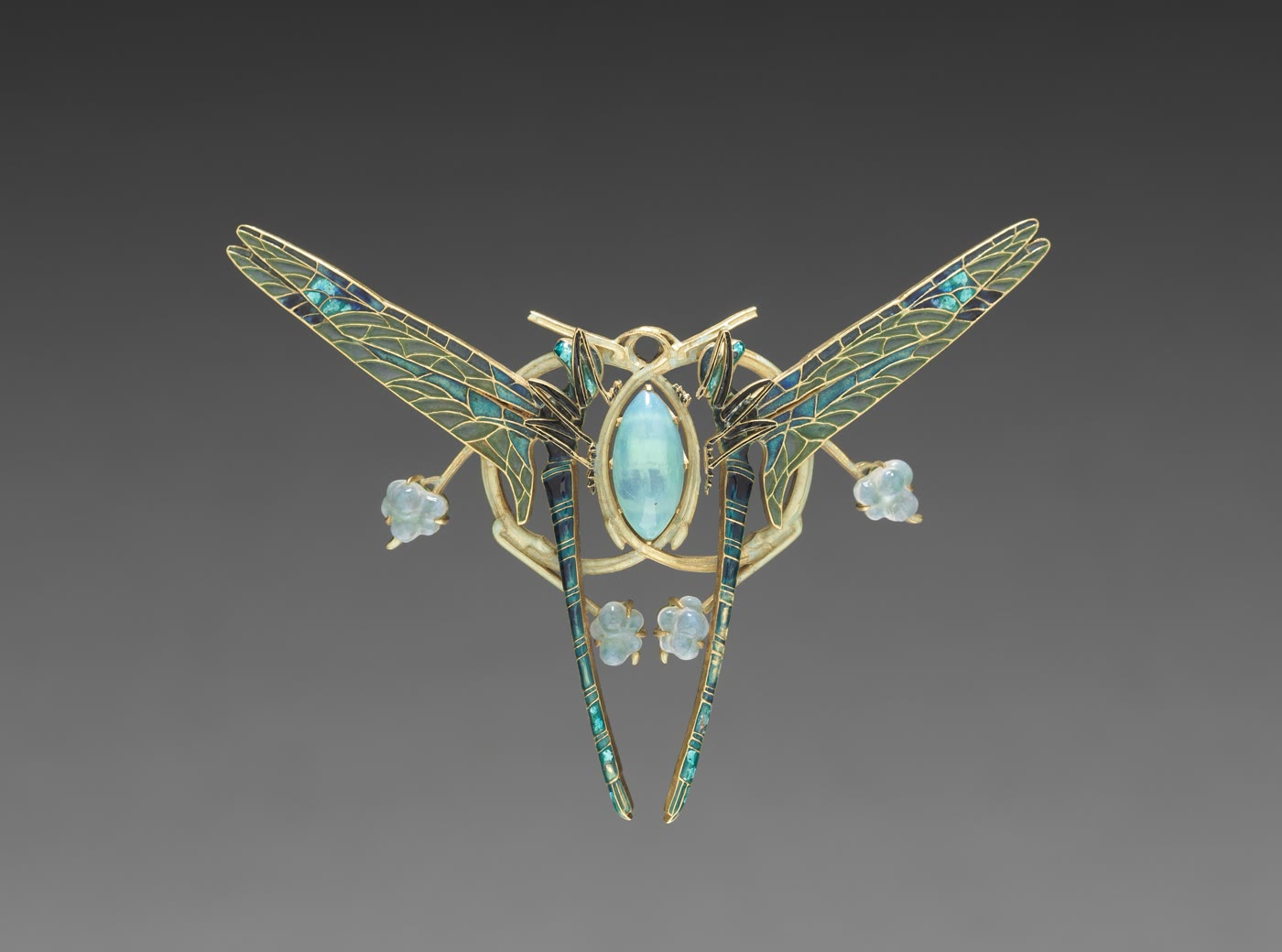
Art glass, produced by makers working with colour, texture and form as ends in themselves, found a place in jewellery from the later 19th century. In Art Nouveau jewellery René Lalique set moulded and carved glass alongside gold, enamel and gemstones in the 1890s and 1900s, and in the 1920s he produced moulded glass pendants in quantity. Gabriel Argy-Rousseau and other French makers made pendants in pâte de verre, a glass paste packed into a mould and fired, which gives soft, translucent colour.
Glass as Enamel
Enamel itself is, at the material level, a form of glass - finely powdered coloured glass fused to a metal surface by firing - making it another, rather different expression of glass in jewellery, one bonded permanently to metal rather than cut, moulded or set as a separate stone-like element. See Enamel in Jewellery for how enamel is made and how its several specific techniques relate to one another.
Glass’s Dual Reputation
Taken together, these several roles give glass a dual reputation in jewellery history. On one hand, glass has long served as a deliberate, honestly marketed lower-cost imitation of gemstones, in paste, and of organic materials, in black glass imitating jet - both produced to let buyers achieve a fashionable look without the cost of the genuine material. On the other hand, glass has also been worked and worn as a respected material in its own right, in fine period paste, in art glass beads and ornaments, and in enamel, where its qualities are valued for themselves rather than in comparison to something else. Glass is best understood as this broader, dual-purpose material family, rather than as a synonym for “fake” or “cheap.”
How to Recognise Glass Jewellery
Glass elements in jewellery are generally colder to the touch than organic materials like jet or amber and can show mould seams, air bubbles, or a slightly different weight than the material they may be imitating, along with a harder, more resonant sound when gently tapped. Foiled paste stones can show tarnishing or degradation of the foil backing if moisture has reached it over time. These are useful general observations rather than certain proof, and confirming what a given glass element is imitating, if anything, and how it was made generally benefits from examination by a specialist.
Frequently Asked Questions
Does “glass” always mean a piece is an imitation? No - while glass was widely used to imitate gemstones and jet, it was also worked and worn as a respected decorative material in its own right, in fine paste, art glass and enamel.
How can I tell paste from black glass imitating jet? The two are used for different colours and effects - paste generally imitates diamonds and coloured gemstones with faceted, often foil-backed cuts, while black glass imitates jet’s dark, matte-to-glossy black - so the intended material being imitated, along with weight, temperature and surface characteristics, usually points to which is which; a specialist can confirm this with more certainty than visual inspection alone.
Read next
Compare
Paste vs Rhinestone: What's the Difference?
Why paste and rhinestone describe glass simulants from different periods and manufacturing contexts, and why the two words are nonetheless often used interchangeably today.

Eras
Art Nouveau Jewellery
A guide to Art Nouveau jewellery (c.1890-1910): René Lalique and Gulbenkian, Fouquet and Mucha, Vever and Gaillard, plique-à-jour and horn, Jugendstil, Liberty's Cymric range, Tiffany, and the mass-produced silver that spread the style.

Eras
Georgian Jewellery
A guide to Georgian jewellery (1714-1837): Brazilian diamonds, closed-back foiled settings, rococo and Neoclassical styles, paste, cut steel and pinchbeck, sentimental miniatures, girandoles, rivières and Sévigné bows.

Eras
Victorian Jewellery
A guide to Victorian jewellery (1837-1901): the Romantic, Grand and Aesthetic periods, the Great Exhibition, gold rushes and 9ct gold, mourning and Whitby jet, archaeological revival, Scottish jewellery, and how to recognise each phase.
Materials
Enamel in Jewellery
What enamel is, how it was fired, and how cloisonné, champlevé, guilloché, painted enamel and plique-à-jour relate - with the makers and fashions of enamel jewellery from 1700 to the 1930s.

Materials
What Is Jet Jewellery?
What jet is, where it came from - Whitby, Asturias, southern France - its use from the Bronze Age to the Victorian mourning boom, and how to tell genuine jet from vulcanite and French jet.