What Is Micromosaic Jewellery?
How Roman micromosaic was made from smalti filati, its roots in the Vatican Mosaic Studio, the makers who led it, and how it became a Grand Tour souvenir from the 1770s to the 1870s.
Micromosaic jewellery is decorated with extremely small pieces of coloured glass, arranged with great precision into detailed miniature pictures, then set into brooches, pendants, bracelet plaques and other jewellery forms. The technique was developed in Rome in the 1770s and was produced there in quantity until about the 1870s.
What Micromosaic Is Structurally
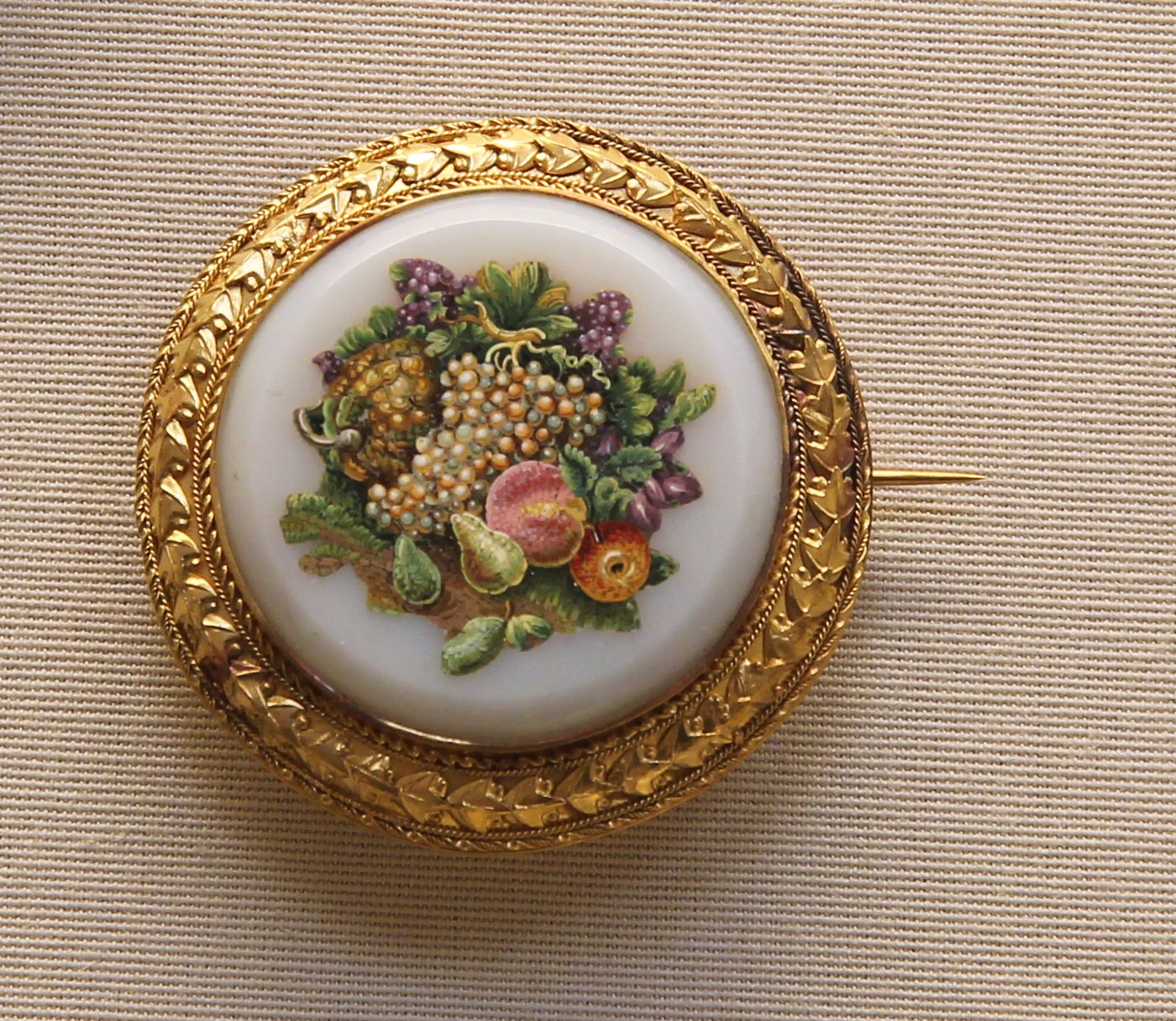
Micromosaic work is built from tiny tesserae - small pieces cut from thin rods of coloured glass known as smalti filati (“spun enamels”), drawn out fine enough to be cut into pieces sometimes barely visible as individual units to the naked eye. These glass elements were set, piece by piece, into a prepared bed and packed closely enough together that the finished surface reads as a continuous picture rather than as a visibly tiled mosaic. The finished panel was then polished flat and mounted into a jewellery setting, most often a brooch, pendant, or a plaque within a bracelet or parure.
How Fine Micromosaic Was Made
The process had three stages, and in larger workshops they could be done by different people.
- Making the glass. Opaque coloured glass (smalto) was melted and pulled out while hot into long thin rods or threads, the smalti filati. Rods could be pulled with a round, square or rectangular section, and multicoloured rods could be made by fusing threads of different colours together, which allowed shading within a single tessera. Workshops kept thousands of graded colours.
- Setting. The mosaicist prepared a shallow tray or plaque - usually of glass, stone or metal, black glass and black marble being common - filled with a slow-setting mastic or cement. Short lengths were snapped or cut from the rods with pliers or a small blade and pressed into the mastic one at a time with tweezers, following a drawn or painted design.
- Finishing. Once the mastic had set, small gaps between tesserae were filled with coloured wax, and the surface was ground and polished. Some pieces were left with a slightly uneven surface, and later restorers sometimes refilled or repainted the wax, which can confuse the appearance of old pieces.
The finest pieces show very small, closely fitted tesserae capable of rendering fine detail - shading in a flower petal, or the light on a ruin - within a space no larger than a brooch. Producing the glass and setting it well were separate specialist skills, which kept fine micromosaic a concentrated Roman trade rather than a widely dispersed craft.
Rome as the Centre of Production
The Studio del Mosaico Vaticano employed mosaicists whose main work was copying paintings at full scale. In the 1770s some of them began working at a much smaller scale for private sale. Giacomo Raffaelli (1753-1836) is generally credited with showing the first work in the new miniature technique in his own studio in the mid-1770s; 1775 is the date usually given. Raffaelli went on to a long career, and in the early 19th century moved to Milan, where he made a full-size mosaic copy of Leonardo’s Last Supper commissioned under Napoleon, now in the Minoritenkirche in Vienna.
Other named Roman makers include Antonio Aguatti, Gioacchino Barberi, Michelangelo Barberi, Luigi Moglia and Clemente Ciuli. Signed jewellery is uncommon - most pieces are unsigned - but signed snuffbox plaques and larger panels help attribute the styles of individual workshops. Shops selling micromosaic clustered around the Piazza di Spagna and the Via del Babuino and Via Condotti, the streets where foreign visitors lodged.
In the 1860s the Castellani firm in Rome used micromosaic in a different way, setting it into archaeological-style gold with early Christian and Byzantine motifs and inscriptions rather than tourist views; see Archaeological Revival Jewellery.
Subjects and Motifs
Micromosaic jewellery favoured small pictorial subjects suited to the technique’s scale. Recurring subjects include:
- Roman monuments: the Colosseum, St Peter’s and its square, the Pantheon, the Forum, and the round Temple of Vesta (or of the Sibyl) at Tivoli.
- Pliny’s Doves: a bowl with drinking doves copied from the ancient mosaic found at Hadrian’s Villa in 1737 and displayed in the Capitoline Museums - one of the most repeated designs of all.
- Animals and birds: spaniels and other dogs, goldfinches and parrots, and butterflies.
- Flowers: sprays and baskets of flowers, often on a black or white glass ground.
- Classical figures: dancers and figures copied from Pompeian and Herculaneum wall paintings, which were widely published from the mid-18th century.
Architectural subjects tied the jewellery to the sightseeing of the buyers who purchased it, and a single bracelet might carry a set of plaques showing several monuments.
The Grand Tour Connection
Micromosaic jewellery was a favourite souvenir among wealthy British and Northern European travellers making the Grand Tour - an extended tour of continental Europe, with Italy and Rome as a central destination. The trade was interrupted by the Napoleonic Wars, when British travel to Italy largely stopped, and revived strongly after 1815. Through the 1820s-1860s micromosaic parures, bracelets of linked plaques, and brooches were standard purchases for visitors to Rome, in a period before photography offered an easy alternative. This souvenir trade sustained Roman workshops into the Victorian period.
How It Changed Over Time
- 1770s-1800: Earliest work, mostly on snuffboxes and small plaques, with very fine tesserae.
- c.1800-1840: The peak of quality in jewellery, with Empire- and Regency-style gold mounts and complete parures of linked plaques.
- c.1840-1870: Larger output for the tourist market; quality varies widely, and tesserae on cheaper pieces become noticeably larger.
- After c.1870: Production of fine work declined. In the late 19th and 20th centuries cheaper mosaic jewellery with coarse tesserae was made in quantity, much of it sold in Venice and Florence as well as Rome, often in gilt metal mounts and with simple flower designs.
Recognising Fine Micromosaic
Very small, closely fitted tesserae, with fine gradations of colour used to render detail and shading, are generally associated with the best and often earlier micromosaic work. Coarser, larger tesserae with little colour blending, or jewellery using moulded or pressed glass imitating a mosaic surface rather than individually set tesserae, are generally associated with cheaper or later production. Under magnification, look for tesserae of varying shapes laid in directional rows that follow the forms of the picture, which is characteristic of Roman workshop practice. These are starting points for observation rather than a means of dating or valuing a specific piece - fine and coarse work were both produced across a long period, and quality alone does not fix a date.
Frequently Asked Questions
Is micromosaic the same as pietra dura (hardstone inlay)? No - pietra dura uses shaped pieces of coloured hardstone inlaid to form a picture, while micromosaic uses tiny cut pieces of coloured glass. The two are often confused because both were popular Italian souvenirs - micromosaic from Rome, pietra dura from Florence - but they are materially and technically distinct.
Was all micromosaic jewellery made in Rome? Rome was the dominant centre, though later and cheaper mosaic jewellery was also made and sold elsewhere in Italy; a Roman origin cannot always be confirmed from the piece alone.
Where can I see important collections? The Gilbert Collection, now displayed at the Victoria and Albert Museum in London, includes one of the largest groups of Roman micromosaics, much of it on snuffboxes and table tops as well as jewellery.
Read next
Compare
Cameo vs Micromosaic: Comparing Two Grand Tour Souvenir Jewellery Forms
How the carved cameo and the tiny-tesserae micromosaic differ in construction and materials, despite sharing a well-documented history as Grand Tour souvenirs.

Eras
Georgian Jewellery
A guide to Georgian jewellery (1714-1837): Brazilian diamonds, closed-back foiled settings, rococo and Neoclassical styles, paste, cut steel and pinchbeck, sentimental miniatures, girandoles, rivières and Sévigné bows.

Eras
Victorian Jewellery
A guide to Victorian jewellery (1837-1901): the Romantic, Grand and Aesthetic periods, the Great Exhibition, gold rushes and 9ct gold, mourning and Whitby jet, archaeological revival, Scottish jewellery, and how to recognise each phase.
Jewellery
What Is a Brooch?
What a brooch is, how its pin-and-catch fastening works, and how brooch styles moved from naturalistic Victorian sprays through mourning brooches to Art Deco geometry.

Jewellery
What Is a Cameo?
What a cameo is, how it differs from an intaglio, and how carved shell and hardstone cameos moved from Grand Tour souvenirs to mass-produced Victorian jewellery.
Jewellery
What Is a Pendant?
What a pendant is, how it differs from an integrated necklace centrepiece, and how forms like the locket, lavalier and negligee pendant developed within the broader category.