Cameo vs Micromosaic: Comparing Two Grand Tour Souvenir Jewellery Forms
How the carved cameo and the tiny-tesserae micromosaic differ in construction and materials, despite sharing a well-documented history as Grand Tour souvenirs.
A cameo and a piece of micromosaic jewellery are both well-documented Grand Tour souvenirs, bought in large numbers by wealthy travellers passing through Italy in the 18th and 19th centuries - but the two are built by entirely different means, one carved from a single piece of layered material and the other assembled from hundreds or thousands of individual glass pieces.
Short Answer
A cameo is a single piece of shell or hardstone, carved in relief so the design stands proud of a contrasting background. Micromosaic jewellery is built from many tiny individual pieces of coloured glass, called tesserae, set closely together into a picture. Both were popular souvenir forms sold to Grand Tour travellers, especially in Italy, but they are materially and technically unrelated crafts.
What Is a Cameo?
A cameo is a carved image, usually a portrait profile or figural scene, raised in relief from a background of contrasting colour, most commonly carved from layered shell or a banded hardstone such as sardonyx or agate. Cameo jewellery became especially fashionable from the mid-18th century, boosted substantially by the Grand Tour and by Napoleon Bonaparte’s own enthusiasm for the form in the early 19th century, and by the Victorian period improvements in shell carving made cameos widely affordable.
What Is Micromosaic Jewellery?
Micromosaic jewellery is decorated with extremely small pieces of coloured glass, cut from thin rods known as smalti filati and set piece by piece into a prepared ground to form a detailed miniature picture. The craft is strongly associated with Rome specifically, where workshops developed the skill of producing fine mosaic work at jewellery scale from the late 18th century onward, building on the city’s older tradition of large-scale architectural mosaic work.
Key Differences
| Property | Cameo | Micromosaic |
|---|---|---|
| Construction method | Carved in relief from a single piece of material | Assembled from many tiny individual glass tesserae set into a ground |
| Typical materials | Layered shell (helmet or queen conch) or banded hardstone such as sardonyx or agate | Smalti filati - thin rods of coloured glass cut into tiny tesserae |
| Typical imagery | Portrait profiles, classical or mythological figures | Views of Roman ruins and monuments, architectural scenes, flowers, birds |
| Centre of production | No single dominant centre; carved widely, with Italy prominent for hardstone work | Strongly centred on Rome specifically |
| Typical setting forms | Brooch, pendant, ring, earrings, bracelet or parure element | Brooch, pendant, or a plaque within a bracelet or parure |
| Relief vs flat surface | Design stands proud of the background in relief | Finished surface is polished flat, with the picture formed by colour, not relief |
Historical Usage
Both forms owe much of their fashionable status to the same broad phenomenon: the Grand Tour, the extended educational journey through continental Europe, with Italy and Rome a central destination, undertaken by wealthy Northern European and British travellers from the 18th century onward. A carved hardstone or shell cameo depicting a classical subject, and a finely worked micromosaic showing a well-known Roman monument, served the same essential purpose for a returning traveller - a wearable, attractive, and portable memento of a journey, at a time when photography did not yet offer a comparable easy alternative.
Their production histories diverge, though. Cameo carving is an ancient technique, practised in classical Greek and Roman contexts long before 1700 and revived intensively during the Renaissance, so 18th- and 19th-century cameo jewellery continues a craft with a very long prior history. Micromosaic jewellery, by contrast, developed specifically as a late-18th-century adaptation of Rome’s existing large-scale architectural mosaic tradition down to a small, wearable scale, making it a comparatively newer craft than cameo carving by the time both were popular Grand Tour purchases.
Where the Forms Overlap
The clearest overlap between the two is commercial and geographic rather than technical: both were sold heavily to the same class of traveller, in many of the same Italian cities, often through the same shops, and both appear in the same range of jewellery settings - a brooch worn at the neckline, a pendant, or a plaque set into a bracelet or parure. A single suite of Grand Tour souvenir jewellery might well combine both forms across different pieces. It is worth noting that a related third technique, pietra dura (hardstone inlay), is sometimes confused with micromosaic because it was another popular Italian souvenir craft using small shaped pieces to form a picture - but pietra dura uses cut hardstone rather than glass tesserae, and is distinct from both cameo carving and micromosaic work. Examining the piece closely is the reliable way to tell all of these apart: a cameo shows carved relief and, under magnification, tool marks in a single material, while a micromosaic shows a flat, polished surface built from a great many individually placed glass pieces.
Related Reading
For the fuller entries on each, see What Is a Cameo? and What Is Micromosaic Jewellery?. For a related distinction within carved gem jewellery, see Cameo vs Intaglio.
Read next
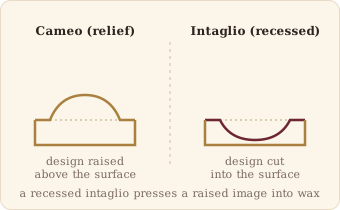
Compare
Cameo vs Intaglio: What's the Difference?
The structural difference between a cameo, carved in relief, and an intaglio, carved into the surface - and why that difference mattered for seals.

Eras
Georgian Jewellery
A guide to Georgian jewellery (1714-1837): Brazilian diamonds, closed-back foiled settings, rococo and Neoclassical styles, paste, cut steel and pinchbeck, sentimental miniatures, girandoles, rivières and Sévigné bows.

Eras
Victorian Jewellery
A guide to Victorian jewellery (1837-1901): the Romantic, Grand and Aesthetic periods, the Great Exhibition, gold rushes and 9ct gold, mourning and Whitby jet, archaeological revival, Scottish jewellery, and how to recognise each phase.
Jewellery
What Is a Brooch?
What a brooch is, how its pin-and-catch fastening works, and how brooch styles moved from naturalistic Victorian sprays through mourning brooches to Art Deco geometry.

Jewellery
What Is a Cameo?
What a cameo is, how it differs from an intaglio, and how carved shell and hardstone cameos moved from Grand Tour souvenirs to mass-produced Victorian jewellery.
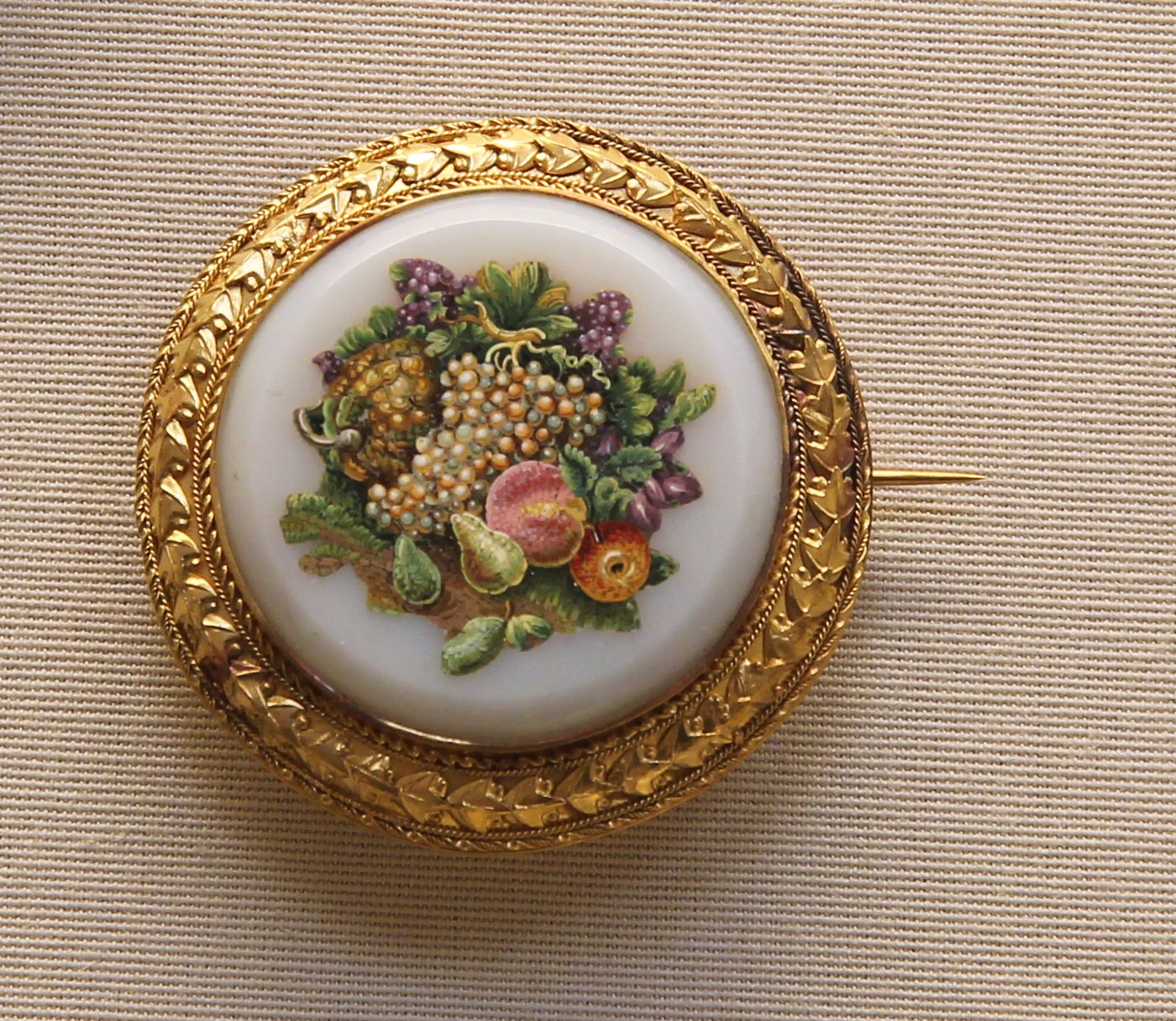
Techniques
What Is Micromosaic Jewellery?
How Roman micromosaic was made from smalti filati, its roots in the Vatican Mosaic Studio, the makers who led it, and how it became a Grand Tour souvenir from the 1770s to the 1870s.