What Is Pietra Dura Jewellery?
What pietra dura hardstone inlay is, how it was cut and fitted, the Florentine Opificio delle Pietre Dure founded in 1588, 19th-century souvenir brooches, and how it differs from micromosaic.
Pietra dura is an inlay technique, its Italian name meaning “hard stone,” in which precisely cut and fitted pieces of coloured hardstone are assembled like a jigsaw into a picture, typically floral or scenic, and set into a contrasting stone ground. In Florence the technique is called commesso di pietre dure, from the Italian for fitting pieces together.
What Pietra Dura Is Structurally
A pietra dura panel is built from individual pieces of coloured hardstone - agate, chalcedony, lapis lazuli, malachite, jasper and similar materials chosen for their natural colour and pattern - cut and shaped so that each piece fits tightly against its neighbours. These pieces are set into a ground, most often black marble or black slate, which gives a strong contrast against which the coloured inlay reads clearly as a picture. Because the pieces are cut to fit one another exactly, a well-made pietra dura surface shows no grout or cement line between adjacent colours, and the finished panel can be ground and polished flat.
How It Was Made
The Florentine method changed little between the 16th and 19th centuries:
- Design. A painted design (the modello) was traced and divided into the shapes each stone would fill, and paper patterns were cut for each piece.
- Choosing stone. The craftsman picked slices of stone whose natural colour and veining matched the shading needed - a vein in a piece of chalcedony might become the curve of a petal. Choosing stone well was as important as cutting it.
- Cutting. Thin slices of stone were glued to the patterns and cut with a bow saw strung with an iron wire, fed with a paste of abrasive and water. The wire itself did not cut the stone; the abrasive did.
- Fitting. The edges were filed so that each piece tapered slightly towards the back, letting the pieces wedge tightly together. The assembled picture was glued with a mastic of resin and wax, then fixed into a recess in the ground.
- Polishing. The whole surface was ground level and polished with progressively finer abrasives.
For landscapes, Florentine workshops used pietra paesina (“landscape stone”), a limestone from the Arno region whose natural markings resemble ruined towns and hills, so that part of the picture was supplied by the stone itself.
Florence and the Opificio delle Pietre Dure
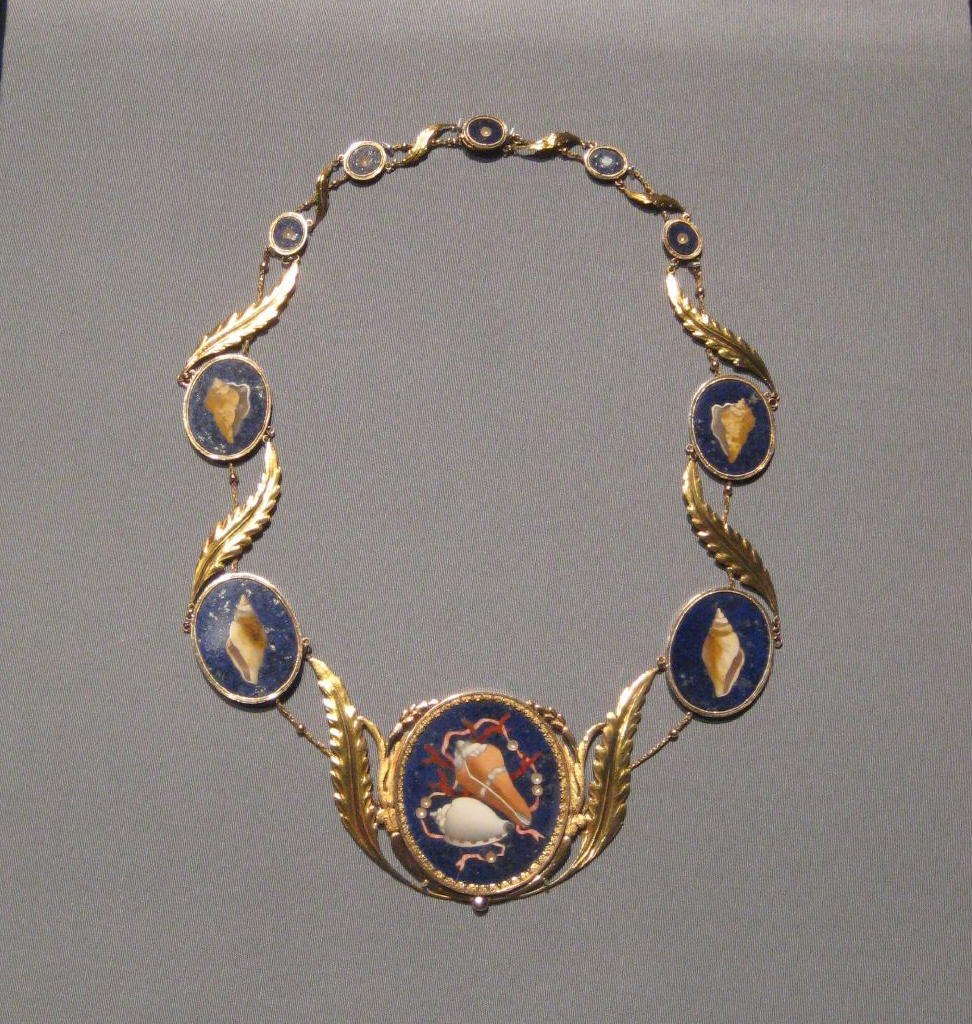
The Florentine court workshop produced table tops, cabinets and panels for the Medici and as diplomatic gifts, and it survived the end of the Medici line in 1737 under the Habsburg-Lorraine grand dukes. In the Napoleonic period hardstone jewellery was made for the Bonaparte family, such as the lapis lazuli necklace shown above, traditionally said to have belonged to Caroline Bonaparte Murat, Queen of Naples; it may have been made in either Florence or Naples, and is now in the Gilbert Collection at the Victoria and Albert Museum. A second royal workshop, the Real Laboratorio delle Pietre Dure in Naples, was founded in the late 1730s by Charles of Bourbon and was initially staffed by craftsmen brought from Florence.
A Grand Tour Souvenir Material
From the early 19th century private workshops in Florence, many of them run by craftsmen trained in the grand-ducal tradition, made small pietra dura plaques for the tourist trade. These were mounted into brooches, pendants, earrings and bracelets, and they became a standard purchase for British visitors to Florence from the 1820s until the later 19th century.
Typical souvenir pieces are:
- Oval or round brooches with a spray of flowers - lily of the valley, forget-me-nots, roses, pansies or fuchsias - on a black ground, often in a gold or silver-gilt mount with a twisted-wire or beaded border.
- Bracelets of linked plaques, each with a different flower, and matching brooch-and-earring sets.
- Birds and butterflies, less common than flowers.
Rome specialised in glass micromosaic, while Florence specialised in hardstone, and travellers often bought both. Some Roman workshops did make hardstone inlay, so a souvenir shop’s location does not prove where a plaque was made. Later 19th- and 20th-century souvenir pieces tend to use fewer, simpler pieces of stone, flatter colours and lighter gilt-metal mounts.
In Britain, a related industry grew up in Derbyshire, where black limestone from Ashford-in-the-Water was inlaid with other stones from the mid-18th century, and floral inlay in the Florentine manner became a speciality in the 19th century. Derbyshire inlay was used mainly for tables, paperweights and ornaments, but small brooches were also made.
Pietra Dura Versus Micromosaic
Pietra dura and micromosaic both produce small, detailed pictures - often floral or architectural - mounted into similar jewellery forms, and the two are easily confused at a glance. Micromosaic is built from many tiny pieces of coloured glass (tesserae), packed closely together so the surface reads as a continuous image but remains a mosaic of small separate units. Pietra dura uses far fewer, larger pieces of solid hardstone, each shaped to interlock with its neighbours, producing a smoother, more seamless surface with no tiling even under close inspection.
How to Recognise It
Look for a small number of larger, precisely fitted stone pieces forming the design, with colour and pattern coming from the natural variation of the hardstone rather than from many tiny uniform glass units. Under magnification, a pietra dura surface shows continuous polished stone with a fine, tight seam between adjacent pieces rather than a grid of small tesserae; visible small glass units indicate micromosaic. Translucent stones such as chalcedony, used for petals, often show natural banding and depth that glass does not.
Frequently Asked Questions
Is pietra dura the same as cameo carving? No - a cameo is carved from a single piece of material, typically shell or hardstone, in relief, while pietra dura is an inlay technique assembling multiple separately cut pieces of stone into a flat picture. Both are associated with Italian craftsmanship but are structurally unrelated.
Was all pietra dura made in Florence? Florence is the principal centre, but hardstone inlay was also made in Naples, Rome and elsewhere, and a related British industry existed in Derbyshire. A Florentine origin should not be assumed for every piece without more specific attribution.
Read next

Eras
Victorian Jewellery
A guide to Victorian jewellery (1837-1901): the Romantic, Grand and Aesthetic periods, the Great Exhibition, gold rushes and 9ct gold, mourning and Whitby jet, archaeological revival, Scottish jewellery, and how to recognise each phase.
Jewellery
What Is a Bracelet?
An overview of bracelets as a broad jewellery category, how wrist fashion shifted with sleeve length across the period, and how a bracelet differs from a bangle.
Jewellery
What Is a Brooch?
What a brooch is, how its pin-and-catch fastening works, and how brooch styles moved from naturalistic Victorian sprays through mourning brooches to Art Deco geometry.

Jewellery
What Is a Cameo?
What a cameo is, how it differs from an intaglio, and how carved shell and hardstone cameos moved from Grand Tour souvenirs to mass-produced Victorian jewellery.
Techniques
What Is Micromosaic Jewellery?
How Roman micromosaic was made from smalti filati, its roots in the Vatican Mosaic Studio, the makers who led it, and how it became a Grand Tour souvenir from the 1770s to the 1870s.