Rubies in Historical Jewellery
Ruby's status as a precious gemstone, Burmese rubies from Mogok and darker Siam stones, spinels mistaken for rubies, and the arrival of Verneuil's synthetic ruby from about 1902.
Ruby is the red variety of the mineral corundum, coloured by traces of chromium, and it stands, with diamond, emerald and sapphire, among the traditional precious gemstones that anchored fine jewellery between 1700 and 1950. Its name comes from the Latin ruber, red.
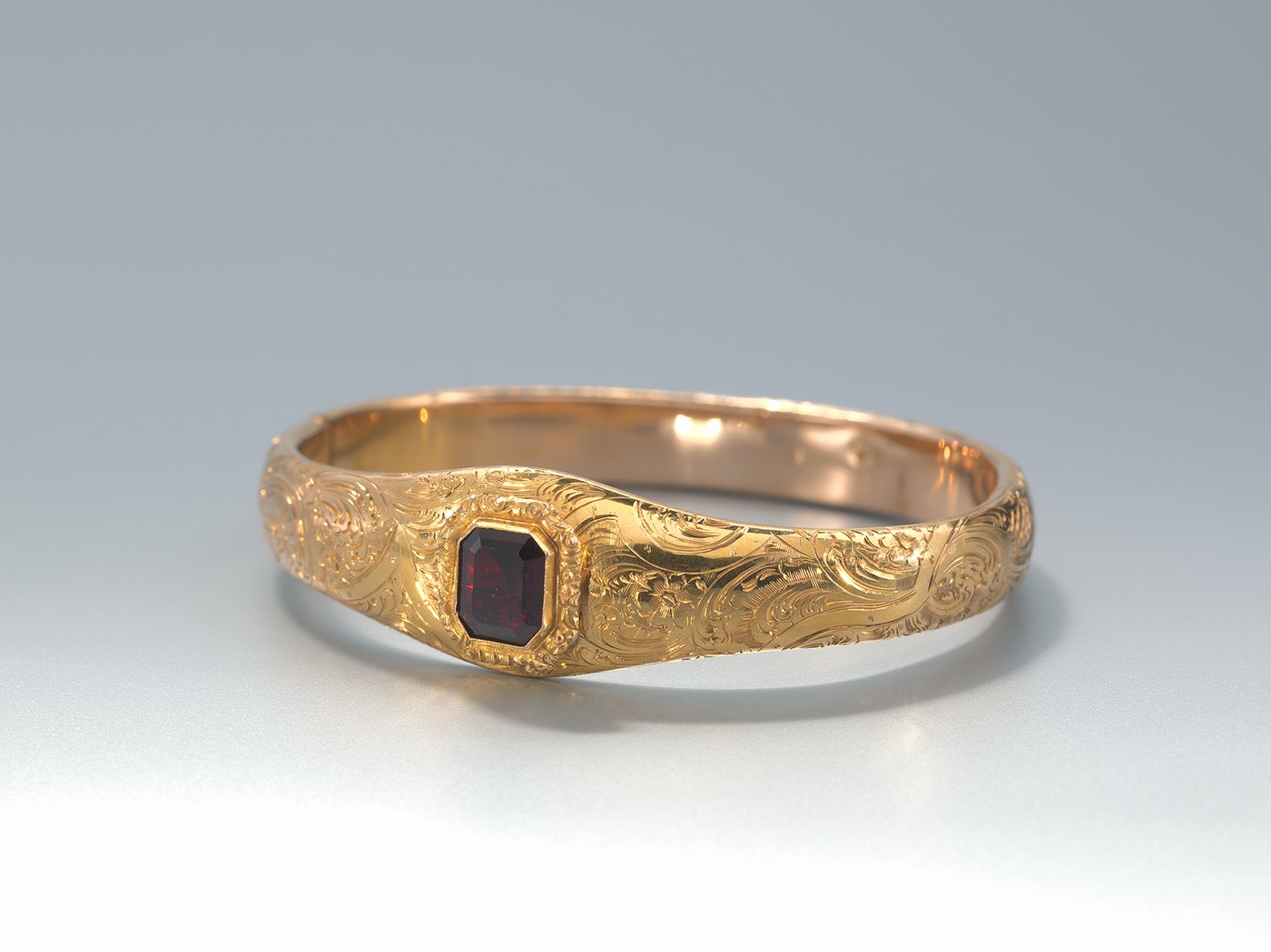
A Long-Prized Precious Stone
Fine ruby’s saturated red has been valued in Western jewellery for centuries, and ruby jewellery appears across the Georgian, Victorian and Edwardian periods, generally as a comparatively rare and costly stone, particularly in larger, well-coloured examples. Large fine rubies are rarer than diamonds of the same size, which has long kept exceptional ruby among the most highly valued of coloured stones. Ruby also supplied two of the six letters in the REGARD acrostic rings and lockets of the early 19th century.
Burmese Rubies from Mogok
The most important source of fine ruby is the Mogok valley in upper Burma (present-day Myanmar), whose mines had been worked for centuries. Under the Burmese kings, large stones found there were reserved for the crown. After Britain annexed Upper Burma in 1885, a London company, Burma Ruby Mines Ltd, was formed in 1889 to work the deposits with modern machinery; it never matched the expectations of its investors and surrendered its lease in 1931, though local mining carried on. Burmese ruby is repeatedly cited in period sources as the standard against which ruby from other localities was judged, and the trade term “pigeon’s blood” was used for the finest, slightly purplish pure red associated with Mogok stones.
Siam Rubies
From the later 19th century a second major source came from the gem fields around Chanthaburi in Siam (Thailand) and across the border at Pailin in Cambodia. Their rubies are typically darker and more brownish or purplish than Burmese stones, because they contain more iron. “Siam ruby” became a common trade description, and much of the ruby in late Victorian and Edwardian jewellery of the middle price range came from these deposits.
Not Every Old “Ruby” Is a Ruby
Until the late 18th century, red spinel and red garnet were often not distinguished from ruby; spinel was sold as “balas ruby”. Several of the most famous historic “rubies” are in fact spinels, including the Black Prince’s Ruby set in the front of the Imperial State Crown, and the Timur Ruby, a large spinel engraved with the names of Mughal emperors, which Queen Victoria had set in a necklace in 1853; both are in the Royal Collection. Once mineralogists had separated the species, spinel continued to be used in jewellery under its own name.
The Arrival of Synthetic Ruby
A significant turning point in the material history of ruby came around the turn of the 20th century. Small synthetic ruby crystals had been grown in Paris by Edmond Frémy in the 1870s, and from the mid-1880s so-called “Geneva rubies”, of uncertain manufacture but now understood to be an early synthetic product, appeared on the market. The decisive step was taken by the French chemist Auguste Verneuil, who developed a flame-fusion process in which powdered alumina with a little chromium oxide is dropped through an oxy-hydrogen flame and builds up, drop by drop, into a pear-shaped crystal or “boule”. Verneuil announced the method in 1902 and published it in full in 1904, and commercial production was under way within a few years. Ruby was the first gem made this way; the same process, with different colouring agents, produced synthetic sapphire and spinel.
The Verneuil process made synthetic ruby widely and inexpensively available for the first time. It was used in watch movements as well as jewellery, and it was not confined to cheap work: a 1913 Cartier bandeau tiara in the Victoria and Albert Museum is set with cabochon synthetic rubies alongside diamonds in platinum. Synthetic corundum went on to be commonly used in both fine and costume jewellery across the following decades, including widely in the jewellery of the 1930s and 1940s.
Jewellery made from the early 20th century using ruby-coloured stones may therefore contain natural or synthetic material, or both across different pieces. This reflects the transformation the Verneuil process brought to the supply of coloured corundum, and is not a comment on the quality or value of a specific piece.
Typical Historical Settings
Georgian and Victorian ruby jewellery typically uses gold mounts, often with closed-back settings in earlier pieces to enhance colour, moving toward open claw settings later in the 19th century. Georgian cluster rings, with a ruby centre surrounded by diamonds set in silver, are a recurring type. Mid-Victorian goldsmiths such as Carlo Giuliano in London set small rubies in enamelled gold in Renaissance revival pendants. By the Edwardian period, fine ruby was also set in platinum, frequently alongside diamonds; it was a less common Edwardian pairing than sapphire but appears in the same general style.
Rubies in Art Deco and Retro Jewellery
In Art Deco jewellery rubies were often used as small calibré stones, cut to fit their settings exactly and set in lines against diamonds and onyx. Cartier’s “Tutti Frutti” pieces combined carved Indian rubies with emeralds and sapphires, and in 1933 Van Cleef & Arpels patented its “Mystery Set”, in which calibré rubies or sapphires slide onto fine gold rails so that no metal shows from the front. In the 1940s, small rubies - natural and synthetic - were a standard accent in Retro gold jewellery, as in Van Cleef & Arpels’ ballerina brooches and in a Verger Frères bangle for Chaumet of 1935-45, now in the Victoria and Albert Museum, which appears sliced open to reveal a core of rubies.
Symbolism
Ruby’s deep red has long carried general associations with passion, vitality and protection across various periods and cultures, associations referenced in period jewellery and gift-giving custom. As with much gemstone symbolism, these meanings reflect popularly repeated sentiment rather than any single fixed or authoritative source.
No claim is made here about determining, from a description or photograph, whether a specific ruby is natural or synthetic - that requires laboratory examination by a qualified gemmologist.
Read next
Compare
Natural vs Synthetic Gemstones: What's the Difference?
The conceptual difference between natural, synthetic and simulant gemstones, and the historical turning point that made synthetic corundum widely available.
Eras
Jewellery in the 1930s
A guide to 1930s jewellery: all-white diamond and platinum, dress clips and double clips, Van Cleef & Arpels' Mystery Set, Belperron and Boivin, Chanel and Schiaparelli, Hollywood, Bakelite and marcasite, and the move towards Retro.

Eras
Jewellery in the 1940s
A guide to 1940s jewellery: wartime platinum bans and the rose-gold Retro style, Cartier's caged bird, Van Cleef & Arpels and Verdura in New York, American costume jewellery in sterling and Lucite, British Utility rings, sweetheart badges and the New Look.
Gemstones
Emeralds in Historical Jewellery
Emerald's status among the precious gemstones, Colombian and Ural sources, Mughal carved emeralds in Art Deco jewels, named royal pieces, oiling, the step cut and the first synthetic emeralds.
Gemstones
Sapphires in Historical Jewellery
Sapphires from Ceylon, Burma and the short-lived Kashmir mines of the 1880s, royal sapphires, the Edwardian sapphire-and-diamond pairing, star sapphires and early synthetic corundum.
Materials
Gold in Historical Jewellery
How gold standards, supply, colour and working methods changed from Georgian to 1940s jewellery - the 1854 standards, the gold rushes, bloomed and coloured gold, rolled gold - and gold's imitations.