Emeralds in Historical Jewellery
Emerald's status among the precious gemstones, Colombian and Ural sources, Mughal carved emeralds in Art Deco jewels, named royal pieces, oiling, the step cut and the first synthetic emeralds.
Emerald is a deep green variety of beryl, and it ranks alongside diamond, ruby and sapphire among the traditional “big four” precious gemstones that dominated fine jewellery between 1700 and 1950. Its colour comes from traces of chromium, and in some deposits vanadium.
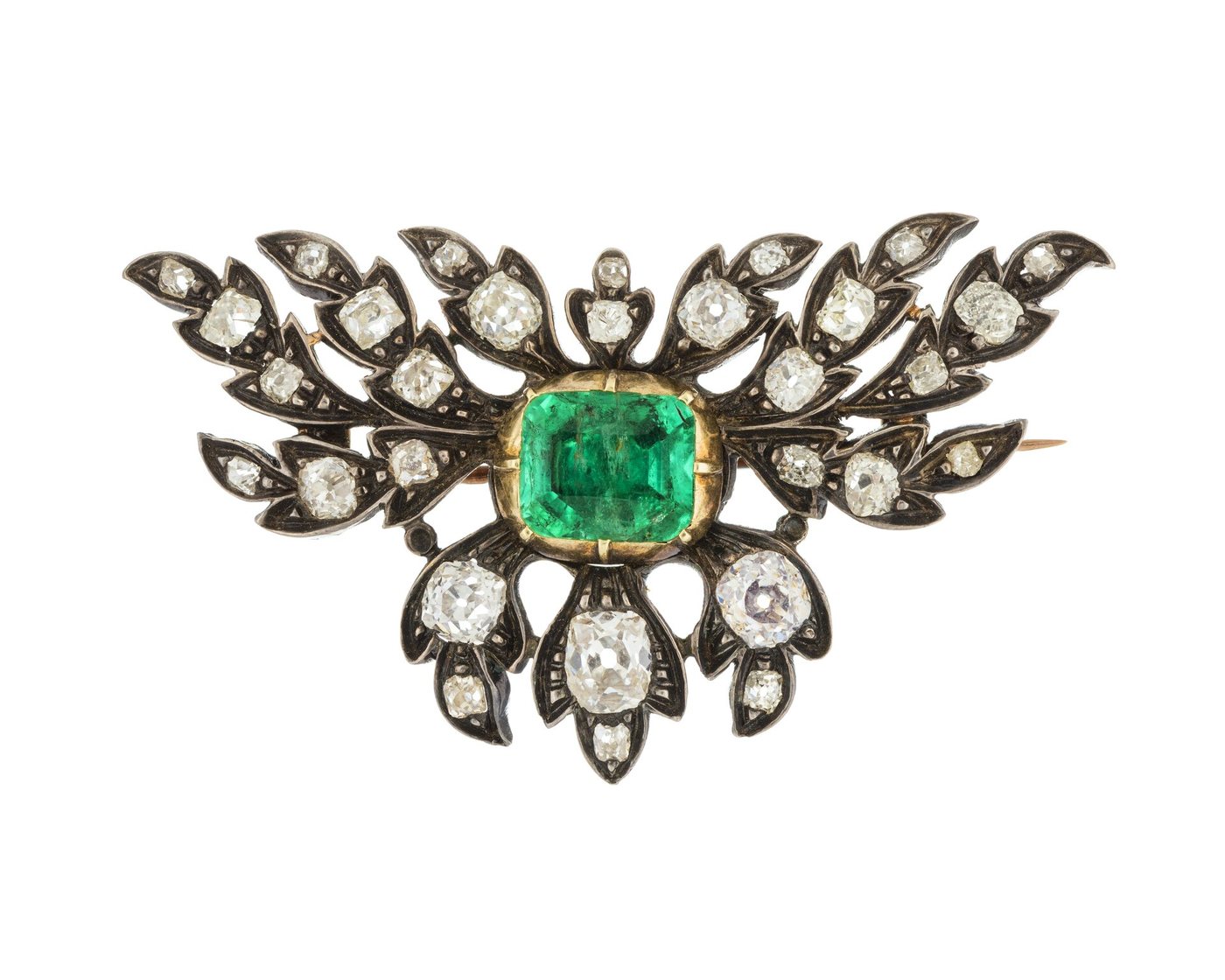
A Precious Stone Throughout
Emerald’s saturated green has been prized in Western jewellery for centuries, and unlike some coloured stones, it did not undergo the kind of dramatic value shift that affected garnet or amethyst following major new 19th-century discoveries. Fine emerald remained a consistently valuable and sought-after material across the Georgian, Victorian and Edwardian periods, used in royal and aristocratic jewellery as well as, in smaller and lesser-quality stones, more modest pieces.
Colombian Sourcing
The most historically significant source of fine emerald is Colombia. The mines at Muzo and Chivor in the eastern Andes had been worked by Indigenous peoples before the Spanish conquest of the region in the 16th century, and under Spanish rule they sent large quantities of emerald to Europe through Seville and Lisbon. Muzo became the most celebrated source of deep, slightly warm green stones; Chivor was worked intermittently and reopened in the early 20th century. Colombian material is repeatedly referenced in gemmological and trade literature as the benchmark against which other emerald sources were judged.
Many Colombian emeralds travelled on from Europe to India, where the Mughal court and its successors valued them above other stones. There they were often carved with flowers and leaves, engraved with inscriptions, or drilled as beads. In the late 19th and early 20th centuries large numbers of these Indian carved emeralds came back to Europe, and they became one of the signature materials of Art Deco jewellery: Cartier set carved emerald leaves and beads with rubies, sapphires and diamonds in its “Tutti Frutti” pieces, and other Paris houses mounted carved emerald plaques in geometric platinum frames.
The Ural Emeralds
A second source opened in 1830, when emeralds were found near the Tokovaya river, north-east of Yekaterinburg in the Ural Mountains of Russia. Ural emeralds are often paler and more bluish than the finest Colombian stones but were used extensively in 19th-century Russian court jewellery and reached Western European jewellers as well.
Named Emeralds and Royal Jewels
Several documented pieces show how emeralds were used and reused:
- Queen Victoria’s engagement ring. In 1839 Prince Albert gave Victoria a gold snake ring with an emerald, her birthstone, set in the head - one reason the snake motif became so popular in early Victorian jewellery.
- The Marie-Louise Diadem. Napoleon gave Empress Marie-Louise a parure of emeralds and diamonds on their marriage in 1810. The diadem’s emeralds were removed and sold in the 1950s and replaced with turquoises; it is now in the Smithsonian’s National Museum of Natural History. See Parure.
- The Cambridge emeralds. A group of cabochon emeralds that, by family tradition, Princess Augusta, Duchess of Cambridge, won in a lottery in Frankfurt in the early 19th century later came to her granddaughter Queen Mary, who had them set by Garrard into the Delhi Durbar parure made for the 1911 Durbar in India. The pieces are still worn by the British royal family.
Inclusions and the Long History of Oiling
Emerald has a natural tendency toward internal inclusions and fractures - a characteristic of the species itself rather than a marker of poor quality in any individual stone, since even fine emerald is very commonly included to some degree. The French trade term jardin, “garden”, describes the mossy look of these inclusions. The jewellery trade has long addressed this characteristic through oiling, in which a clear oil - traditionally cedarwood oil, and in the later 20th century also resins - is used to fill surface-reaching fractures and improve the stone’s apparent clarity. Oiling is a long-established general practice in the emerald trade, and is mentioned here as a fact about how emerald has customarily been treated as a category of stone - not as a claim about the treatment status of any specific piece of jewellery, which cannot be determined without specialist examination.
The Emerald Cut
The rectangular step cut now generally called the “emerald cut” - with its parallel rows of long, narrow facets and cropped corners - takes its name from this stone. Step cuts had long been the usual choice for emerald, and the reason usually given is practical: emerald is included and prone to fracture, and a step cut with bevelled corners avoids the sharp points and stress of other cuts, lowering the risk of chipping during cutting and setting while showing off the stone’s colour across a broad table. The name became standard in the 20th century, when the same cut was widely applied to diamonds and other stones in Art Deco jewellery. Old emeralds are also found as cabochons, in table cuts, and - in Indian work - carved or drilled.
Typical Historical Settings
Emerald in Georgian and Victorian jewellery is most often found in gold mounts, typically in closed-back or partially closed settings in earlier pieces, often surrounded by diamonds set in silver as in the 1830 brooch above, moving toward more open claw settings later in the 19th century. By the Edwardian period, fine emeralds were also set in platinum, frequently paired with diamonds, and in the 1920s calibré-cut emeralds - small stones cut to fit their setting exactly - were used as lines of colour against diamond and onyx.
The First Synthetic Emeralds
Emerald was much harder to synthesise than ruby. Gem-quality synthetic emerald was first grown in the 1920s and 1930s by the flux-growth method: in Germany by Richard Nacken and then by IG Farben, whose stones, announced in 1935, were known as “Igmerald”, and in the United States by Carroll Chatham of San Francisco, whose synthetic emeralds were sold commercially from the 1940s. Before then, emerald imitations were green glass paste or assembled “doublets” with a green layer between two pieces of colourless material.
Symbolism
Emerald’s green has carried a long-standing general association with nature, renewal and fidelity across various periods and cultures, referenced in period jewellery and gift-giving custom, though - as with much gemstone symbolism - these meanings were popularly repeated rather than fixed by any single authoritative source. Emerald supplied the E in acrostic jewellery spelling REGARD and DEAREST.
No claim is made here about determining, from a description or photograph, whether a specific emerald is natural, synthetic or treated - that requires laboratory or specialist examination.
Read next

Eras
Edwardian Jewellery
A guide to Edwardian jewellery (1901-1915): platinum and the garland style, Queen Alexandra's dog collars, Cartier, Boucheron and Fabergé in London, the Cullinan diamond, lavaliers, milgrain settings and day jewellery.

Eras
Georgian Jewellery
A guide to Georgian jewellery (1714-1837): Brazilian diamonds, closed-back foiled settings, rococo and Neoclassical styles, paste, cut steel and pinchbeck, sentimental miniatures, girandoles, rivières and Sévigné bows.

Eras
Victorian Jewellery
A guide to Victorian jewellery (1837-1901): the Romantic, Grand and Aesthetic periods, the Great Exhibition, gold rushes and 9ct gold, mourning and Whitby jet, archaeological revival, Scottish jewellery, and how to recognise each phase.
Gemstones
Rubies in Historical Jewellery
Ruby's status as a precious gemstone, Burmese rubies from Mogok and darker Siam stones, spinels mistaken for rubies, and the arrival of Verneuil's synthetic ruby from about 1902.
Gemstones
Sapphires in Historical Jewellery
Sapphires from Ceylon, Burma and the short-lived Kashmir mines of the 1880s, royal sapphires, the Edwardian sapphire-and-diamond pairing, star sapphires and early synthetic corundum.
Materials
Gold in Historical Jewellery
How gold standards, supply, colour and working methods changed from Georgian to 1940s jewellery - the 1854 standards, the gold rushes, bloomed and coloured gold, rolled gold - and gold's imitations.