Scottish Agate Jewellery
Scottish pebble jewellery: native agates, jaspers and cairngorm set in silver, the stones' sources, Balmoral and Queen Victoria, Edinburgh and Birmingham makers, and the plaid, dirk and garter brooch forms.
Scottish agate jewellery - often called “Scottish pebble jewellery” in general antique-jewellery literature - refers to the distinctive 19th-century tradition of jewellery set with native Scottish agates and other locally sourced banded and coloured hardstones, cut and polished and mounted, typically in silver, into brooches, bracelets and related pieces.
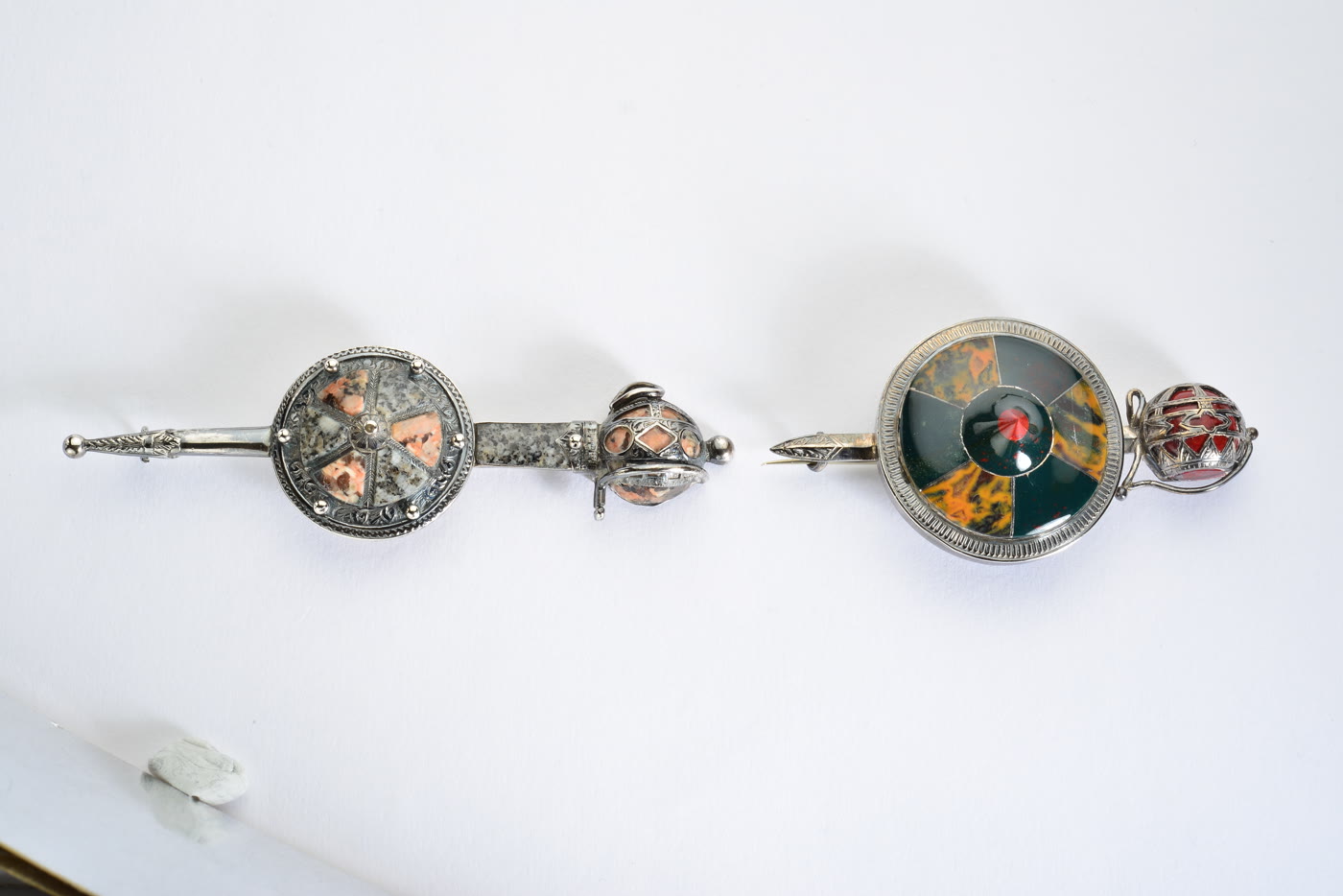
What It Is
The category covers jewellery built around native Scottish hardstones - principally banded agates in a range of natural colours, alongside cairngorm quartz (a smoky yellow-to-brown quartz named for the Cairngorm mountains) and other locally available coloured stones. Typical materials were:
- Agate - banded chalcedony in greys, browns, reds and creams, found in volcanic rocks along the Angus coast near Montrose, in Perthshire around Kinnoull Hill, and in Ayrshire and Fife.
- Jasper and bloodstone - opaque red, yellow and green stones; bloodstone is dark green with red spots.
- Carnelian - translucent orange-red chalcedony.
- Cairngorm - smoky quartz, used as large faceted centre stones and on the hilts of dirks.
- Granite - polished grey and pink granite from Aberdeenshire, used for some brooches and bracelets.
These stones were cut into cabochons or flat polished sections, chosen and arranged to show off their natural banding and colour variation, and set into silver mounts, most often as brooches but also as bracelets, earrings and other small accessories. The style is defined as much by its materials and their local Scottish origin as by any single decorative form.
Materials and Technique
Working Scottish pebble jewellery centred on cutting and polishing the stone to reveal its natural pattern - the concentric or wavy banding characteristic of agate, or the warm, clear colour of cairngorm quartz. The stones were then fitted into a prepared silver mount. In the characteristic inlaid technique, a silversmith made a flat frame divided into cells, often engraved on the surrounding silver, and a lapidary cut thin slices of stone to fit each cell exactly. The slices were bedded on shellac or a similar cement, so that several different agates and jaspers lay side by side in a smooth, symmetrical mosaic. Larger cabochons and faceted cairngorms were held in collets or claws.
Silver was the standard setting metal for the great majority of this jewellery, reflecting its role as a widely accessible, moderately priced form of jewellery rather than an exclusively high-end one. Finer pieces were mounted in gold.
Not every stone was Scottish. As demand grew, much of the agate came from the lapidary centre of Idar-Oberstein in Germany, which imported Brazilian agate from the 1830s and supplied cut and sometimes dyed stones to jewellers across Europe. Strong blues, greens and uniform blacks in a “Scottish” brooch usually indicate dyed agate rather than a native stone.
Where It Was Made
Edinburgh was the main Scottish centre, with jewellers and lapidaries along Princes Street and the Old Town supplying both local customers and visitors, and Aberdeen, Perth, Inverness and Glasgow also had makers. Firms such as M. Rettie & Sons of Aberdeen were known for granite and agate jewellery. As the fashion spread south, however, a large share of the trade moved to Birmingham, whose Jewellery Quarter produced Scottish-style brooches and bracelets in quantity from the 1860s onward, and some pieces were made in Germany. Much Scottish pebble jewellery is unmarked, so the place of manufacture often cannot be confirmed.
Historical and Regional Context
Interest in Scotland had been growing since the early 19th century. Sir Walter Scott’s poems and novels made the Highlands romantic, and George IV’s visit to Edinburgh in 1822, stage-managed by Scott, made tartan and Highland dress fashionable. Silver brooches set with Scottish stones were already being made in the 1820s and 1830s.
Scottish pebble jewellery rose to real prominence as a fashionable souvenir and as an expression of Scottish identity from the mid-19th century, in the middle of the Victorian era. Its popularity was helped along by Queen Victoria’s own attachment to Scotland - she and Prince Albert first leased Balmoral in the Scottish Highlands in 1848, bought the estate in 1852 and completed a new castle there in 1856, and the couple’s evident enthusiasm for Scottish life, dress and custom helped popularise a broader fashionable interest in Scottish-themed style, including tartan and Highland dress, across British society more widely. This royal association is best understood as one real and significant contributing factor within a wider 19th-century climate of growing tourism, souvenir-buying and interest in regional and national identity, rather than as the sole explanation for the style’s rise.
Popularity as Souvenir and National Jewellery
Scottish pebble jewellery functioned in two overlapping roles across the period: as a souvenir bought by visitors to Scotland, commemorating a journey to the Highlands in a way that was portable, wearable and unmistakably tied to its place of origin, and as an expression of Scottish identity worn by Scots themselves and by those with Scottish family connections further afield. Its moderate cost, built on native materials and silver rather than gold and precious gemstones, made it accessible to a broad market, and it was produced and sold in substantial quantity through the second half of the 19th century to meet demand from both audiences.
Typical Motifs
Brooches in this tradition were frequently made in circular, shield, or thistle-inspired forms, the thistle being Scotland’s long-established national emblem and a recurring decorative motif across the category. Other characteristic forms include:
- Plaid brooches - large ring or penannular brooches, based on the brooches that held a Highland plaid at the shoulder, often with a cairngorm at the centre.
- Dirk and sword brooches - miniature Highland daggers and claymores with agate or cairngorm hilts and pommels.
- Garter or strap-and-buckle brooches - a belt fastened in a circle.
- St Andrew’s cross, anchors, hearts and keys - made as brooches and pendants.
- Bracelets - flexible bracelets of linked agate panels, often with a heart-shaped padlock clasp, and hinged bangles inlaid with agate.
Many pieces combine these forms with engraved silver in tartan-like cross-hatching or scrollwork. Celtic knotwork patterns, drawing on earlier historic ornament, are also commonly associated with Scottish pebble jewellery, either worked into the silver mount itself or reflected in the overall symmetry and arrangement of the piece. These motifs reinforced the jewellery’s identity as specifically and deliberately Scottish, distinguishing it from other regional hardstone jewellery traditions of the period.
How to Recognise It
Silver mounts set with multiple small polished agates or cairngorm quartz in varied natural colours, arranged in symmetrical patterns within a brooch, bracelet or similar piece, are strongly characteristic of this tradition, particularly when combined with a thistle form or Celtic knotwork detailing. Look at the back: stones bedded in cement within engraved silver cells, and simple C-catches, suggest earlier work, while machine-stamped mounts and safety catches point to later pieces. Edinburgh’s castle mark or Glasgow’s tree, bird, bell and fish confirm a Scottish assay, though most pieces are unmarked. These features can help place a piece within this general tradition, but confirming a specific piece’s date, maker or exact origin requires closer physical examination.
Frequently Asked Questions
Is “Scottish pebble jewellery” a formal historical term? It is the term most commonly used in general antique-jewellery literature to describe this category, referring to the native “pebbles” - agates and other hardstones - collected and worked into jewellery, though period sources did not always use one single fixed name for the style.
Was all Scottish agate jewellery made for tourists? No - while souvenir demand was a significant driver of the trade, the style was also worn as a genuine expression of Scottish identity by Scots and those with Scottish connections, not purely as a visitor’s memento.
Read next
Compare
Bangle vs Bracelet: What's the Difference?
Why every bangle is a bracelet, but not every bracelet is a bangle - the rigid, clasp-free construction that sets bangles apart.
Compare
Brooch vs Pin: What's the Difference?
Why brooch and pin often mean the same thing, where usage diverges, and how a stickpin differs structurally from both.

Eras
Georgian Jewellery
A guide to Georgian jewellery (1714-1837): Brazilian diamonds, closed-back foiled settings, rococo and Neoclassical styles, paste, cut steel and pinchbeck, sentimental miniatures, girandoles, rivières and Sévigné bows.

Eras
Victorian Jewellery
A guide to Victorian jewellery (1837-1901): the Romantic, Grand and Aesthetic periods, the Great Exhibition, gold rushes and 9ct gold, mourning and Whitby jet, archaeological revival, Scottish jewellery, and how to recognise each phase.

Gemstones
Amethyst in Historical Jewellery
How amethyst went from a costly stone, prized in its deep 'Siberian' colour from the Urals, to an affordable one after Brazilian supply grew, and its royal, ecclesiastical and mourning uses.
Materials
Silver in Historical Jewellery
Silver as gold's cheaper alternative, silver-topped gold settings, the Victorian silver fashion of the 1870s-80s, Birmingham's Jewellery Quarter, and Arts and Crafts silver from Ashbee to Liberty and Jensen.