What Are Earrings?
An overview of earrings as a jewellery category, how earring fashion tracked hairstyle and headwear, and how fitting types shifted between pierced wire hooks and screw or clip backs.
Earrings are jewellery worn through or against the ear, ranging from a single small stud to an elaborate multi-tier drop, and one of the jewellery forms most closely tied to fashions in hairstyle and headwear rather than to clothing.

What Are Earrings?
“Earrings” is a broad category rather than one specific form. It covers simple studs and hoops, single pendant drops, elaborate multi-drop chandelier and girandole earrings, and clustered designs, unified mainly by their place of wear rather than by any one method of construction or fastening. This page gives an overview of the category and how it changed across the period; specific sub-forms are noted below rather than treated on separate dedicated pages.
How to Recognise It
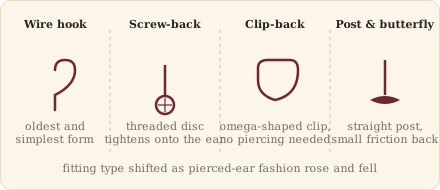
Look first at the fitting on the reverse of the earlobe-facing side. A plain wire hook or hinged wire passing through a pierced hole is the oldest and most consistent fitting across the whole period, while a screw mechanism or spring clip that grips the earlobe without piercing is a later development, generally associated with the late 19th century onward and especially common through the early-to-mid 20th century. See Earring Fittings Through History for a fuller discussion of specific fitting types and their approximate dating value, since fitting mechanisms can also be replaced or altered over time.
When Was It Worn?
Earrings were worn from 1700 to 1950, though their visibility rose and fell considerably with hairstyle - prominent and highly visible when hair was worn swept up and away from the face and neck, and comparatively restrained or less fashionable when hairstyles and headwear covered or obscured the ears.
Origins
Ear ornaments are ancient and found across many cultures well before 1700. Within the 18th and 19th centuries specifically, the earring’s fashionable prominence tracked the broader history of hairstyling closely, since a style that left the ear and neck exposed gave an earring a clear, decorative place to be seen, while a style that covered the ear removed much of its reason to be worn visibly at all.
How It Changed Over Time
Georgian and Regency earrings favoured elegant pendant drops, often in a three-part girandole form, in gold set with paste, garnets, pearls or other coloured stones, suited to the era’s upswept hairstyles. Victorian earrings ranged from small, restrained studs and simple drops in the earlier decades to bolder, longer designs later in the period, including naturalistic and mourning forms in jet and hairwork. Earrings became less fashionable for a stretch of the earlier 20th century as hats, longer covering hairstyles and, for a period, a general decline in ear-piercing itself reduced their visibility, before the close-cropped hairstyles of the 1920s brought earrings strongly back into fashion, now frequently worn with screw or clip fittings rather than a pierced wire hook. The Art Deco period produced geometric drop and chandelier earrings in platinum and diamonds, designed to catch light against short hair and a bare neck.
Materials
Gold was the standard base metal across most of the period, with silver-topped gold used for stone-set earrings before platinum became more widely available in the late 19th and early 20th centuries. Paste, garnets, pearls, coral and diamonds all appear regularly depending on era and cost, and mourning-appropriate materials such as jet were used for earrings made or adapted for mourning wear.
Construction
A drop or chandelier earring is typically built from a small decorative top element, fitted to the ear, from which one or more pendant sections hang on jump rings, chains or articulated links, allowing the lower sections to move. Simpler stud and hoop forms are more compact, with the decorative element mounted directly on, or very close to, the fitting itself rather than suspended below it.
How It Was Worn
Worn through or against the earlobe, singly as a pair, with their visual weight and length calibrated to the wearer’s hairstyle - a longer drop suited hair worn up and away from the neck, while a smaller stud or hoop suited hair worn closer to the ear.
Who Wore It?
Earrings were worn overwhelmingly by women through most of the period from 1700 to 1950, though the specific popularity of pierced ears, and of visible earrings generally, fluctuated with wider fashion in a way that affected how commonly they were worn at any given time.
Notable Variations
- Drop earring - a single pendant section hanging from a smaller top fitting.
- Girandole earring - a Georgian three-part drop form, with a central and two flanking pendants.
- Chandelier earring - an elaborate, multi-tier drop, especially associated with Georgian and Art Deco design.
- Hoop earring - a continuous or near-continuous ring passing through the earlobe.
- Stud earring - a compact form with the decorative element mounted directly at the ear.
Similar Jewellery
Earrings are occasionally confused with other small decorative fittings intended for the hair or headwear near the ear, such as a comb or hairpin worn close to the ear, though the presence of a genuine ear fitting - a hook, screw, clip or post - is the clearest way to tell an earring from a hair ornament.
Examples in Museum Collections
- Pair of girandole earrings, probably French, c.1760. Victoria and Albert Museum, London, M.154A&B-1975. Opaline and white pastes set in silver, with three drops hanging from a central top - a form the museum calls very typical of the mid to late 18th century.
- Pair of jet earrings, probably English, c.1870. Victoria and Albert Museum, London, M.944A&B-1983. Carved with female-head medallions among roses and leaves, in the Whitby jet associated with Victorian mourning.
- Pair of long earrings, c.1925. Victoria and Albert Museum, London, M.107:1, 2-2007. Platinum, coral, black onyx and diamonds. The museum’s record quotes the Illustrated London News of 1925 linking long earrings to the fashion for cropped “Eton” hair.
Read next
Compare
Edwardian vs Art Deco Jewellery
Edwardian and Art Deco jewellery both favoured platinum, but one is soft and curved and the other hard-edged and geometric - here's how to tell the garland style from Deco.
Compare
Georgian vs Victorian Jewellery
How Georgian and Victorian jewellery differ in settings, techniques and motifs, and why Victorian jewellery itself spans several distinct phases.
Identify
Earring Fittings Through History
How pierced wire hooks, screw-backs and clip-backs rose and fell in prominence, and why fitting type is a useful but replaceable clue to an earring's age.

Jewellery
What Is a Hair Comb?
What a decorative hair comb is, its close association with elaborate upswept Victorian and Edwardian hairstyles and Art Nouveau design, and its decline with 1920s bobbed hair.

Jewellery
What Is a Hairpin?
What a hairpin is, the difference between a plain functional hairpin and a decorative jewelled hairpin, and why elaborate Victorian and Edwardian hairstyles needed so many of them.
Jewellery
What Is a Parure?
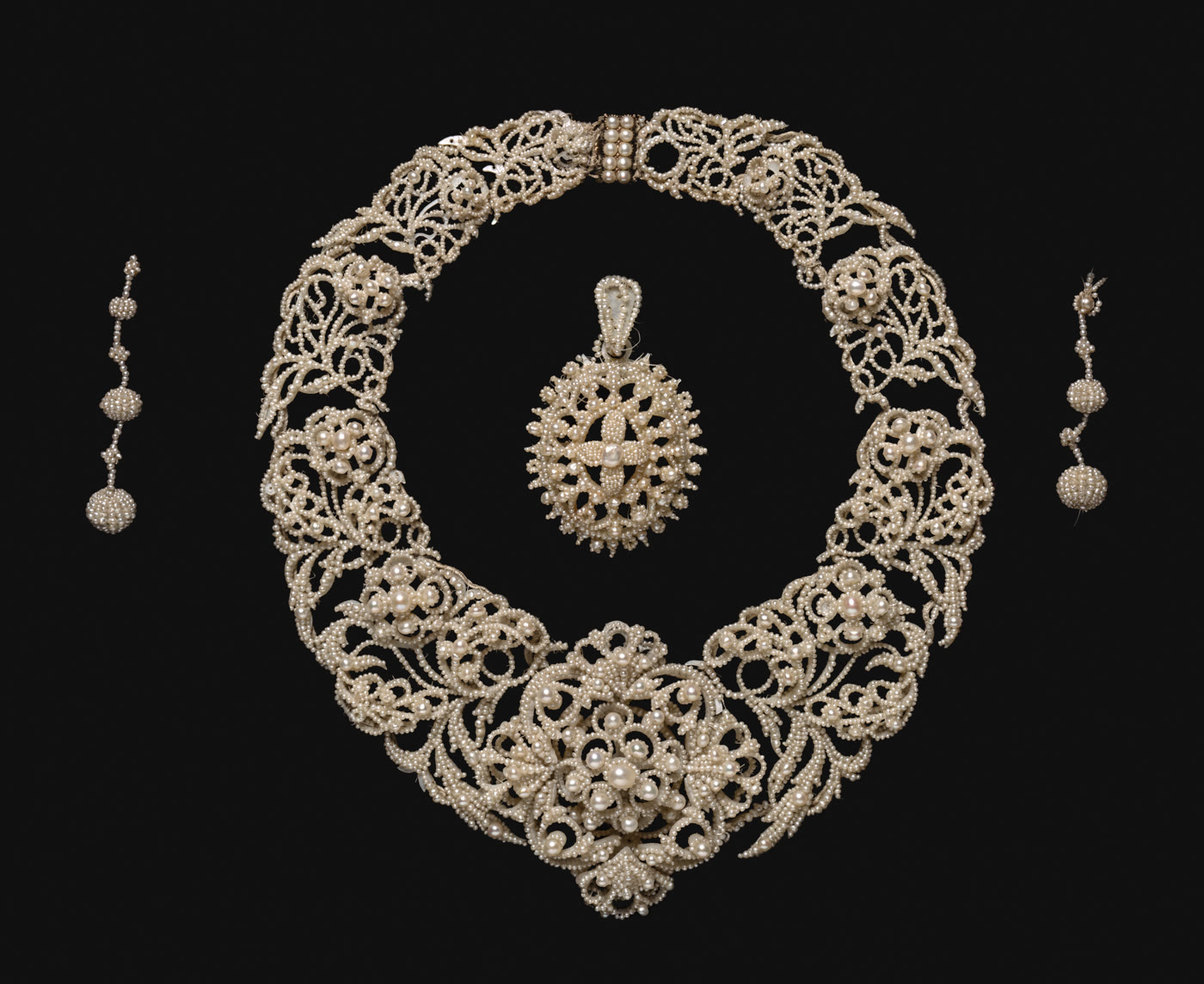
What a parure and a demi-parure are, how matching sets developed at the Napoleonic court and spread through Georgian and Victorian jewellery, how they were cased and converted, and why so many survive broken up.