Whitby Jet and Victorian Jewellery
How Whitby's jet workshops grew from the early 19th century, boomed after 1861 with Victorian mourning, showed at the 1851 Great Exhibition, and declined by the 1880s and 1890s.
Whitby jet refers to jet mined and, more importantly, carved in and around the coastal town of Whitby in Yorkshire, England, which became the dominant centre of English jet jewellery production during the 19th century.
Why Whitby
Whitby sits on a stretch of Yorkshire coastline where jet occurs naturally in the local rocks. The best material, known as “hard jet”, comes from a band of Jurassic shale called the Jet Rock, around 180 million years old, which runs through the cliffs on either side of the town and inland under the North York Moors. Jet washed up on the beach or picked from the cliffs had been collected and worked in the area since prehistory, and Roman craftsmen at York made jet jewellery from Yorkshire material.
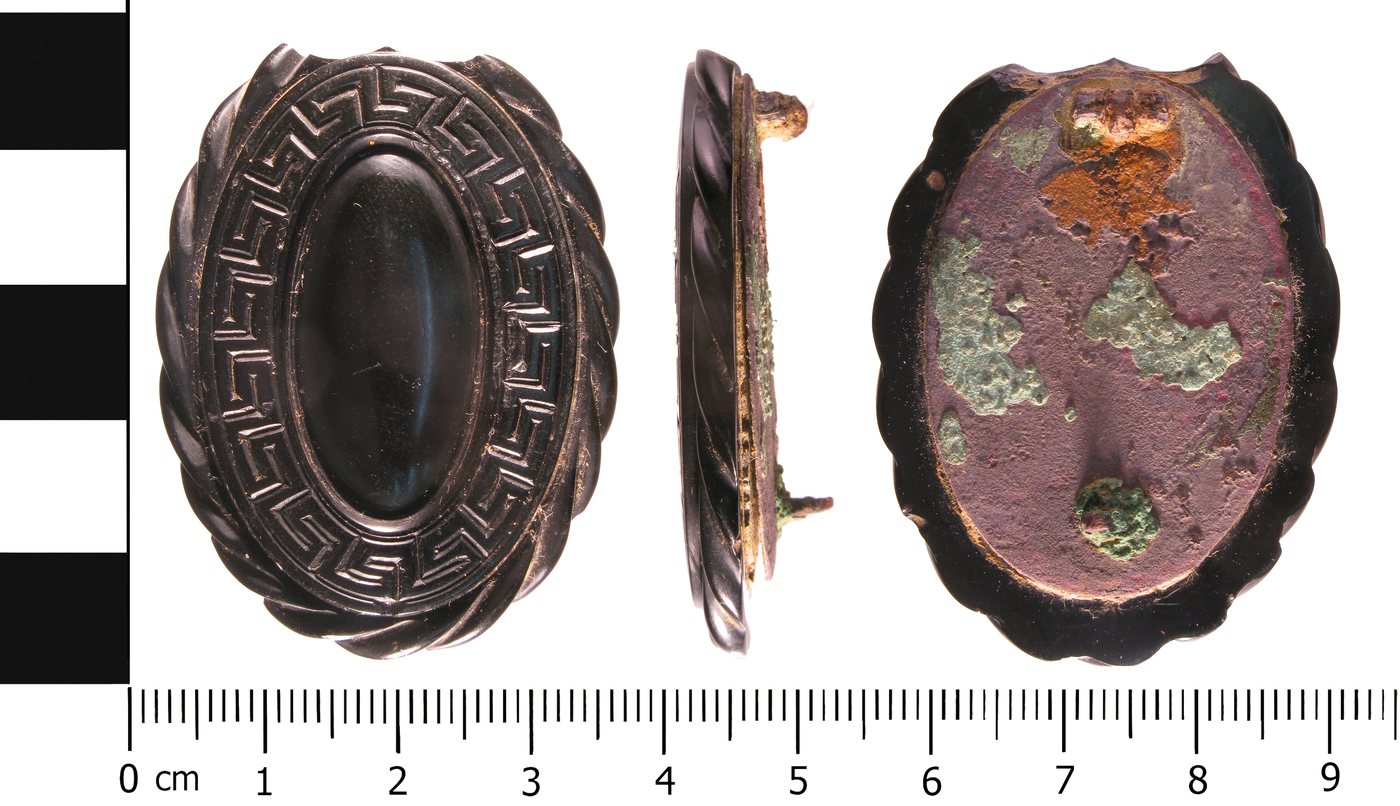
What made Whitby distinctive was not just access to raw material but the growth, in the 19th century, of a local craft industry - workshops of carvers and turners who shaped jet into beads, cameos, chains, lockets and the elaborately carved and faceted mourning jewellery that made the town’s name synonymous with the material.
Mining the Jet
Early 19th-century jet was gathered from the shore after storms or chipped from the cliff face. As demand rose, men began to tunnel into the cliffs and into the sides of moorland valleys inland, following the jet-bearing seam. Jet occurs as irregular lenses and flattened pieces, often only a few centimetres thick, so a long tunnel might yield only a small amount of usable material. Workers distinguished hard jet from the “soft jet” found in younger beds, which looks similar when freshly polished but is more liable to crack and craze.
The Victorian Boom
Tradition dates the modern Whitby trade to around 1800, when jet began to be turned on lathes in the town; by the 1840s there were several jet workshops. The trade gained national attention at the Great Exhibition of 1851 in London, where Whitby jet makers showed their work.
The real expansion came with Victorian mourning jewellery. After Prince Albert’s death in December 1861, Queen Victoria and her court wore deep mourning for long periods, and black jewellery became essential for anyone following the court’s example. Whitby jet was the most prestigious material for it. Through the 1860s and early 1870s the number of workshops multiplied, and figures often cited for the early 1870s put the trade’s workforce at about 1,500 men, women and children. Workshops were concentrated in the old town, and jet shops lined Church Street and the streets around the harbour.
Whitby supplied mourning brooches, bracelets, beads, watch chains and earrings, and also fashionable black jewellery worn outside strict mourning in the Victorian period. See What Is Jet Jewellery? for how the material itself was worked and how to distinguish it from its imitations.
Scale and Organisation
A typical workshop had a few men and apprentices working at benches by a window, with treadle or power-driven lathes and grinding wheels. Rough jet was sawn into blanks, shaped on grindstones, carved with knives and fine gravers, and polished on revolving wheels to bring up its deep black lustre. Many pieces were made by several hands, with turners, carvers and polishers each doing their part.
Production ranged from simple turned beads to highly detailed carved brooches, chains and parures, with quality and price varying considerably. Finer Whitby jet pieces show crisp, confident carving and a deep, even polish; the cheaper end of the trade produced simpler, more repetitive designs to meet high-volume demand from a national and, to some extent, export market.
Decline
Whitby’s jet trade contracted sharply from the late 1870s, and by the 1880s and 1890s it was in steep decline. Several causes overlapped:
- Falling quality. As good local hard jet became scarcer, workshops used more soft jet and imported jet, much of it from Spain, which was cheaper but more brittle. Cracked and crazed pieces damaged Whitby’s reputation.
- Imitations. Vulcanite, bog oak and French jet (black glass) undercut carved jet on price while looking similar enough to satisfy much of the market.
- Changing fashion. Heavy black jewellery went out of fashion in the 1880s, and mourning etiquette relaxed further by the early 20th century, reducing the demand that had driven the boom.
By the early 20th century the industry that had once employed a large local workforce had shrunk to a handful of workshops.
Whitby Jet Today
Jet carving has never entirely disappeared from Whitby, and the town retains a strong modern identity built around jet as both a craft tradition and a tourist association, with jewellers still working and selling jet in the town. Whitby Museum in Pannett Park has a large collection of Victorian jet jewellery and carving. Antique Whitby jet jewellery is collected both for its craftsmanship and as a record of a specific 19th-century British industry, distinct from jet worked elsewhere and from jet’s imitations.
Frequently Asked Questions
Is all antique jet jewellery from Whitby? Not necessarily - jet was also carved in Spain, France and elsewhere, and Whitby workshops themselves used imported jet in the later 19th century. Whitby was the dominant English centre of the trade during its Victorian peak. Most pieces are unmarked, so attribution to Whitby usually rests on style and quality rather than a mark.
How can I tell if a piece is genuine jet rather than an imitation? See What Is Jet Jewellery? for the physical differences between genuine jet and its common imitations, vulcanite and French jet.
Read next

Eras
Georgian Jewellery
A guide to Georgian jewellery (1714-1837): Brazilian diamonds, closed-back foiled settings, rococo and Neoclassical styles, paste, cut steel and pinchbeck, sentimental miniatures, girandoles, rivières and Sévigné bows.

Eras
Victorian Jewellery
A guide to Victorian jewellery (1837-1901): the Romantic, Grand and Aesthetic periods, the Great Exhibition, gold rushes and 9ct gold, mourning and Whitby jet, archaeological revival, Scottish jewellery, and how to recognise each phase.

Materials
What Is Jet Jewellery?
What jet is, where it came from - Whitby, Asturias, southern France - its use from the Bronze Age to the Victorian mourning boom, and how to tell genuine jet from vulcanite and French jet.

Mourning & Sentimental
What Is Hair Jewellery?
What hair jewellery is, how table-work and palette-work hairwork were made, the hairworkers and manuals behind the craft, and why it served sentimental as well as mourning purposes.
Mourning & Sentimental
What Is a Memorial Brooch?
What a memorial brooch is, how its design changed from Georgian sepia-and-hair brooches to Victorian black-enamel and photographic brooches, and how it differs from general mourning jewellery.

Mourning & Sentimental
What Is Mourning Jewellery?
What mourning jewellery is, how it developed from Stuart and Georgian memorial rings, why it peaked in Victorian Britain after Prince Albert's death in 1861, and the etiquette and materials behind it.