What Is an Eternity Ring?
What an eternity ring is, how the Victorian and Edwardian half-hoop developed into the full eternity band of the 1920s and 1930s, how the modern anniversary custom began, and how to date an eternity ring.
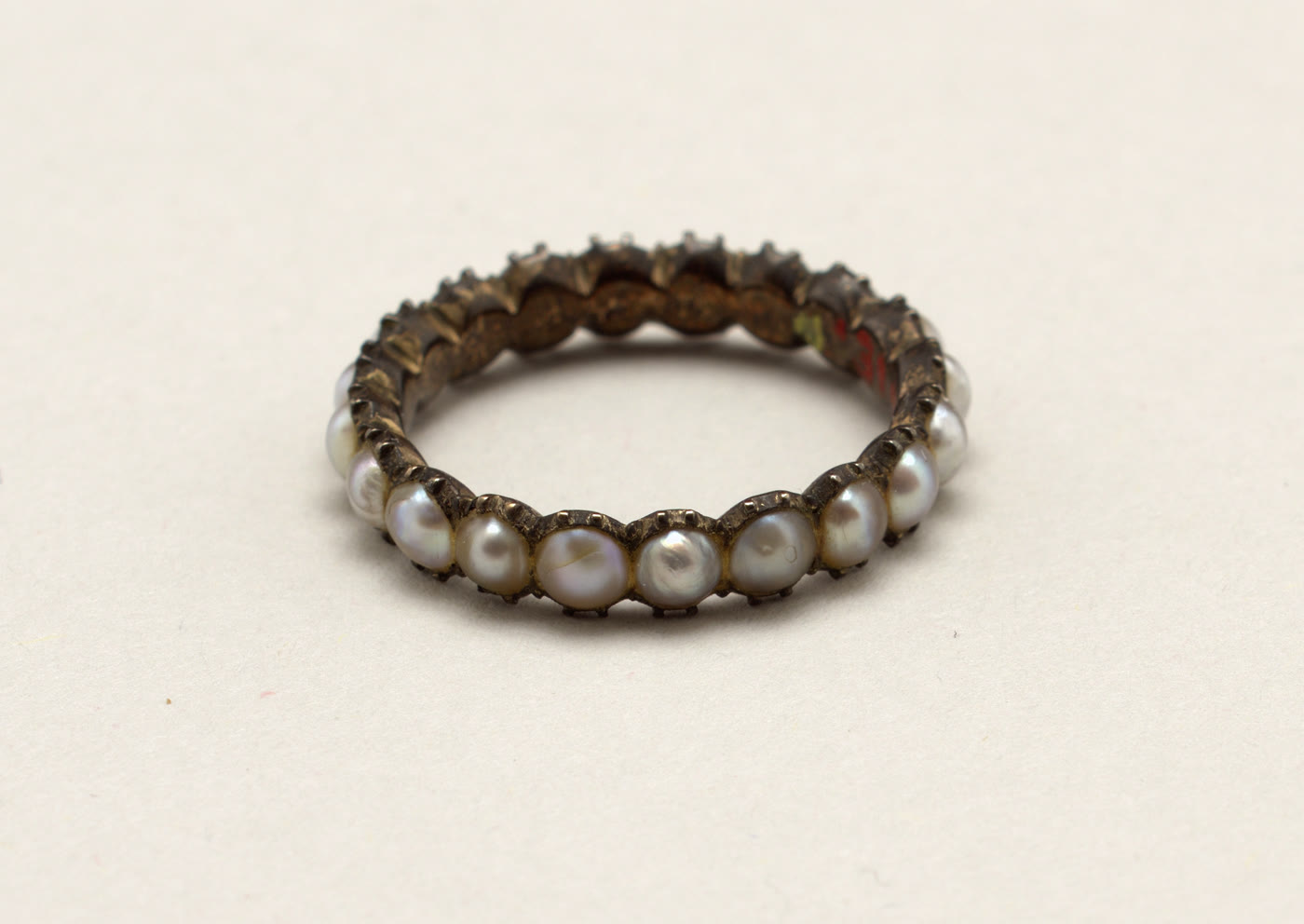
An eternity ring is a band set with a continuous line of matching stones, either all the way round (a full eternity ring) or across the front only (a half eternity or half-hoop ring). The unbroken line of stones stands for unending love. Today it is usually given on an anniversary or the birth of a child, but the form is older than the custom.
What Is an Eternity Ring?
The defining feature is a single row of stones of the same size and type, set close together along the band. In a full eternity ring the stones continue around the whole circumference; in a half-hoop, they cover the top half, leaving the underside plain so the ring can be resized.
How to Recognise It
Look for a narrow band with one line of uniform stones and no central feature stone. Half-hoops are usually slightly tapered and may have a carved or openwork gallery beneath the stones. Full eternity rings have stones all the way round and usually no space for a hallmark, which may instead be struck on the inside edge or omitted.
When Was It Worn?
The symbolism of an endless circle is ancient - the snake swallowing its tail, or ouroboros, was a familiar emblem of eternity, and snake rings carried a similar meaning in the 19th century. The gem-set half-hoop ring became one of the most popular ring forms of the Victorian and Edwardian periods, set with diamonds, rubies, sapphires, opals, turquoise or pearls, often worn as a keeper above a wedding ring. Full eternity bands, with stones all the way round, became fashionable in the 1920s and 1930s, when platinum and calibré-cut stones made slim channel- and bead-set bands practical.
Origins
Rings with stones set around the hoop were made earlier, but the modern custom of an “eternity ring” as a specific anniversary gift is much more recent. It is usually credited to the diamond trade, particularly De Beers’ advertising from the 1960s, which encouraged husbands to give an eternity ring as a mark of a lasting marriage. Antique half-hoops and bands were not necessarily bought with that meaning.
How It Changed Over Time
- Victorian (c.1850-1900): half-hoops of five or seven stones in yellow gold, claw-set or in a carved gallery; diamonds, opals, rubies and turquoise; old mine-cut and rose-cut diamonds.
- Edwardian (c.1900-1915): finer half-hoops in platinum or platinum-topped gold, old European-cut diamonds, milgrain edges.
- Art Deco (c.1920-1935): full eternity bands in platinum, channel-set with calibré sapphires, rubies or emeralds, or alternating with diamonds; step-cut stones.
- 1940s: bands in yellow or rose gold with small diamonds or synthetic stones, following wartime platinum restrictions.
Materials
Gold for Victorian half-hoops; platinum or white gold for the Edwardian and Art Deco periods. Stones were usually diamonds or a single coloured gemstone, sometimes alternating with diamonds.
Construction
Half-hoops are typically built with a decorative gallery under the stones and claws or grains holding each stone. Full eternity bands use channel settings (stones held between two rails), bead or grain settings, or individual claws. Because stones run all the way round, full bands cannot easily be resized - a practical point that explains why so many survive as half-hoops.
How It Was Worn
Half-hoops were often worn above a wedding ring to secure it, and sometimes stacked in twos or threes. Full eternity bands were worn alone or with an engagement ring.
Who Wore It?
Mainly married women. Victorian half-hoops were affordable in a range of stones and qualities, while platinum full eternity bands were luxury pieces.
Notable Variations
- Half-hoop - stones across the front only.
- Full eternity - stones all the way round.
- Channel-set band - stones held between two continuous metal rails.
- Alternating band - coloured stones alternating with diamonds.
Terminology
Antique half-hoops are often sold as “eternity rings” today, but the term is mainly modern; period sources more often simply describe them as half-hoop rings.
Similar Jewellery
An eternity ring differs from a keeper ring, which is usually a plainer band, and from a cluster or solitaire engagement ring, which has a central feature stone. See History of Engagement Rings.
Examples in Museum Collections
Half-hoop and band rings are well represented in museum ring collections, but they are usually catalogued simply as “ring”, with the stone and setting described. Searching for “half-hoop” alongside a stone name such as “opal” or “diamond” is often more productive than searching for “eternity ring”.
Read next
Jewellery
What Is a Keeper Ring?
What a keeper ring is, how it was worn alongside a more valuable ring to help hold it securely on the finger, and its relationship to the modern guard ring.
Mourning & Sentimental
History of Engagement Rings
How the engagement ring moved from posy and gimmel rings through Georgian regard rings to the diamond solitaire - Kimberley, the Tiffany setting and De Beers' 1947 slogan.
Mourning & Sentimental
History of Wedding Rings
The plain gold band as the Western wedding ring: the Book of Common Prayer, the vena amoris tradition, 22ct Victorian bands, men's rings and wartime Utility rings in Britain.
Symbols
Snake Jewellery and Eternal Love
Why the snake, often shown biting its own tail, stood for eternal love in 19th-century jewellery - from Queen Victoria's 1839 emerald snake ring to Lalique's serpents.

Techniques
Stone-Setting Styles Explained
Historical stone-setting styles from foiled closed-back collets to open claws, coronet, gypsy, millegrain, platinum knife-edge, channel, illusion and mystery settings - and roughly when each was used.
Identify
How to Date a Diamond by Its Cut
How diamond cutting changed from the rose cut and old mine cut to the old European and modern brilliant, the step cuts of Art Deco, and how to read a stone's outline, table, culet and facets as dating evidence.