What Is a Festoon Necklace?
What a festoon necklace is, how its draping swagged strands differ from a riviere's unbroken line of stones, and why it stayed popular from the Georgian through the Victorian period.
A festoon necklace is built from one or more curved, swagged strands of stones or metalwork, designed to drape in a graceful garland-like curve across the chest, distinguishing it from necklaces made of a single unbroken line of stones.

What Is a Festoon Necklace?
The defining feature of a festoon necklace is its draped, garland-like construction: rather than a single continuous line, the necklace is built from one or more curved swags, often strung between decorative stations or clasps, so that the piece hangs in a series of graceful curves rather than a flat, taut line. Many festoon necklaces are further decorated with a fringe of small drops hanging from the lower edge of the swag, adding movement and depth to the overall design.
How to Recognise It
Look for a necklace made of one or more distinctly curved, drooping strands - rather than a single unbroken line of similarly sized stones - often strung between decorative junction points or small clasps that create the characteristic swagged, garland shape. A fringe of small drops hanging from the lower curve is a further common feature, adding a layered, dimensional look absent from a plainer necklace form.
When Was It Worn?
Festoon necklaces were worn at the neckline for both formal and fashionable daytime wear across a long span of the period from 1700 to 1950, from the mid-18th century into the early 20th century.
Origins
The festoon or swag motif has deep roots in decorative arts more broadly, drawing on the classical garland as an ornamental device, and it was adapted into necklace form during the 18th century alongside the wider Georgian taste for floral and swagged decorative motifs across jewellery, textiles and interior design.
How It Changed Over Time
Georgian festoon necklaces typically used foiled, closed-back settings to enhance the colour and brilliance of diamonds and coloured gemstones, strung in graceful curved swags often echoing the floral and ribbon motifs fashionable in 18th-century decorative arts generally. The form remained popular through the Victorian period, when festoon necklaces were made in a wide range of materials and price points, from fine diamond and gemstone versions to more affordable gold, garnet or coral examples, often with an added fringe of drops for a fuller, more dimensional effect. As open, claw-set mounts became more common through the 19th century, festoon necklaces increasingly adopted this lighter setting style alongside the closed-back settings that had dominated earlier examples.
Materials
Diamonds, garnets, coral, pearls and other gemstones were all used for festoon necklaces across this period, with gold and silver the standard setting metals. Less expensive versions substituted paste or lower-value coloured stones for diamonds while keeping the same characteristic swagged construction.
Construction
A festoon necklace is built from multiple linked swag or garland units - strands of stones or metalwork strung between decorative stations - joined so the piece hangs in a series of curves rather than a single straight line. Many examples add a fringe of small drops suspended from the lower edge of each swag, and the whole piece is typically finished with a secure clasp positioned at the back or side of the neck.
How It Was Worn
Worn draping across the chest and upper décolletage, with the curved swags creating a layered, garland-like effect quite different from the flat, close line of a rivière necklace.
Who Wore It?
The festoon necklace was women’s jewellery, worn across a broad social and economic range from fine diamond examples worn by the wealthiest wearers to more modest gold, garnet or coral versions worn more widely.
Notable Variations
- Fringe festoon - a festoon necklace with an added row of drops hanging from the lower curve of the swag.
- Multi-strand festoon - a necklace built from several linked swagged strands rather than a single curve.
- Stomacher-related festoon - some 18th-century stomachers were later broken down and reset as festoon necklaces once the stomacher itself fell out of fashion.
Similar Jewellery
A festoon necklace is most often confused with a rivière necklace, both featuring multiple stones across the chest, but a rivière forms a single unbroken, close-fitting line of similarly sized stones, while a festoon necklace drapes in one or more distinct curved swags, often with an added fringe - the presence of that draping, garland-like structure is the clearest way to tell the two apart.
Examples in Museum Collections
- Necklace, c.1810. Victoria and Albert Museum, London, M.176-1941. Gold with pietra dura panels of butterflies, linked by what the museum describes as “delicate festoons of chain”, typical of early 19th-century necklaces.
- Necklet, Portuguese, 1780-1800. Victoria and Albert Museum, London, M.104-1930. White topaz in silver openwork, with five loops hanging from a symmetrical bow - the draped, garland-like curve of the Neoclassical festoon.
- Necklace, c.1840. Victoria and Albert Museum, London, T.242-1965. Four bead-embroidered squares linked by seven graduated swags of crystal-bead chain: a low-cost early Victorian version of the same swagged construction.
Read next
Compare
Georgian vs Victorian Jewellery
How Georgian and Victorian jewellery differ in settings, techniques and motifs, and why Victorian jewellery itself spans several distinct phases.
Gemstones
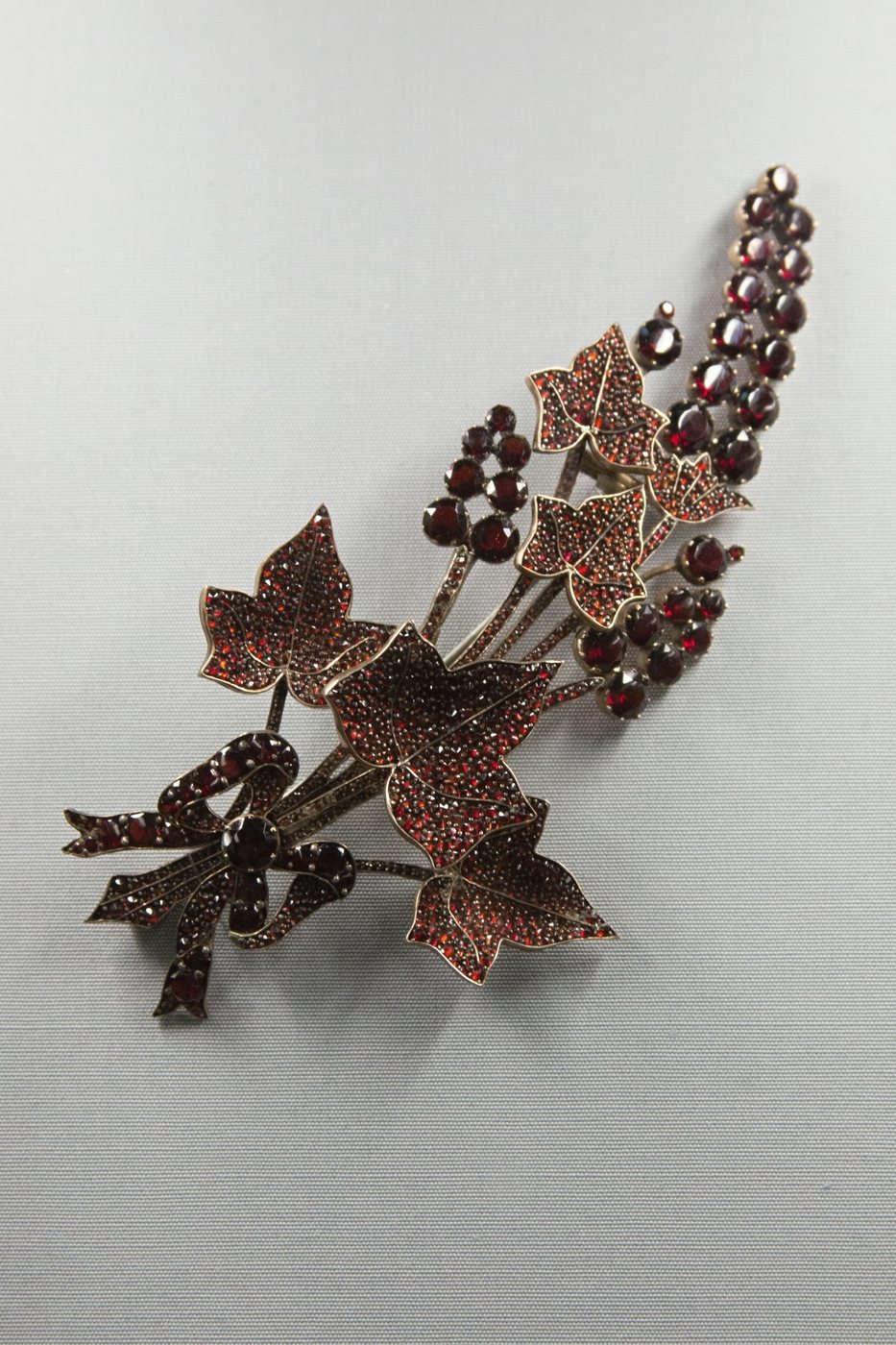
Garnets in Victorian Jewellery
Why Bohemian pyrope garnets from Třebenice, cut and set in Turnov and Prague, became a hallmark of Victorian jewellery, with carbuncles, demantoids, cluster settings and their meanings.
Gemstones
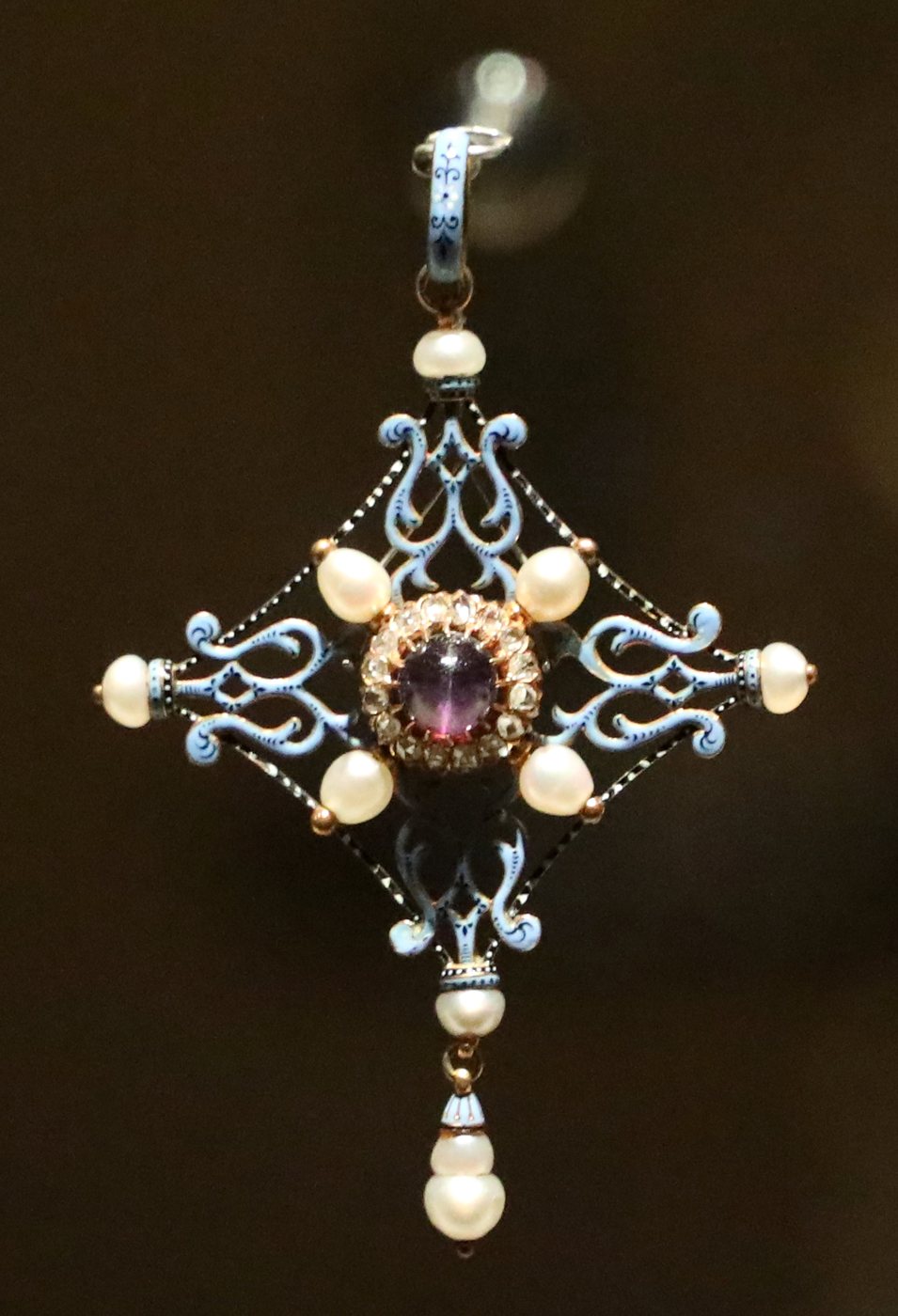
Pearls in Jewellery History
Natural pearls from the Gulf and Ceylon, seed-pearl work, Edwardian chokers and ropes, Mikimoto's cultured pearls of the 1910s-20s, imitation pearls, and pearls' bridal and mourning meanings.
Jewellery
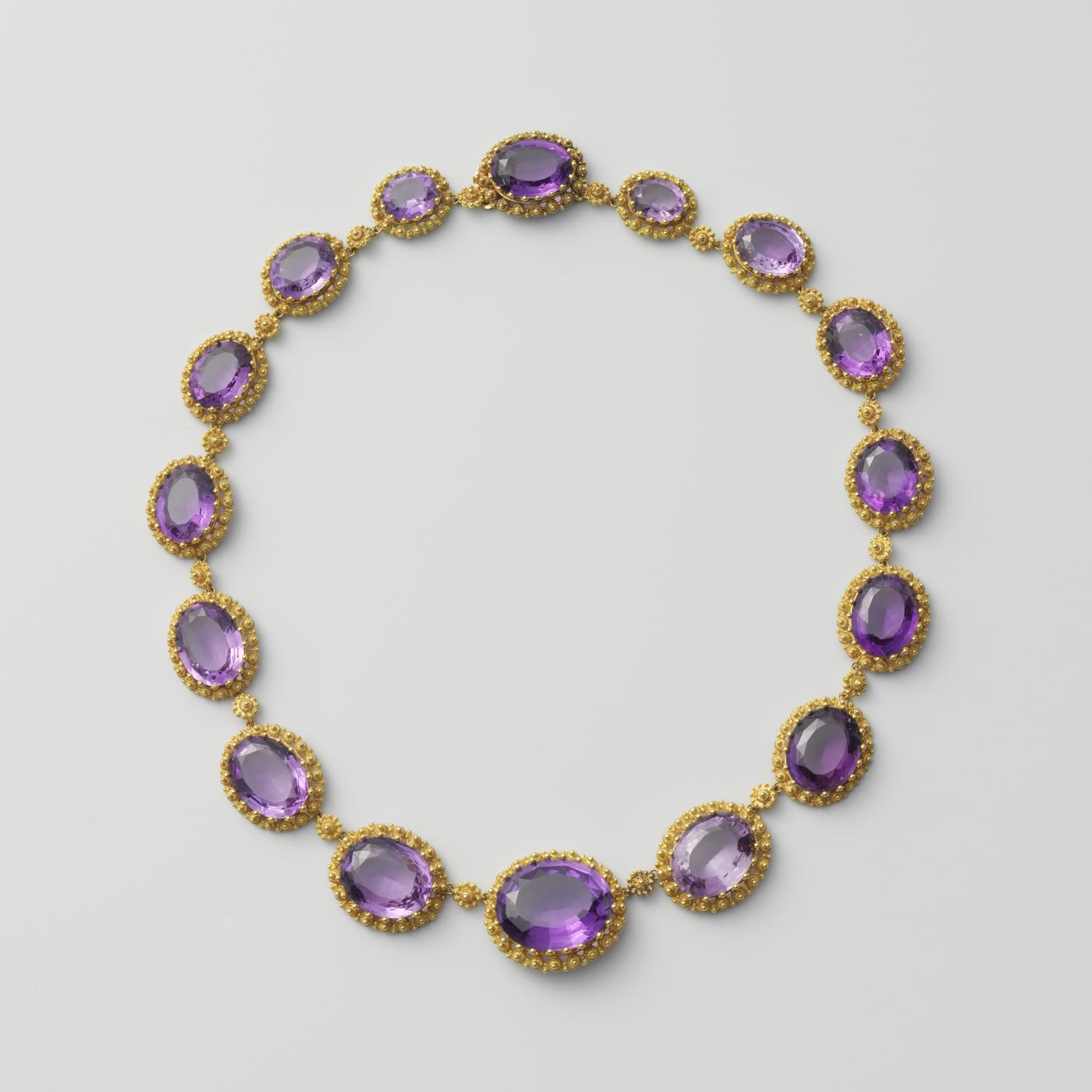
What Is a Rivière Necklace?
What a riviere necklace is, why its unbroken line of individually set stones made it one of the most enduring necklace forms, and how it differs from a festoon or fringe necklace.
Jewellery
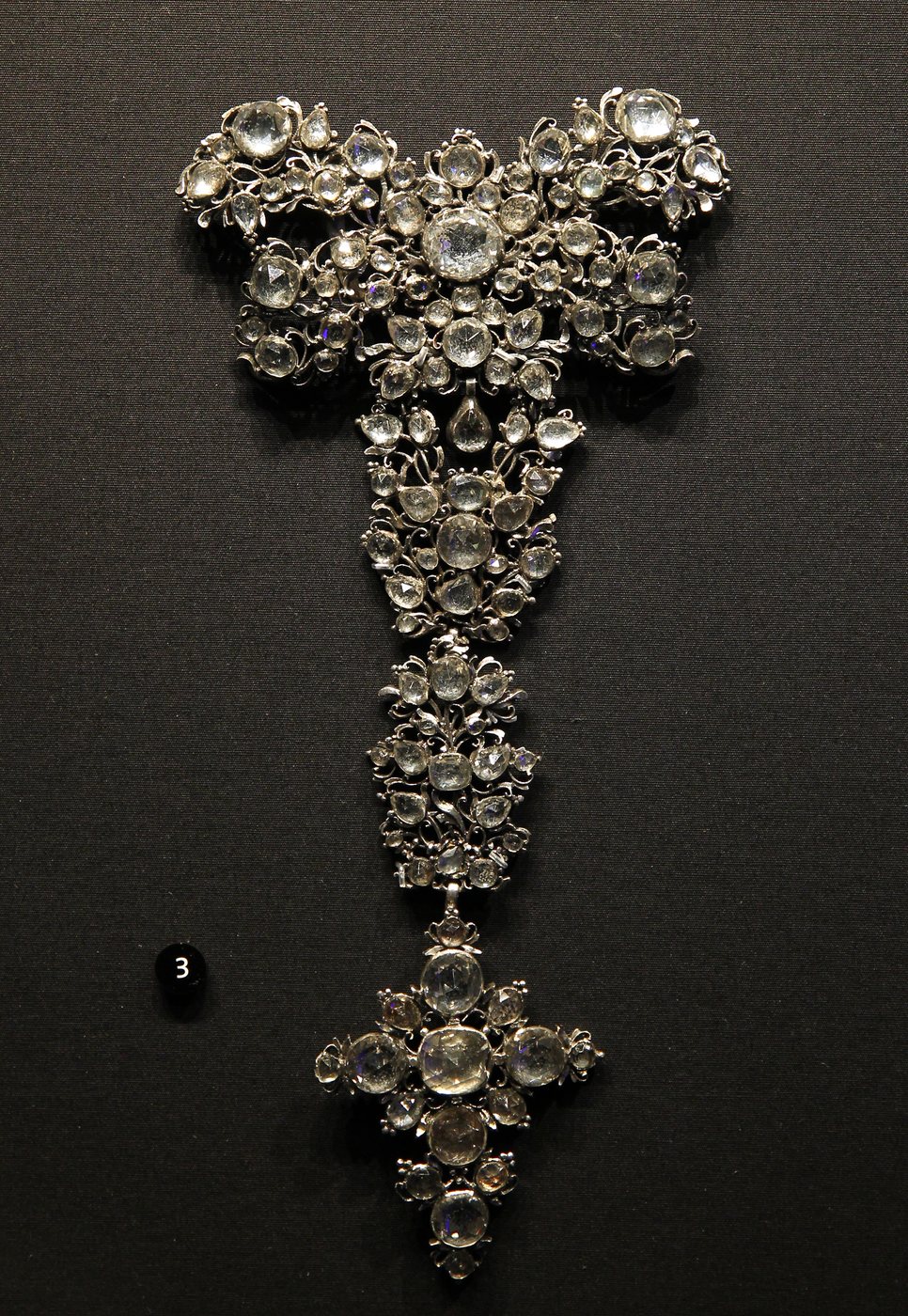
What Is a Stomacher?
What a jewelled stomacher is, how it covered the front of an 18th-century bodice, and why so few survive intact once dress styles changed.