What Is a Stickpin?
What a stickpin is, how its simple push-through pin differs structurally from a hinged brooch, and why it became a leading form of men's jewellery in this period.
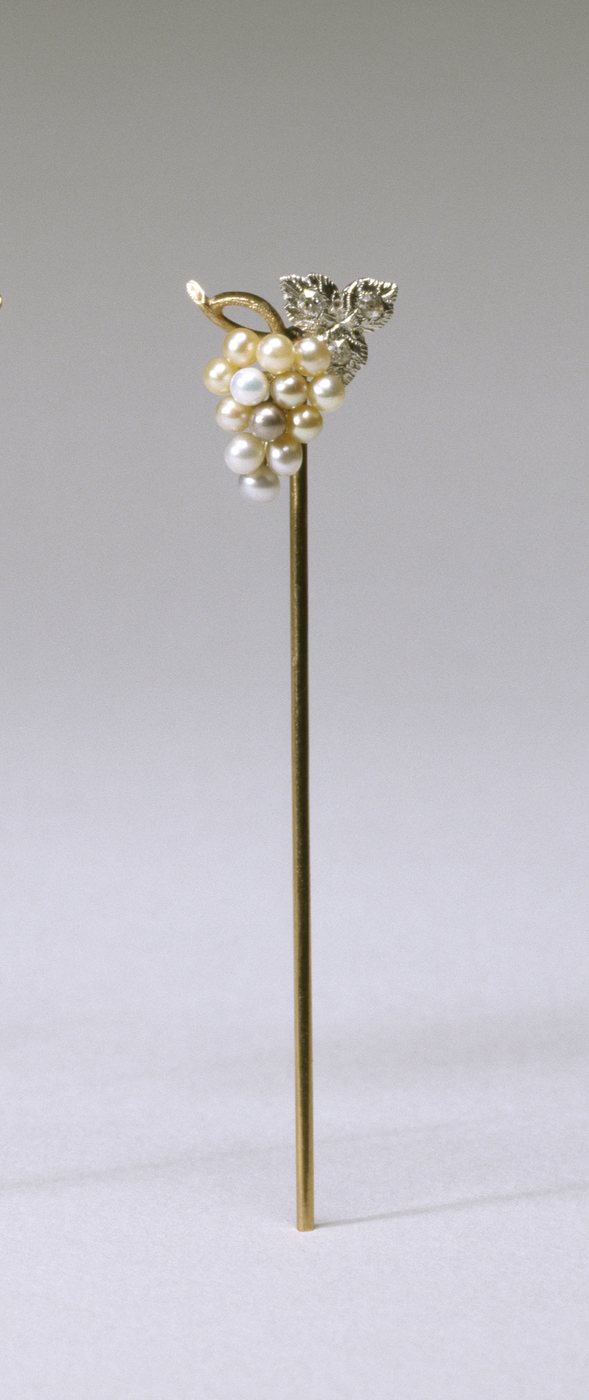
A stickpin is a single decoratively headed pin, pushed straight through fabric - most often a man’s necktie or cravat - and held in place by the tension of the fabric itself or a separate clutch, rather than by any hinge or catch built into the pin.
What Is a Stickpin?
Structurally, a stickpin is much simpler than a brooch: it is a plain straight pin with an ornamental head at one end and a sharpened point at the other, with no moving parts at all. Where a brooch relies on a hinged pin and a catch fixed to the piece itself, a stickpin has neither - it is simply pushed through the fabric, and the point either sits exposed on the reverse or is capped by a separate clutch or guard that slides onto the pin independently. See Brooch vs Pin for a closer look at how these two related but structurally distinct forms compare.
How to Recognise It
Look for a single straight shaft with no hinge and no fixed catch anywhere on the piece; if a separate clutch or guard is present, it will be a distinct, removable fitting rather than part of the pin itself. The decorative head - set with a gemstone, shaped as a motif, or finished with enamel - is usually the pin’s main point of craftsmanship, much as with a hatpin, though a stickpin is considerably shorter, sized for a necktie rather than a hat and a full head of hair.
When Was It Worn?
Stickpins were worn through the day and into evening wherever a necktie, cravat or, less often, a lapel called for a small decorative fastening, with strong popularity from the mid-19th century through the early 20th century.
Origins
Simple pins used to secure neckwear predate the fashionable stickpin as a distinct jewellery form, but the stickpin became especially prominent as men’s neckwear evolved through the 19th century, with the cravat and later the necktie offering a natural place for a small, personal piece of jewellery in an era when men’s dress otherwise allowed relatively little decorative display.
How It Changed Over Time
Mid-Victorian stickpins often featured a single gemstone or a modest decorative head suited to the more formal cravat styles of the period. As neckwear fashions diversified in the later 19th century, so did stickpin motifs, with horseshoes, animal and sporting subjects, and other novelty forms becoming common alongside more restrained single-stone designs. The form remained fashionable through the Edwardian period and into the 1910s before declining alongside broader changes in men’s formal dress after the First World War.
Materials
Gold was standard for finer stickpins, with silver and platinum also used, particularly for Edwardian examples. Heads were set with diamonds, pearls and coloured gemstones, or finished in enamel; less expensive stickpins used paste or base metal.
Construction
A stickpin is little more than a decorated head fixed to a straight, sharpened shaft, with no hinge, spring or catch built into the piece. Where a clutch or guard was used to protect the point and secure the pin, it was a separate fitting, slid onto the shaft from the reverse after the pin had been pushed through the fabric.
How It Was Worn
Pushed through a necktie or cravat, typically at or just below the knot, with the point either left exposed on the reverse of the fabric or capped by a separate guard; occasionally worn on a lapel in a similar manner.
Who Wore It?
Stickpins were primarily, though not exclusively, men’s jewellery through this period, offering one of the few outlets for personal decorative display within otherwise restrained masculine dress; some stickpin forms were also worn by women, particularly on lapels or as hair ornaments repurposed from their original use.
Notable Variations
- Horseshoe stickpin - a widely produced sporting motif associated with luck and, often, an interest in racing or riding.
- Monogram stickpin - a head engraved or formed as the wearer’s initials, offering a personal rather than decorative motif.
- Single-stone stickpin - a plain head set with one gemstone, among the most restrained and enduringly popular forms.
Terminology
“Stickpin” and “scarf pin” are used interchangeably in period and collector sources for the same form; “tie pin” is also common, though it is occasionally used more loosely for later, structurally different tie fastenings.
Similar Jewellery
A stickpin is most often confused with a bar brooch or other small brooch forms, but its lack of any hinge or catch is the clearest distinguishing feature; see Brooch vs Pin for a fuller discussion of where these forms overlap and where they differ.
Examples in Museum Collections
- Scarf pin with an enamel portrait of Queen Victoria, English, c.1850. Miniature by William Essex after Franz Xaver Winterhalter. Victoria and Albert Museum, London, 750-1890. A gold pin whose only decoration is its enamel-portrait head - and a reminder that “scarf pin” and “stickpin” describe the same form.
- Stick pin in the form of a skull, Auguste-Germain Cadet-Picard, Paris, 1867. Victoria and Albert Museum, London, M.121-1984. Gold and enamel with diamond sparks, shown at the 1867 Paris Exhibition. When wired to a pocket battery, the skull’s eyes rolled and its jaw snapped - an extreme example of the novelty heads of the later 19th century.
- Silver tie pin in the shape of a rapier, British, mid-19th century. Victoria and Albert Museum, London, M.29-1969. Silver with a silver-gilt guard and pommel - a less costly motif pin.
Read next
Compare
Brooch vs Pin: What's the Difference?
Why brooch and pin often mean the same thing, where usage diverges, and how a stickpin differs structurally from both.

Eras
Victorian Jewellery
A guide to Victorian jewellery (1837-1901): the Romantic, Grand and Aesthetic periods, the Great Exhibition, gold rushes and 9ct gold, mourning and Whitby jet, archaeological revival, Scottish jewellery, and how to recognise each phase.

Identify
Understanding Pin and Hinge Construction
How pin-and-hinge mechanisms work across brooches, hatpins and stickpins, and why the presence or absence of a catch is a useful structural distinction.

Jewellery
What Is a Bar Brooch?
What a bar brooch is, why its narrow horizontal form suited late Victorian and Edwardian dress, and how it compares with fuller, more elaborate brooch styles.
Jewellery
What Is a Brooch?
What a brooch is, how its pin-and-catch fastening works, and how brooch styles moved from naturalistic Victorian sprays through mourning brooches to Art Deco geometry.

Jewellery
What Is a Signet Ring?
What a signet ring is, how its engraved bezel was historically used to seal documents in wax, and how it became a largely decorative, strongly male-associated accessory.