Eye Symbolism in Jewellery
Three eye motifs in jewellery: the late-Georgian lover's eye miniature, the Eye of Providence, and the protective 'evil eye' amulet as it reached Western Europe.
The eye appears in Western jewellery between 1700 and 1950 in traditions that are easy to conflate: the lover’s eye, a late-Georgian portrait miniature; the Eye of Providence, a religious and later Masonic emblem; and the far older “evil eye” protective amulet, which reached British and French jewellery mostly at second hand.
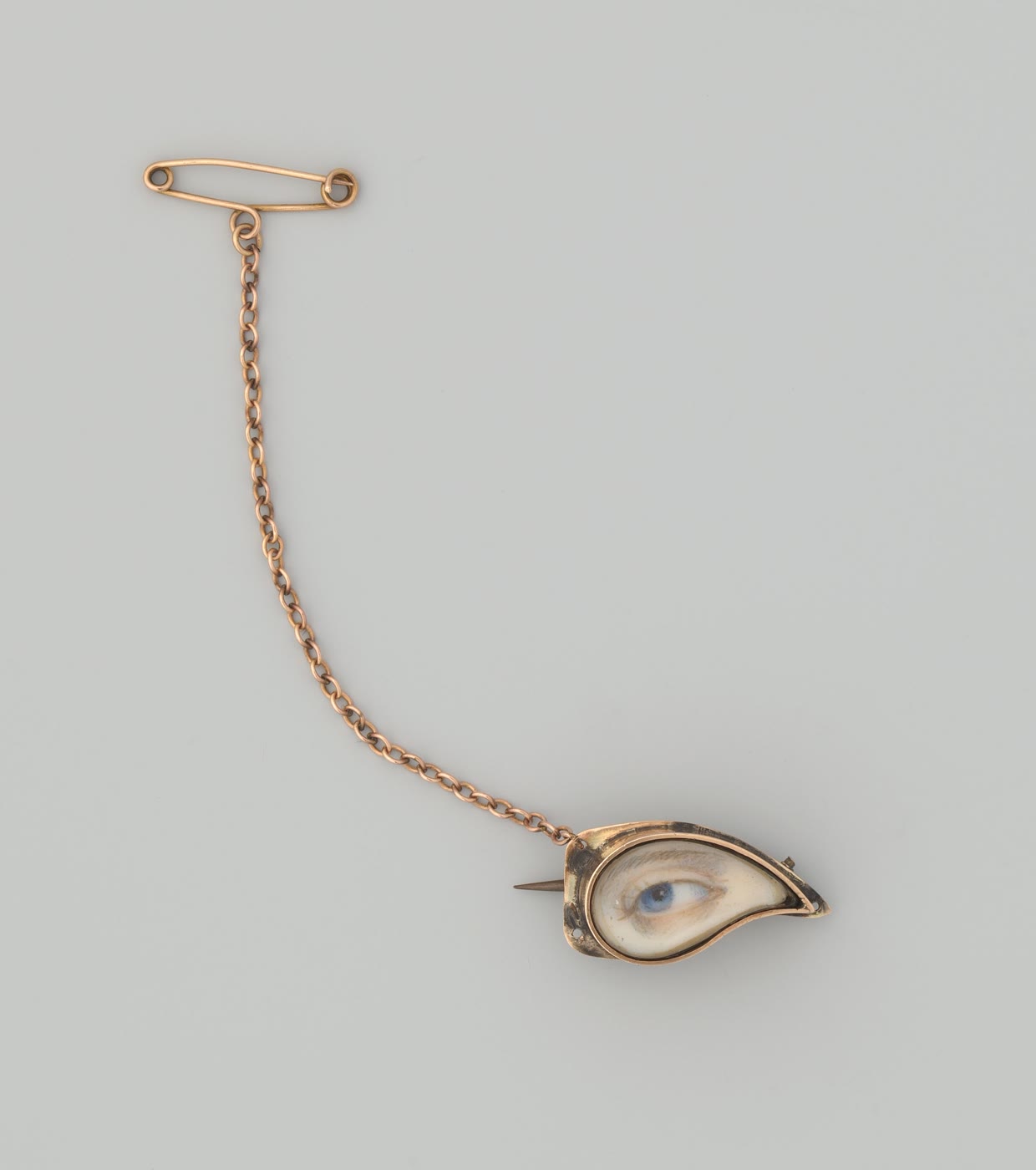
The Lover’s Eye Miniature
The lover’s eye is a late Georgian and Regency fashion in which a single eye - occasionally a pair - was painted in miniature, usually in watercolour on ivory, and set into a brooch, ring, pendant or locket. Cropped tightly enough to conceal the sitter’s identity, an eye miniature allowed a keepsake of a loved one to be worn openly without revealing whose likeness it was.
The fashion is traditionally traced to the Prince of Wales, later George IV, who in 1785 is said to have sent Maria Fitzherbert a miniature of his own eye while pressing her to marry him; the miniature is commonly attributed to Richard Cosway, the Prince’s favourite miniaturist. The story is widely repeated and plausible, but it should be read as the traditional account rather than a fully documented origin. Eye miniatures were painted in London from the 1780s into the 1820s, often by established portrait miniaturists, and were set by goldsmiths in frames of seed pearls, garnets, rose-cut diamonds or blue enamel; some frames echo mourning conventions with black enamel or a tear-shaped pearl. The form receives full treatment at lover’s eye jewellery; the point here is that it is a portrait of one particular person’s eye, not a generic symbolic eye.
The Eye of Providence
A third eye motif is the Eye of Providence, or all-seeing eye: a single eye, often within a triangle and surrounded by rays of light, representing the watchful eye of God. It appears in European religious painting and engraving from the 16th and 17th centuries, the triangle standing for the Trinity. The design was used on the reverse of the Great Seal of the United States, adopted in 1782, and was taken up as an emblem in Freemasonry in the late 18th century, so it appears on engraved Masonic jewels, fobs and pendants of the 19th century - see Masonic jewellery. An eye in a triangle with rays is therefore a religious or fraternal emblem, not a lover’s token or a protective charm.
The Evil Eye: A Much Older, Broader Tradition
An eye motif has long been used across many cultures as a protective device, worn to ward off ill fortune or harm believed to be transmitted through an envious or hostile look - the “evil eye”. The belief is ancient and geographically wide, documented around the Mediterranean, the Near East and well beyond, and this page does not attempt to cover its many regional forms. The best-known protective eye in modern Western shops - a blue glass bead with concentric rings of white and blue - comes from the Turkish (nazar) and Greek (mati) traditions.
The Evil Eye in Western European Jewellery
Within Western European jewellery, protection against the evil eye more often took forms other than an eye. In southern Italy, belief in the malocchio sustained a large trade in red coral amulets from Naples and nearby Torre del Greco: the curved horn (corno), the hand making the horned gesture (mano cornuta) and the clenched fist with the thumb between the fingers (the fica or figa). In Spain and Portugal the same fist gesture was carved in jet (azabache), especially at Santiago de Compostela. Nineteenth-century travellers brought these amulets home from the Grand Tour and later tourist journeys, and coral horns and hands appear in British and American jewellery boxes as souvenirs - see coral in historical jewellery. Where a stylised eye itself appears in British or French jewellery, it is usually a small enamelled or glass eye on a novelty brooch or charm, sometimes combined with other lucky devices such as a horseshoe, and reflects a borrowed, generalised protective idea rather than a local tradition.
A related ancient eye, the Egyptian wedjat or Eye of Horus, re-entered European jewellery through Egyptian-revival fashions - after the opening of the Suez Canal in 1869 and again after the discovery of Tutankhamun’s tomb in 1922.
Distinguishing the Eyes in Practice
The traditions are usually easy to tell apart by what the eye depicts. A lover’s eye shows a specific, individually painted human eye, often with an eyebrow, a lock of hair or a suggestion of cheek - it is a portrait. An Eye of Providence is drawn within a triangle or sunburst, usually engraved or enamelled. An evil eye motif is stylised and repeatable, often a simple eye shape in blue and white worked in enamel, glass or stone. A wedjat has the distinctive stylised Egyptian markings below the eye. Where a piece’s purpose is unclear, its origin, any inscription and the style of the mount are more reliable guides than the eye alone.
Materials and Typical Forms
Lover’s eyes were painted miniatures set behind glass or rock crystal in gold-mounted brooches, rings, pendants and lockets, often with a hair compartment at the back. Eye of Providence motifs are mostly engraved or enamelled on gold and silver fraternal jewels and seals. Evil eye motifs in Western jewellery are usually a small enamelled, glass or gemstone eye on a brooch, pendant or charm, often one element among several lucky charms.
Read next

Eras
Georgian Jewellery
A guide to Georgian jewellery (1714-1837): Brazilian diamonds, closed-back foiled settings, rococo and Neoclassical styles, paste, cut steel and pinchbeck, sentimental miniatures, girandoles, rivières and Sévigné bows.
Eras
Regency Jewellery
A guide to Regency jewellery (c.1795-1837): Empire fashion, cameos and Neoclassical parures at Napoleon's court, coloured gold and cannetille, Berlin iron and cut steel, acrostic rings, and memorial jewellery for Nelson and Princess Charlotte.
Jewellery
What Is a Pendant?
What a pendant is, how it differs from an integrated necklace centrepiece, and how forms like the locket, lavalier and negligee pendant developed within the broader category.
Mourning & Sentimental
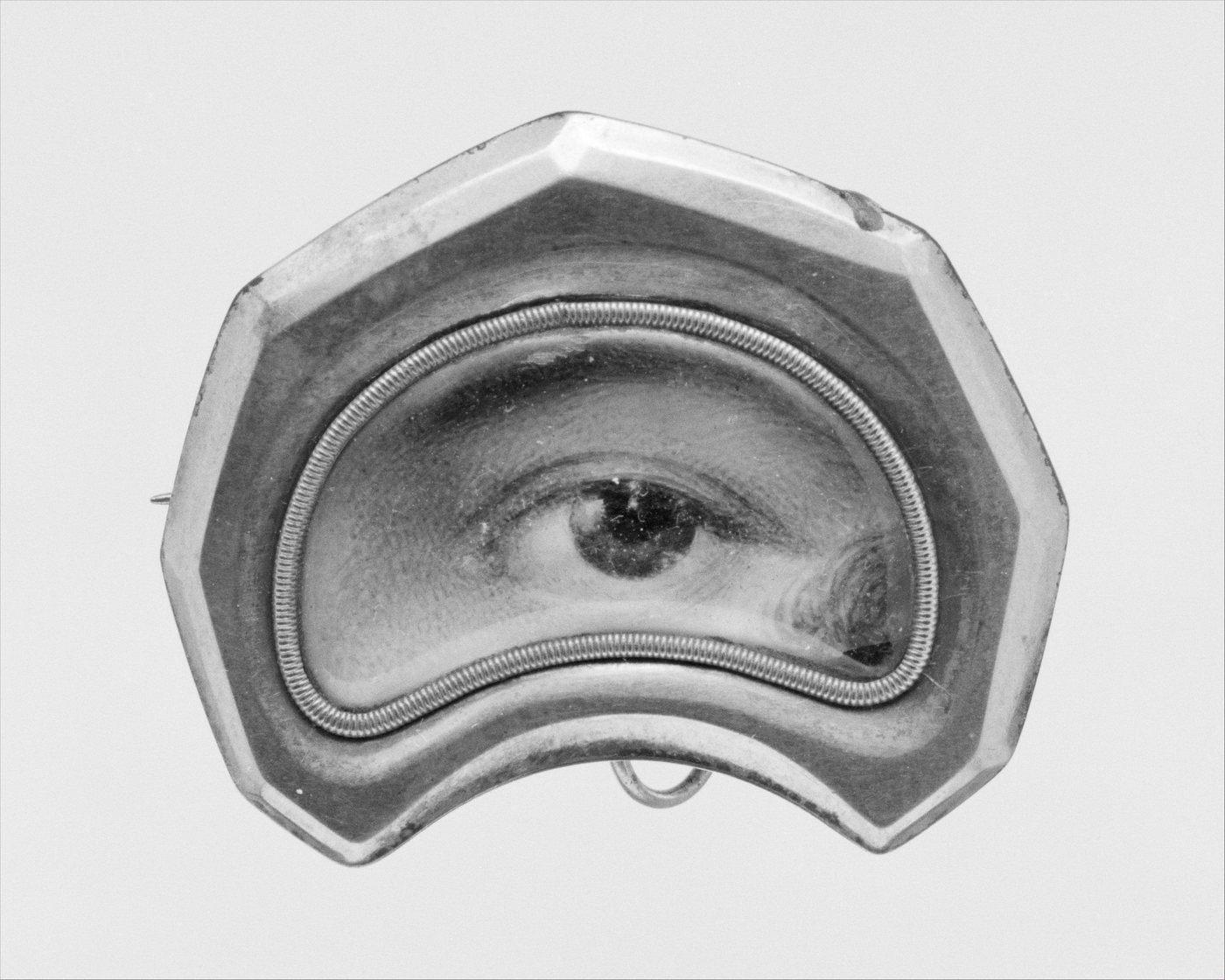
What Is Lover's Eye Jewellery?
What lover's eye jewellery is, the Prince of Wales, Maria Fitzherbert and Richard Cosway story behind it, how eye miniatures were painted and mounted c.1785-1830, and why they are rare.

Symbols
Heart Jewellery Through History
The heart in jewellery from 1700 to 1950: crowned hearts, Scottish luckenbooth brooches, Sacred Heart pendants, padlock-and-key pendants, Claddagh rings and wartime sweetheart brooches.
Symbols
Snake Jewellery and Eternal Love
Why the snake, often shown biting its own tail, stood for eternal love in 19th-century jewellery - from Queen Victoria's 1839 emerald snake ring to Lalique's serpents.